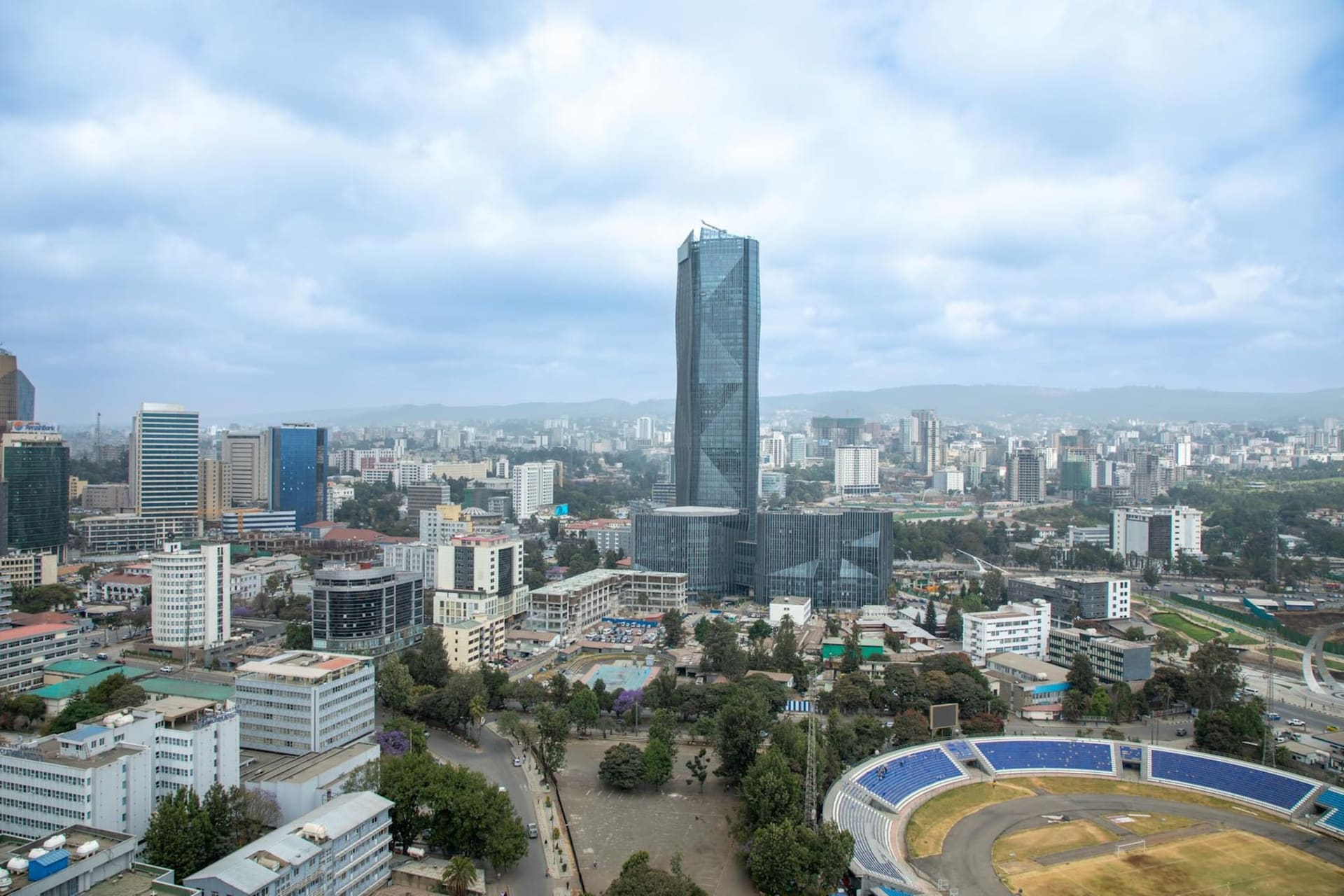
Addis Ababa
"Every coffee here has been made slowly since long before anyone was watching."
Africa's diplomatic capital — Lucy's bones, the finest coffee ceremony, and a city permanently under reinvention.
There is a particular quality to the light in Addis Ababa at altitude — thin and clean, almost European, but with a warmth underneath that reminds you this is Africa. The city sits at 2,300 metres and the air has a slight edge to it even in October. I stepped off the plane at Bole International and felt my lungs recalibrate.
The Weight of Ancient Things
The National Museum on King George VI Street holds something that stopped me completely: Lucy. The fossilised remains of Australopithecus afarensis, 3.2 million years old, arranged in a glass case under low light. She is smaller than I expected. Her bones have the fragile quality of dried leaves. Lia stood beside me for a long time without speaking, which is rare for her. There is something vertiginous about being in the same room as the earliest known ancestor of every human being alive — as if the floor had shifted slightly beneath you and never quite settled back.
Downstairs, the museum’s ethnographic collection holds processional crosses, ceremonial robes, painted icons from the Ethiopian Orthodox tradition. The smell is old wood and cedar. I spent an hour there that I had not planned to spend.
The Ceremony on Bole Road
The coffee ceremony is not a tourist performance in Addis — it is the actual rhythm of the city. A woman roasts green beans over charcoal in a flat iron pan, shaking them slowly until the kitchen fills with a smoke that is part incense, part caramel. The beans go into a clay jebena with hot water. Three rounds of cups, each slightly weaker than the last: abol, tona, baraka. The whole process takes forty minutes. You do not rush it. I tried to photograph it once and the woman running the ceremony looked at me with such patient disapproval that I put my phone away and just drank.
The best cup I had was at a small place near the Mercato, Africa’s largest open-air market, where the air outside smelled of spices, livestock, and diesel in equal measure.
Piazza and the Unexpected City
I had expected Addis to feel provisional, mid-construction, exhausting. What surprised me was its neighbourhood logic. The Piazza district, built during the Italian occupation, still has faded ochre buildings and espresso bars where old men read newspapers in the afternoon. The city is simultaneously ancient and mid-sentence — cranes above, Orthodox priests below, a tuk-tuk threading between both.
I ate tibs — sautéed lamb with rosemary and chilli — at a restaurant off Churchill Avenue and walked back through streets that smelled of eucalyptus, which grows everywhere here, planted on Menelik II’s orders over a century ago. The trees are still doing their job.
When to go: October through January brings cool, dry weather after the long rains — the city is at its clearest and the highlands around it are green. Avoid July and August when the heavy rains make unpaved roads impassable.