
Saqqara
"Everyone races to Giza for the perfect pyramid, and skips the rougher one south of the city that came first and explains everything."
The Pyramids of Giza are extraordinary, and you should see them, but they have a problem: everyone else is seeing them too. By contrast Saqqara, half an hour south down the edge of the desert, gets a fraction of the crowds and arguably tells a better story. This is where the Egyptians worked out how to build in stone at monumental scale, and the Step Pyramid of Djoser — the thing that started it all, around 2670 BC — is the oldest large stone structure on Earth. We had a guide named Hassan who said it plainly: Giza is the masterpiece, but Saqqara is the workshop where they learned the trade. I have thought about that framing ever since.
The pyramid that started pyramids
The Step Pyramid is not smooth-sided and perfect like Giza’s. It rises in six uneven tiers, a stack of stone mastabas piled up by the architect Imhotep into the first thing humans ever built toward the sky in dressed stone. Standing in front of it, you can read the experiment in it — the moment someone decided a tomb did not have to be flat, that it could climb. The surrounding complex has been beautifully restored in recent years: a colonnade of stone columns carved to imitate bundled reeds, courtyards, the whole stage-set of a king’s eternal estate. We arrived early, and for a stretch had the great courtyard almost to ourselves, which at any monument this old feels like a small miracle.
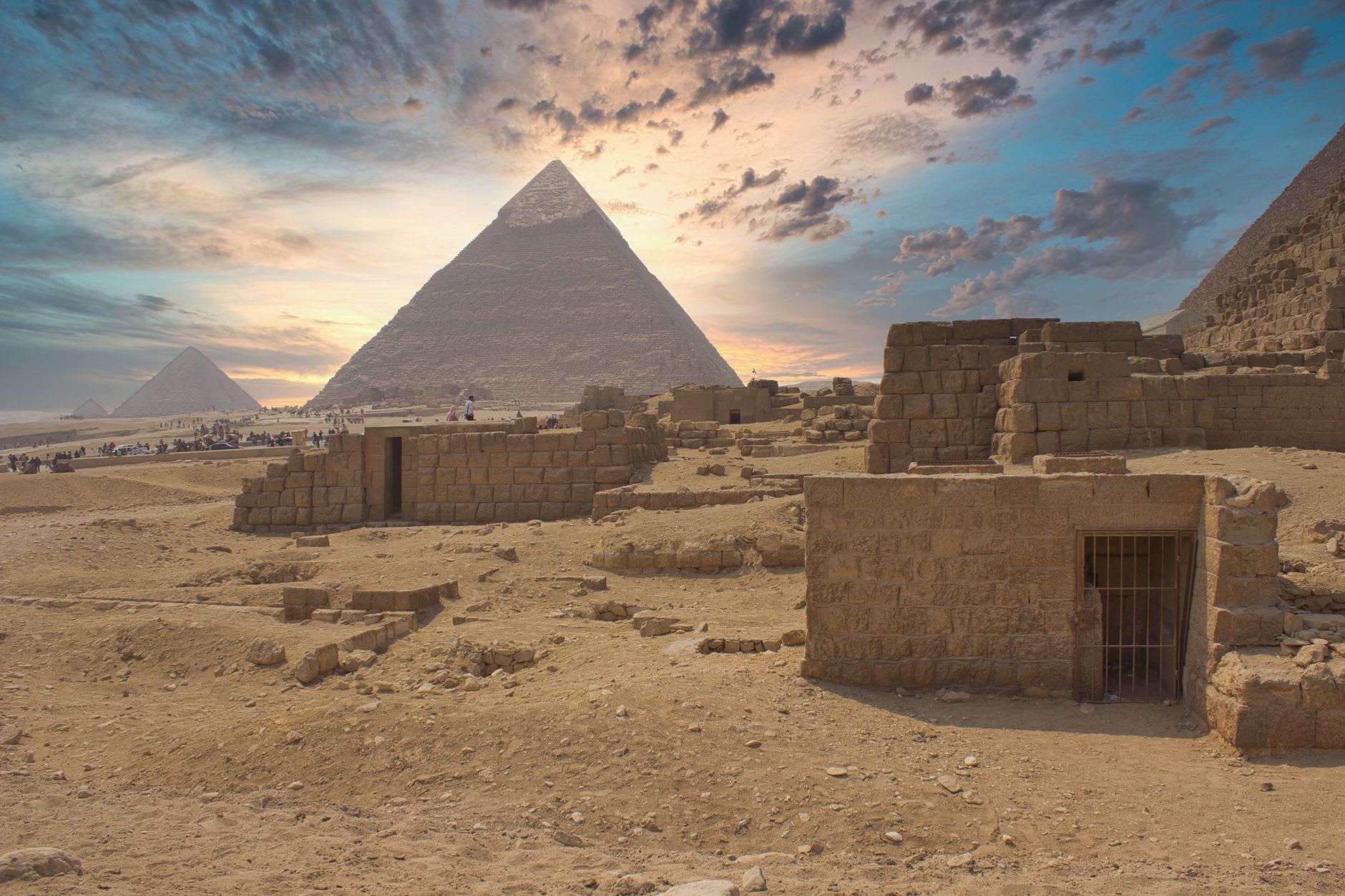
What Hassan really wanted us to see, though, was underground. Saqqara was the necropolis of Memphis for thousands of years, and the desert here is honeycombed with tombs of nobles and officials, many of them open to visitors and almost all of them empty of other tourists.
The painted tombs
The mastaba tombs of Saqqara are, to my mind, the best-kept secret in Egypt. We climbed down into the tomb of Kagemni and the tomb of Ti, and the walls were covered floor to ceiling in carved and painted relief — men spearing fish in papyrus marshes, cattle fording a river with a calf carried on a herdsman’s shoulders, hippos and crocodiles, bakers and brewers and dancers, all rendered with a liveliness that five thousand years has not dulled. In one scene a hand reaches out to steady a stumbling ox, and the gesture is so human and so immediate that Lia actually gasped. There is none of the roped-off, glass-cased distance of a museum here. You stand a foot from images older than almost anything else humans have made, and you are nearly alone with them.

We finished at the newer excavations on the southern edge, where in recent years archaeologists have pulled hundreds of intact painted coffins and bronze statues from sealed shafts — Saqqara is still actively giving up its dead, still making headlines. Driving back toward Cairo through the date palms, dusty and overheated and quietly elated, I was certain we had chosen the better pyramid. Giza is the postcard. Saqqara is the place where you actually feel how old this all is.
When to go: October to April for bearable desert heat; come at opening time to beat both the temperature and the tour buses that arrive mid-morning from Cairo. Combine it with nearby Memphis and Dahshur for a full day among the oldest monuments in Egypt. Bring cash for the separate tomb tickets, which are worth every pound.