Banos de Agua Santa
"Banos is where thrill-seekers and pilgrims share the same steaming thermal pools."
The swing at the end of the world, taffy pulled on every corner, and an active volcano looming overhead.
The first thing I noticed in Banos was not the volcano — it was the taffy. Every few meters along Calle Ambato, someone was pulling melcocha, great ropes of amber candy stretched and folded over iron hooks bolted to the wall. The smell of caramelized sugar cut through the thin mountain air, and the rhythm of the pull was almost meditative, the kind of repetitive motion that slows a traveler down whether they mean to stop or not. I bought a paper cone of it and burned my fingers and didn’t regret any of it.
Under the Shadow of Tungurahua
Banos sits at 1,800 meters in a crease between ridgelines, pressed against the flank of Tungurahua — an active volcano that last sent ash into the streets in 2016. The locals have a relationship with it that I found genuinely humbling: they evacuated twice in living memory and came back both times. The Basilica of Our Lady of the Holy Water stands at the top of town, and inside hang ex-voto paintings depicting the Virgin interceding as lava poured toward the streets. Pilgrims leave crutches, braids of hair, hand-painted miracles on the walls. Downstairs, paragliders sell packages from a folding table.
I spent a morning at the thermal baths on Calle Martínez, the ones fed by the volcano itself. The water runs sulfurous and genuinely hot. At six in the morning, mist off the pools blends with cloud coming off the ridge, and the whole town disappears. Lia stayed in up to her chin for forty minutes and said it was the closest thing to a reset button she had found in years.
The Swing at the End of the World
The Casa del Árbol treehouse sits at 2,660 meters above the town, reachable by a bumping tarabita cable car or by road. The swing — a plank and two ropes bolted to a tree at the edge of a cliff — arcs out over several hundred meters of nothing. There is no harness. The drop on the forward swing reveals a valley so green it looks implausible, and Tungurahua directly across, exhaling. What surprised me was that on the day I went, a school group arrived from Ambato. Children who live with this volcano lined up cheerfully to dangle over it. I swung twice, badly, and found myself grinning in a way I had not expected.
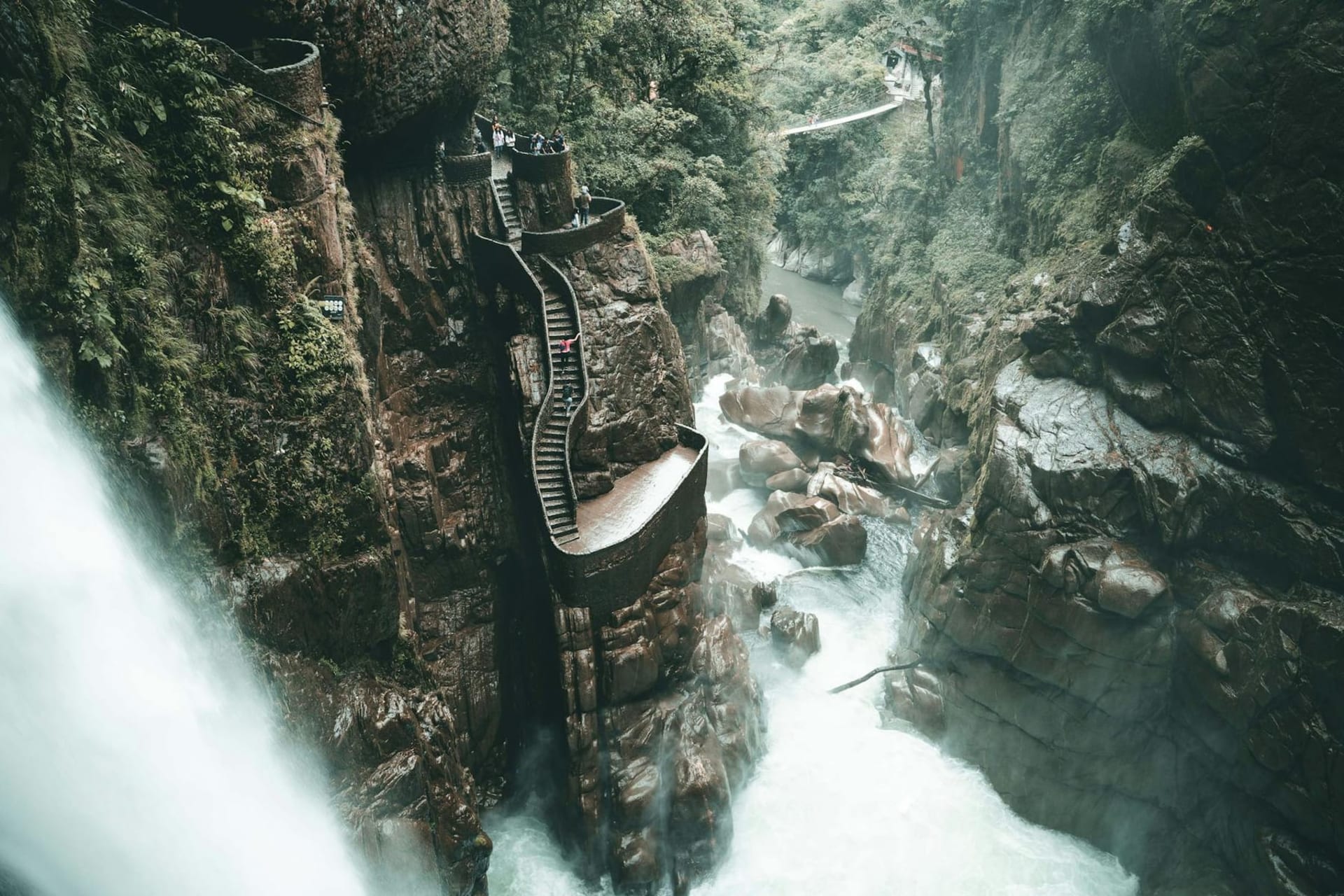
The road back down passes a waterfall — the Pailón del Diablo, about 16 kilometers south — where the Pastaza River drops 80 meters through black rock. We ate grilled corn from a cart on the viewing platform, watching the spray disappear into the gorge below.
When to go: June through September is dry season and the clearest for Tungurahua views. Weekends fill with Ecuadorian tourists from Quito and Ambato; arrive mid-week to have the thermal baths and the treehouse swing nearly to yourself.