
Puna Pau
"Everyone photographs the giant heads. Almost nobody walks up to the small red hill where they made the hats, which is exactly why I went there twice."
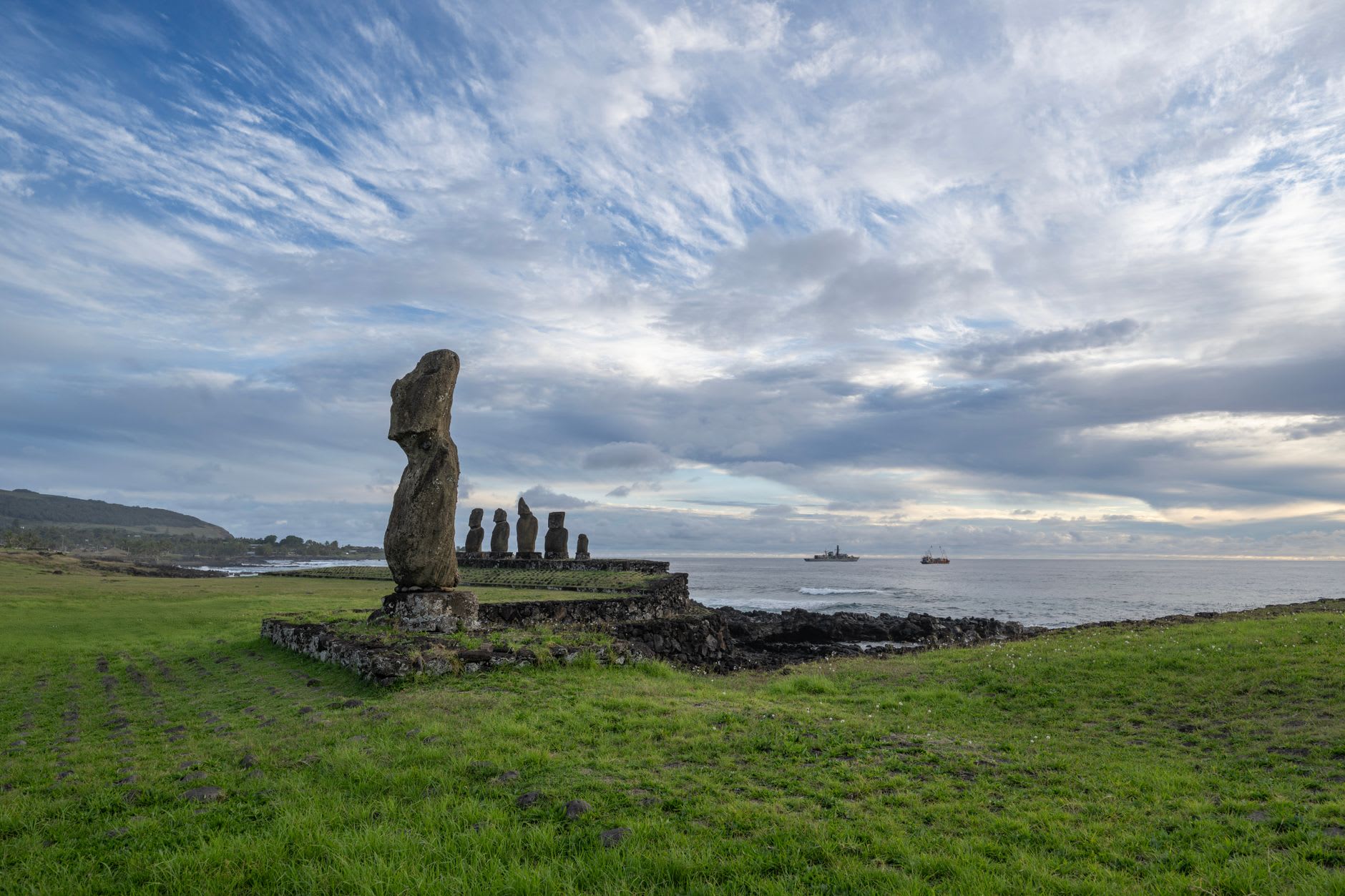
By the time we reached Puna Pau we had already spent three days among the moai, and like most people I had been so fixated on the statues themselves that I had barely registered the red cylinders perched on top of some of them. Then a guide at Tongariki said one sentence that reorganised everything: the bodies came from one quarry, on the far side of the island, and the hats came from another, here, from a single small hill of red rock. They were carved in different places, by different logic, and somehow brought together and stacked. I changed the next morning’s plan on the spot.
The hat quarry
Puna Pau is not dramatic in the way Rano Raraku is. It is a modest cinder cone with a shallow, grassy crater, and the rock here is a soft red scoria called hani hani, light and easy to work, completely different from the grey volcanic tuff of the statue bodies. The Rapa Nui used it for one purpose above all: the pukao, the cylindrical topknots that sat on the heads of certain moai. Walking the short loop around the crater you come across them everywhere — dozens of them, some finished, some half-carved, some abandoned mid-shaping, lying in the grass exactly where they were left. There is a stillness to it that the big sites do not have. No restored platform, no ranked statues facing the sea. Just a hillside scattered with red stone hats, as if everyone had walked off at lunchtime several centuries ago and not come back.
What I had not understood until I stood there was the scale and the absurdity of the logistics. A pukao could weigh several tonnes on its own. It was carved here, rolled or dragged across the island, and then somehow lifted onto the head of a statue already standing several metres tall. Archaeologists still argue about exactly how. Lia, who has a low tolerance for that kind of unanswered question, kept saying “but how, though” while we walked, and the honest answer is that nobody is entirely sure, and that the not-knowing is part of what makes the place hold you. The red colour mattered too — red was a colour of power and status across Polynesia, and these were not decorative caps so much as crowns.
The view nobody mentions
The other thing Puna Pau quietly offers is the best general view on the island. Behind the quarry a short path climbs to a low summit dotted with a few weathered topknots and a cross, and from there the whole of Hanga Roa spreads out below — the only town, the airport runway slicing across the peninsula, the green flank of Rano Kau in the distance, and the Pacific wrapping it all in that uninterrupted blue that reminds you, constantly, how far from anywhere this place is. We sat up there as the wind flattened the grass and watched the light move across the island, and I thought about the people who came up here not for the view but to make several tonnes of hat by hand, and carried it away.
It is a fifteen-minute stop if you treat it as a checklist item. Give it an hour. Puna Pau is the workshop, the unglamorous backstage where the iconic image was partly manufactured, and there is something clarifying about standing in it.
When to go: Year-round, but go early or late in the day when the low sun turns the red scoria almost luminous and the tour buses are elsewhere. Combine it with the nearby Ahu Akivi for a quiet half-day inland, away from the coastal crowds.