Americas
Easter Island
"The loneliest place I've ever landed, and somehow the most alive."
The plane banks hard over the ocean and there it is: a triangle of green in nothing, in absolute nothing. No other islands on the horizon. No shipping lanes. Just the South Pacific, stretching out in every direction until it stops making sense. When I stepped off the LAN flight at Mataveri — one of the most remote commercial airports on Earth — the first thing I noticed wasn’t the famous statues. It was the wind. It comes from everywhere at once, warm and salt-heavy, and it never really lets up.
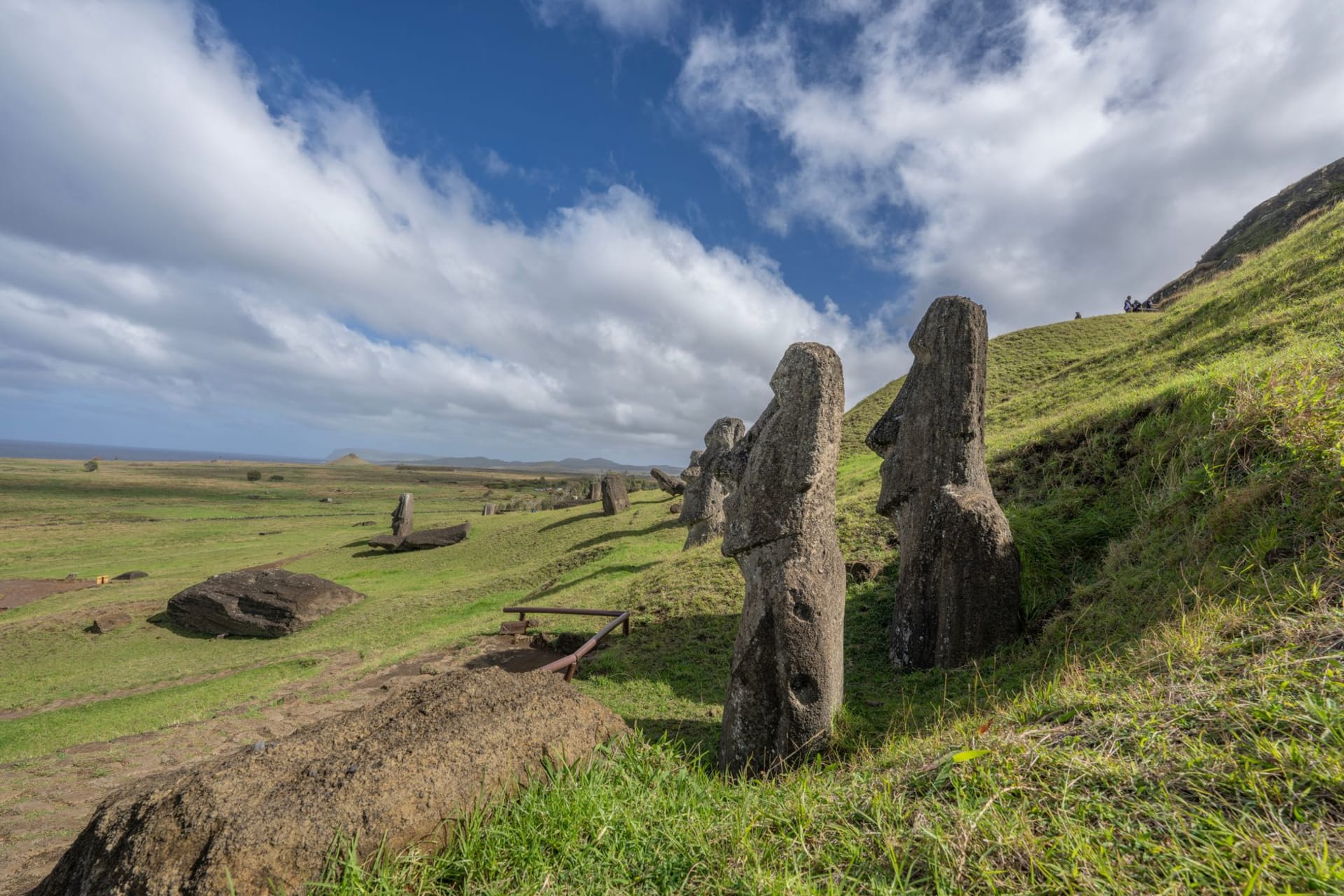
I’d been warned that Easter Island was overhyped, that the moai were disappointingly small in person, that the place had been hollowed out by tourism. None of that was my experience. Rano Raraku, the quarry where the statues were carved, hit me somewhere I wasn’t prepared for. You walk up a low hillside and suddenly there are hundreds of them, half-finished, buried to their chins in earth, poking out of the grass at odd angles. It’s not a museum. It’s more like a workshop frozen mid-breath. Some of the figures are enormous — bigger than I expected — and they have a weight to them that no photograph ever captures. I sat there for a long time and ate a mango I’d bought in Hanga Roa.
Hanga Roa itself is the only town, and it’s a good one to be stuck in. A main street, a handful of restaurants serving tuna ceviche and empanadas, a fish market in the morning where locals buy whatever came off the boats. I ate well there, better than I’d expected. The tuna is extraordinary — thick, dark red, fished from waters so deep and cold they produce something almost different from the fish I know from Mexico. At night, the restaurants fill with a mix of Chilean backpackers and European couples, but it never feels overwhelmed. The island absorbs people quietly.
What I kept coming back to was the light. The sky over Rapa Nui is enormous, unobstructed, and it changes fast. Late afternoon at Ahu Tongariki — the row of fifteen restored moai on the eastern coast — the shadows go long and the stone turns orange and you feel very clearly that you are somewhere that took genuine effort to reach, and that the effort was worth it.
When to go: October through April is the Southern Hemisphere summer — warmer, calmer seas, better for swimming and snorkeling at Anakena beach. February brings the Tapati Rapa Nui festival, a two-week celebration of Rapanui culture with canoe races, traditional singing, and body painting competitions. July and August are cooler and windier but far less crowded, which has its own appeal when you’re standing alone in front of the moai at sunrise.
What most guides get wrong: Every guide tells you to see the moai at sunrise. Which means every tourist is there at sunrise, in a crowd, taking the same photo. The statues don’t care what time it is, and they’re there all day. I went to Ahu Tahai — the cluster closest to Hanga Roa — at five in the evening on a Tuesday and had it nearly to myself for an hour. The light was better than sunrise anyway. The other thing guides miss is how much the island is actually about the landscape itself, not just the statues. The calderas, the cliffs, the horses wandering loose across the hillsides, the way the ocean looks from the north coast on a clear day — that’s the thing you’ll carry home.