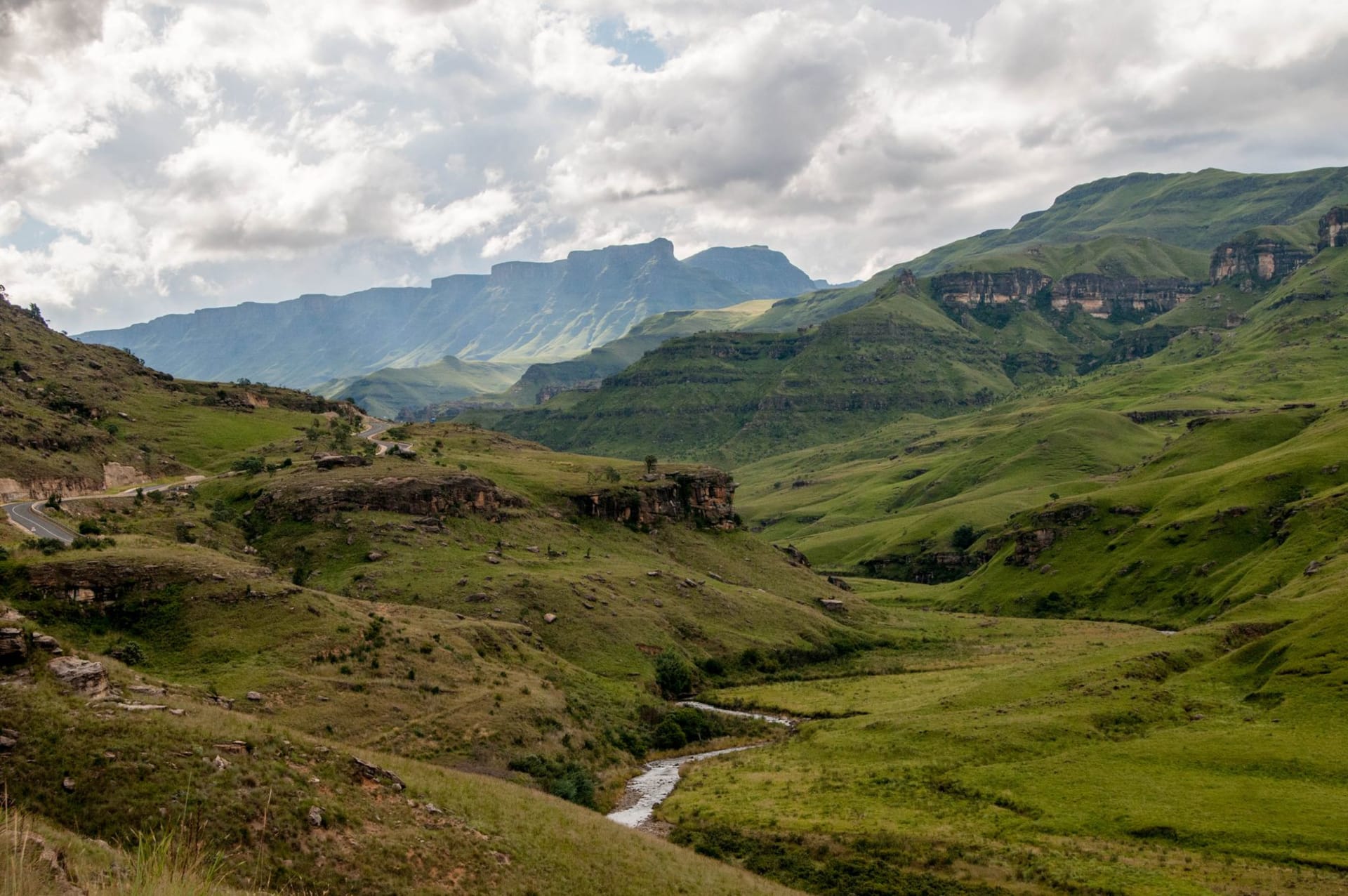
Kamberg
"Game Pass Shelter is the one place where I understood, actually understood, what those paintings were trying to say."
Kamberg is the Drakensberg’s best-kept non-secret. It’s in every guidebook, but the roads are long enough and the amenities modest enough that the valley draws perhaps a tenth of the visitors who go to Champagne Valley, just an hour north as the crow flies. The drive in from Rosetta passes through commercial forestry and then suddenly opens onto a valley so green and unhurried that the first impulse is to pull over and verify you’re in the right place. The Mhlwazini River runs through the middle of it, cold and clear, lined with willows and reed beds where Cape weaver birds build their intricate hanging nests in numbers that make the river banks look decorated.
The Game Pass Shelter San art site is the reason Kamberg belongs on any serious itinerary. It requires a guided visit — a condition I initially resented and immediately stopped resenting when the guide, a man named Sipho who has been interpreting this shelter for eighteen years, stopped in front of a particular panel and asked what I saw. I said figures and animals. He said: look again. He pointed to the figure at the centre of the composition, arms raised, surrounded by lines radiating outward, body half-dissolved into something that wasn’t human or animal but something between. This, he explained, is a shaman in the process of entering the spirit world. The lines are the sensation of hallucination. The eland beside him is the animal whose energy the shaman is absorbing. I looked at it again and the panel reorganised itself completely — not art, but a report from an altered state of consciousness, painted with careful specificity by someone who was describing something they had experienced.

The trout fishing here draws its own quiet community. The nature reserve stocks both the Mooi River and several farm dams, and fly-fishing estates on the valley approaches manage private stretches of river. On any weekday morning you’ll find two or three figures standing in the water with the particular stillness that fly-fishing requires, casting loops of line that catch the light as they unfurl. I don’t fish and I found the watching entirely absorbing. The Kamberg valley has that quality — activities that would be mundane elsewhere become meditative here, as though the mountains do something to your relationship with time.
The KZN Wildlife camp at Kamberg is basic in a way that used to embarrass the management and now qualifies as atmosphere. The chalets are concrete block, sparsely furnished, positioned above the river on a slope where the morning mist rises slowly through the yellowwood trees. There’s a small camp kitchen with a gas stove and an outdoor braai area where the rangers gather in the evenings. The hiking trails in the reserve itself are mostly unmarked by the standards of the northern Berg — you work from a paper map and the occasional cairn, which in practice means you spend more time looking at the landscape and less time at your feet.

The drive up to the escarpment base passes through country that holds Natal mountain toad habitat, and in spring the frogs are audible from a hundred metres — a sound like small bells in sequence. The area around the river also supports oribi, one of the smallest and most delicate of southern Africa’s antelope, a species that has become rare enough that seeing one at close range in the reed beds felt genuinely significant.
When to go: April through September for dry hiking conditions and clear art site lighting. The Game Pass Shelter guide operates daily with set departure times — book ahead, especially in July. Spring (September-October) brings wildflowers to the valley grassland. Trout fishing season runs September through May.