Giant's Castle
"The eland painted on that cave wall has been running for three thousand years. It has not tired."
The ranger who walked me to the Main Cave site spoke slowly and with the careful authority of someone who has watched too many visitors rush through in fifteen minutes. He stopped in front of a panel of red-ochre figures — dancing shamans, elongated elands, half-human forms dissolving at the edges — and said: “The San didn’t make art. They recorded what they saw on the other side.” He meant the spirit world, the altered states induced by trance dances, the journeys their healers believed they took to the realm beyond this one. I stood there looking at a three-thousand-year-old shaman mid-transformation and felt something I don’t usually feel in front of ancient things: not distance, but proximity.
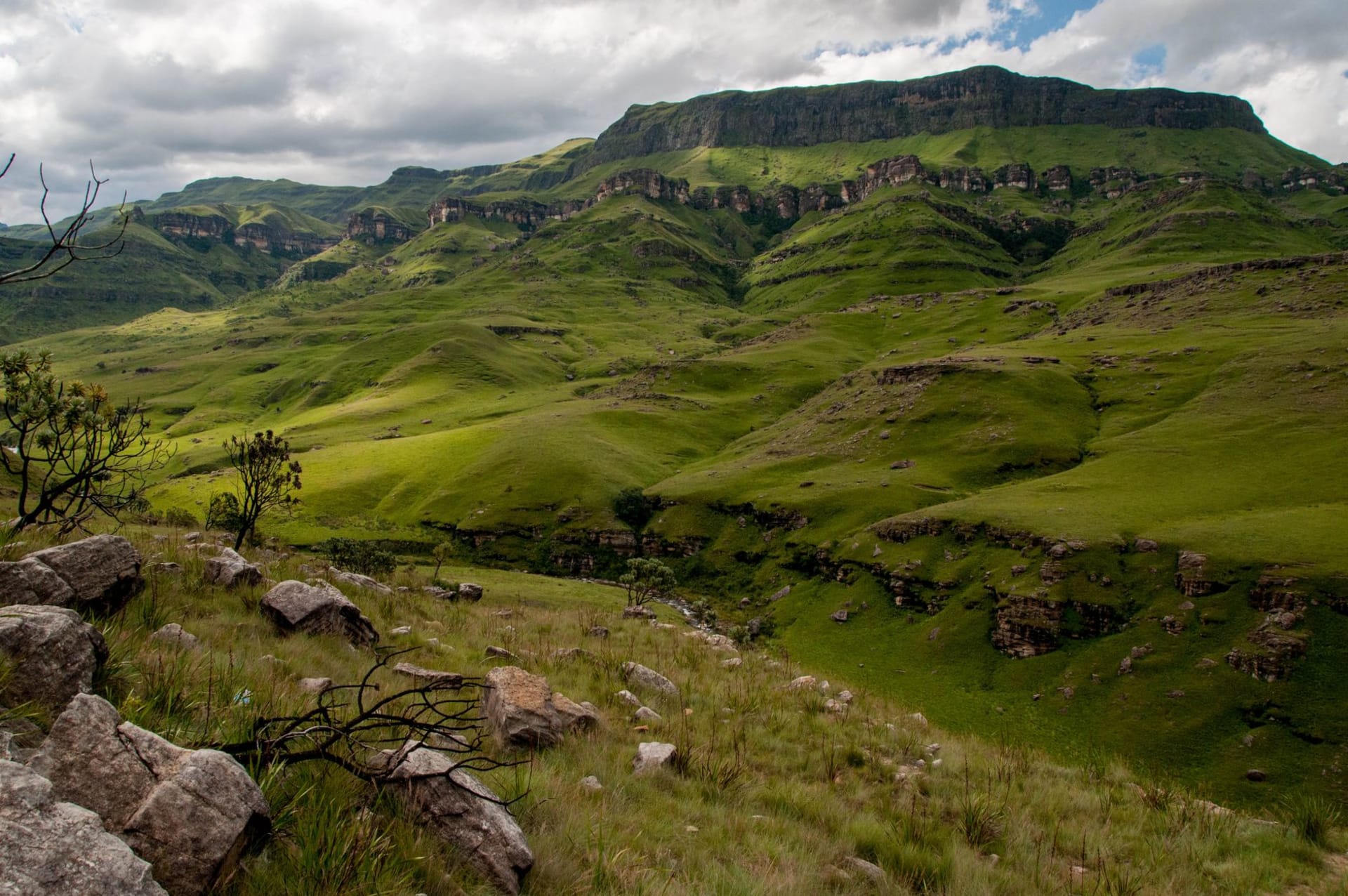
Giant’s Castle Game Reserve occupies the central plateau of the Drakensberg, its escarpment face rising above grassland valleys that hold oribi, mountain reedbuck, eland, and the occasional leopard whose presence is announced only by pugmarks in the mud near watercourses. The main camp sits at roughly fourteen hundred metres, surrounded by a valley that opens south toward the Injisuthi peaks and north toward the Cathedral Range. In winter the grass turns tawny and the air smells of cold stone and dry grass, and the silence is the particular deep silence of altitude.

The lammergeier hide is the other reason people come, and it operates on winter weekends from June through September. The bearded vulture — lammergeier in Afrikaans — is one of the strangest birds I have encountered anywhere: rust and cream and black, bone-faced, with a wingspan that creates a sound like cloth tearing when it banks close overhead. The hide puts a dozen people behind glass on a ledge above a bone yard where park staff have laid out carcasses. The vultures arrive first as specks, then as shapes, then suddenly as massive birds that seem to fall rather than land. I counted nine individuals in three hours. A woman beside me wept quietly and tried to pretend she wasn’t. I understood.
The hiking here is long and demanding. The contour path that connects Giant’s Castle to Injisuthi in the south runs through high grassland where the trail markers are sometimes the only evidence of the twentieth century. On the plateau above, the rock is fractured into strange formations — columns, overhangs, natural shelters whose walls are often covered in more art, smaller and more intimate than the main cave panels. I found one site on a ridge, marked on no official map, where a single painted eland stood alone on a white rock face with the valley far below. The paint was faded to a whisper, but the animal was unmistakably running, forever mid-stride.

The main camp’s self-catering chalets are plain but well positioned, and the small interpretive centre near the cave trail has some of the best contextual material I’ve seen at any San art site — patient explanations of trance states, the significance of specific animals, the role of the eland above all others in San spiritual life. It takes maybe forty minutes to read carefully and changes completely what you see when you stand in front of the paintings.
When to go: June to August for the lammergeier hide (weekends only, book months in advance) and the sharpest mountain clarity. Spring wildflowers arrive in September and October. The cave art is accessible year-round but the walk out is exposed and unpleasant in heavy rain.