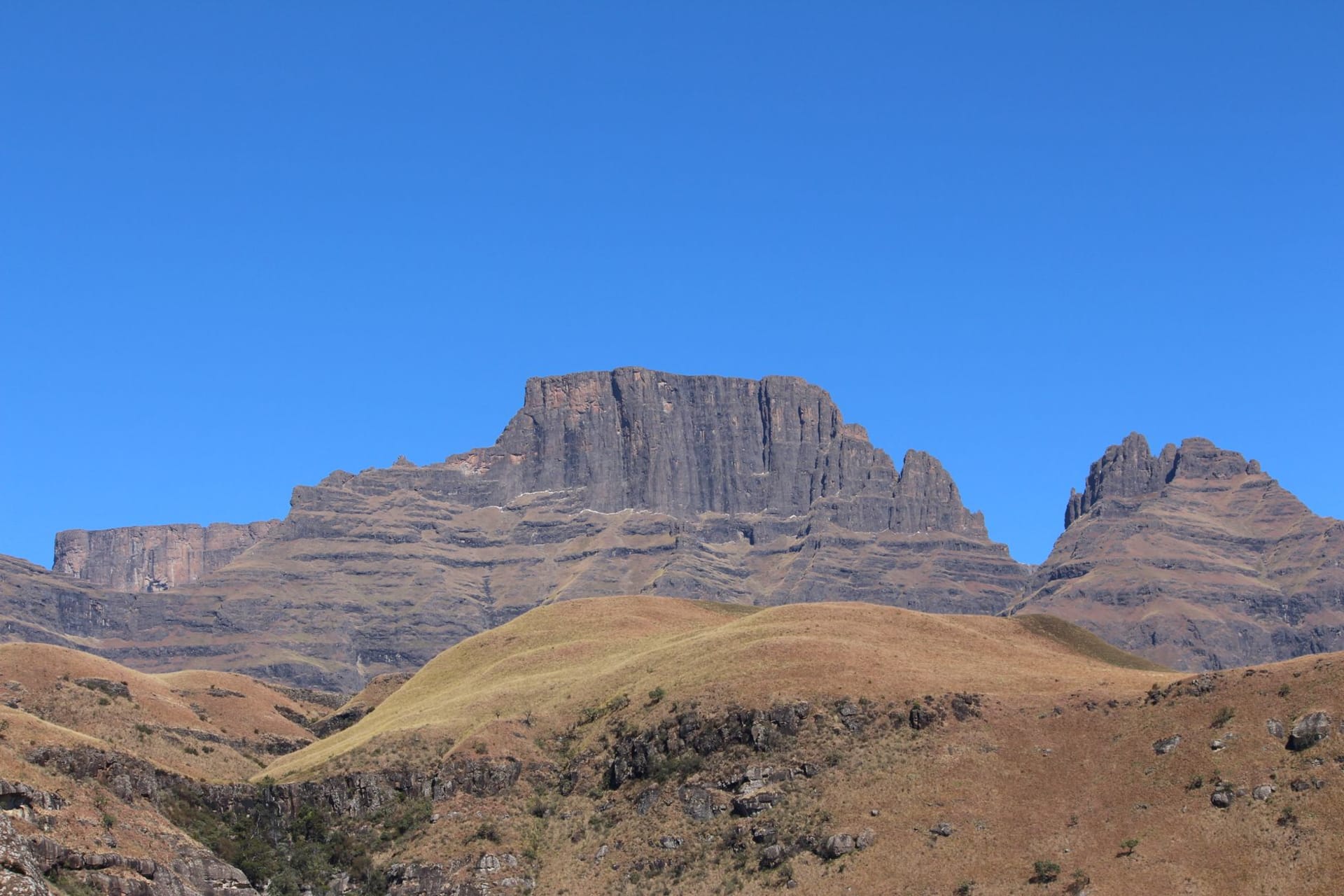
Cathedral Peak
"I woke up before dawn at Didima and watched the mountain turn from nothing into something pink and specific."
The morning I arrived at Didima Camp, the mountain wasn’t there. Low cloud sat in the valley and the peaks were entirely swallowed, not even a silhouette. I set up in my chalet, made rooibos on the small gas burner, and went to sit on the stoep in the dark at five in the morning, wrapped in a blanket that smelled faintly of campfire from a previous occupant. The cloud began to lift after half an hour — first showing the lower slopes, then the middle ridgeline, then the characteristic spire of Cathedral Peak emerging from the grey like a slow reveal, turning from charcoal to rust to the warm amber of direct sunlight. It was the most theatrical entrance I’ve seen a mountain make.
The Cathedral Peak area covers a stretch of the central Drakensberg with a character distinct from its northern and southern neighbours. The valley here is wider, more pastoral, the lower slopes supporting small farming operations and the traditional homesteads of Zulu communities who have lived alongside the mountain for generations. The camp staff at Didima mostly come from these communities, and on the evening cultural programme — which I almost skipped and now consider one of the better decisions I’ve made — a young man from the valley explained the Zulu relationship to the uKhahlamba, the barrier of spears, which is what the mountains have been called long before the Dutch renamed them Drakensberg.

The trails in the Cathedral Peak section cover an enormous range of difficulty. The Rainbow Gorge walk, accessible even to casual hikers, follows a stream through indigenous forest where the light falls differently than it does anywhere else in the Drakensberg — filtered through yellowwood and Natal fig canopy, green and still, the water running clear over polished boulders. At the gorge narrows, the rock walls close to arm’s width and you scramble through with water at knee height in summer, and find small waterfalls dropping into crystal pools. The sound in the gorge is the water’s reverberation off wet stone, and nothing else.
The summit trail to Cathedral Peak itself is a different proposition: a full day, seven hours minimum, requiring experience on loose rock and the chain ladder section that brings you onto the cathedral’s spine. I went with a guide from Didima who carried nothing but water and moved across the scree with a patience that made my own scrambling look frantic by comparison. At the top — three thousand and four metres — the wind was sharp enough to make conversation impossible, and the view southward along the Berg escarpment showed range after range disappearing into a blue-grey haze. It looked like the edge of the continent, which it more or less is.

Didima Camp is the kind of accommodation that makes you wonder why you ever stay anywhere more elaborate. The chalets are modest, built from local stone, designed to frame the mountain view from every room. Dinner is served communally at long tables and you end up talking to whoever sits nearest — usually birdwatchers, serious hikers, or Durban families who come every year out of habit that has become something closer to ritual. The braai area is lit after sunset and someone always has firewood. The mountain holds its orange glow above the treeline until it’s fully dark.
When to go: April to October for reliable clear skies. September and October bring the best wildflowers in the valley. June and July offer the sharpest air and the most dramatic light, though the summit route requires warm layers even mid-afternoon. Avoid the exposed upper trails during December-February afternoon lightning season.