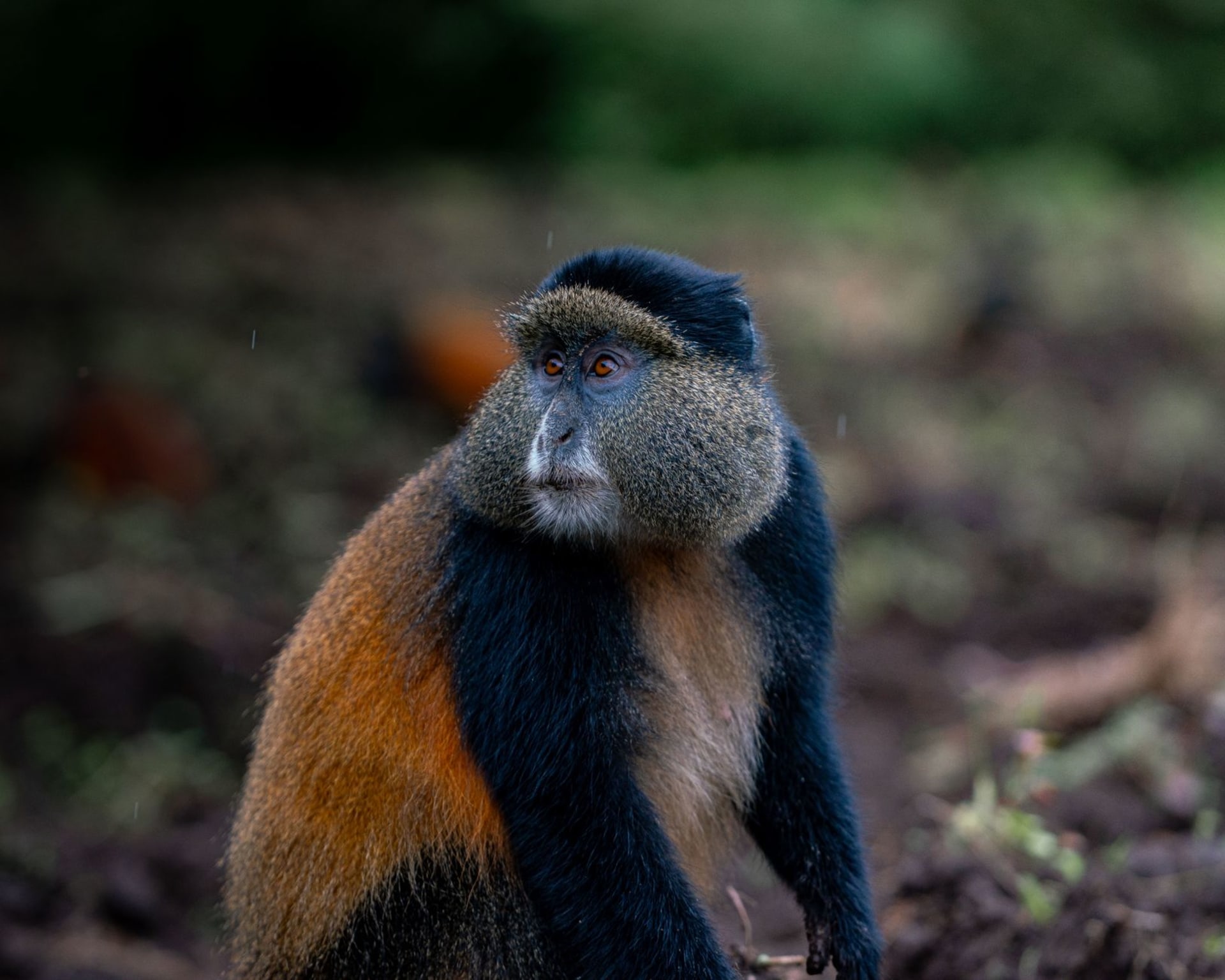
Virunga National Park
"The silverback looked through me the way you look through a window — I was the one being assessed."
The trail began in darkness. My guide Bahati had me on the path at five-thirty in the morning, the headlamp catching swirling mist and the first giant lobelias at the forest edge. We were hiking into the Mikeno sector, the high volcanic forest where a habituated family of mountain gorillas spends its days. The altitude was climbing through 2,500 metres and my lungs were registering the information steadily, without alarm, like a polite but insistent notification.
Virunga is the oldest national park in Africa, designated in 1925 when the Belgians still called this place the Belgian Congo. It holds an almost implausible range of ecosystems — from lowland forests near Lake Edward in the north to the ice fields of the Rwenzori peaks, through bamboo zones and mid-altitude rainforest, to Nyiragongo’s volcanic summit with its permanent lava lake glowing orange in the pre-dawn sky twenty kilometres south. The gorillas, though — the mountain gorillas, of which perhaps 1,000 remain on earth and a third of them live here — are why people cross oceans.

The trackers had found the family an hour above our starting point. Bahati stopped, touched my arm, put one finger to his lips. I could hear something moving in the vegetation — a heavy, deliberate rustling, like someone rearranging furniture in the next room. Then the leaves parted and a juvenile, maybe three years old, sat down in the open and looked at me with the expression of a child who has been told about these strange creatures called tourists and has decided they are less interesting than expected. Behind him, barely visible in the undergrowth, a female was feeding. Then the silverback moved. He came out to the right of the trail, ten metres away, and sat down in the classic silverback posture — chest broad, arms resting on his knees — and surveyed the scene. I was the scene. He looked at me for perhaps thirty seconds with an assessment so thorough and so calm that I found myself straightening my posture.
The park’s rangers are among the most courageous people I’ve encountered anywhere. More than two hundred have been killed protecting these forests over the past two decades, in a region where armed groups move through the same vegetation that is home to the gorillas. When Bahati told me this as we walked back down, I didn’t know what to say, and he didn’t require anything. He was matter-of-fact about it, the way people are about things that are simply true.

There is also Nyiragongo, the active volcano whose lava lake — the world’s largest — glows on the horizon at night from the streets of Goma below. The hike to the summit (3,470 metres) can be done in a day with a very early start, and the crater rim view of that molten orange lake, churning at the base of a vertical-walled caldera, is one of the stranger views available on this planet. I stood at the rim for twenty minutes in absolute silence and felt very small in a way that didn’t feel like a bad thing.
When to go: June through September is the dry season in the eastern highlands and the optimal window for gorilla trekking — trails are passable and visibility through the forest is marginally better. December and January offer a shorter dry window. Gorilla permits must be arranged well in advance through the ICCN (Institut Congolais pour la Conservation de la Nature) or a registered tour operator; access conditions shift with security situations, and checking current advisories is not optional.