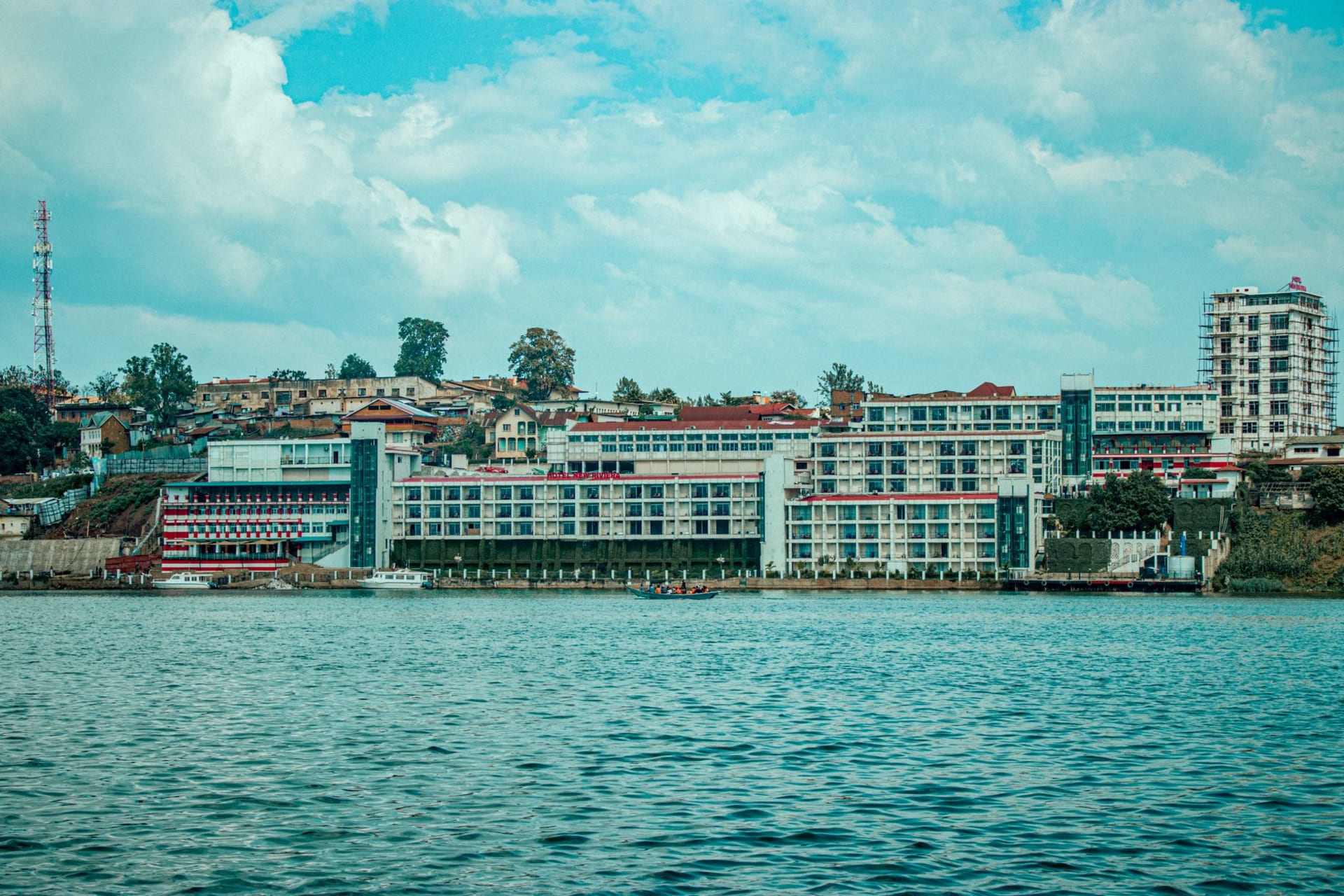
Kisangani
"In Kisangani, the forest doesn't frame the city — the city hides inside the forest."
I flew in from Kinshasa on a morning when the cloud layer sat low over everything, and the descent into Kisangani was thirty minutes of featureless white before the forest broke through below — dark green, absolutely uninterrupted, in every direction to the horizon. The Congo River appeared as a grey-brown ribbon threading through the canopy, then the small red rooftops of the city, then the runway, then we were down in a heat that was different from Kinshasa’s heat — stiller, heavier, more interior, as though the temperature itself had nowhere else to go.
Kisangani sits at the point where the Congo River bends, at the geographic heart of the largest tropical forest after the Amazon. The city was Stanleyville once, named for Henry Morton Stanley, who dragged the colonial project through this forest with an efficiency that left behind it a century of extraction and its aftermath. The name changed in 1966 and the city has been trying, ever since, to mean something on its own terms. What I found was a river city that has adapted to isolation — a place where the boat is still the primary infrastructure and where the forest is not background but fact.

The Boyoma Falls — known in Conrad’s era as Stanley Falls, which tells you whose era that was — are not a single waterfall but seven cataracts spread over about 100 kilometres of river upstream of the city. The combined flow here is the largest waterfall by discharge volume in the world, greater than Victoria Falls or Niagara, but it achieves this not through vertical drama but through sheer horizontal accumulation. I hired a pirogue and two paddlers for an afternoon and we went out onto the upper section, the boat riding low on the brown water, the forest walls on both sides dense and listening. The sound builds slowly — a white noise that gets inside your head before you understand what it is — and then the first cataract appears, a line of white water across the full width of the river, and the paddlers pull hard for the bank.
At dusk, the market along the riverfront fills with the evening trade. Women sell catfish cooked in moambe sauce from pots balanced on coal stoves; men bring bundles of manioc off the river barges. I ate at a table literally on the bank, the river sliding past below, and the catfish was extraordinary — a river fish with a flavour as complex as anything from the sea, the moambe sauce bringing smoke and palm oil richness to white flesh that fell from the bone. A man at the next table was reading a French-language newspaper from three days ago that had arrived by boat. He read it with the focused attention of someone for whom news is still news regardless of date.

The city’s isolation is extreme by any measure but it is not melancholy. The Université de Kisangani runs on a campus of improbably well-maintained colonial buildings. The central market has a vitality that speaks to the number of river connections the city maintains with villages across thousands of kilometres of waterway. People here know the river the way coastal people know the sea — they read it, time things by it, understand that the river is the reason everything else is possible.
When to go: June through September is the drier season and the most manageable for road access around the city, though the equatorial forest is never truly dry. The river level varies significantly — high water (November–January) makes navigation easier but some sites around the cataracts are partially submerged. Flights from Kinshasa run several times a week; check current schedules as these change frequently and with little warning.