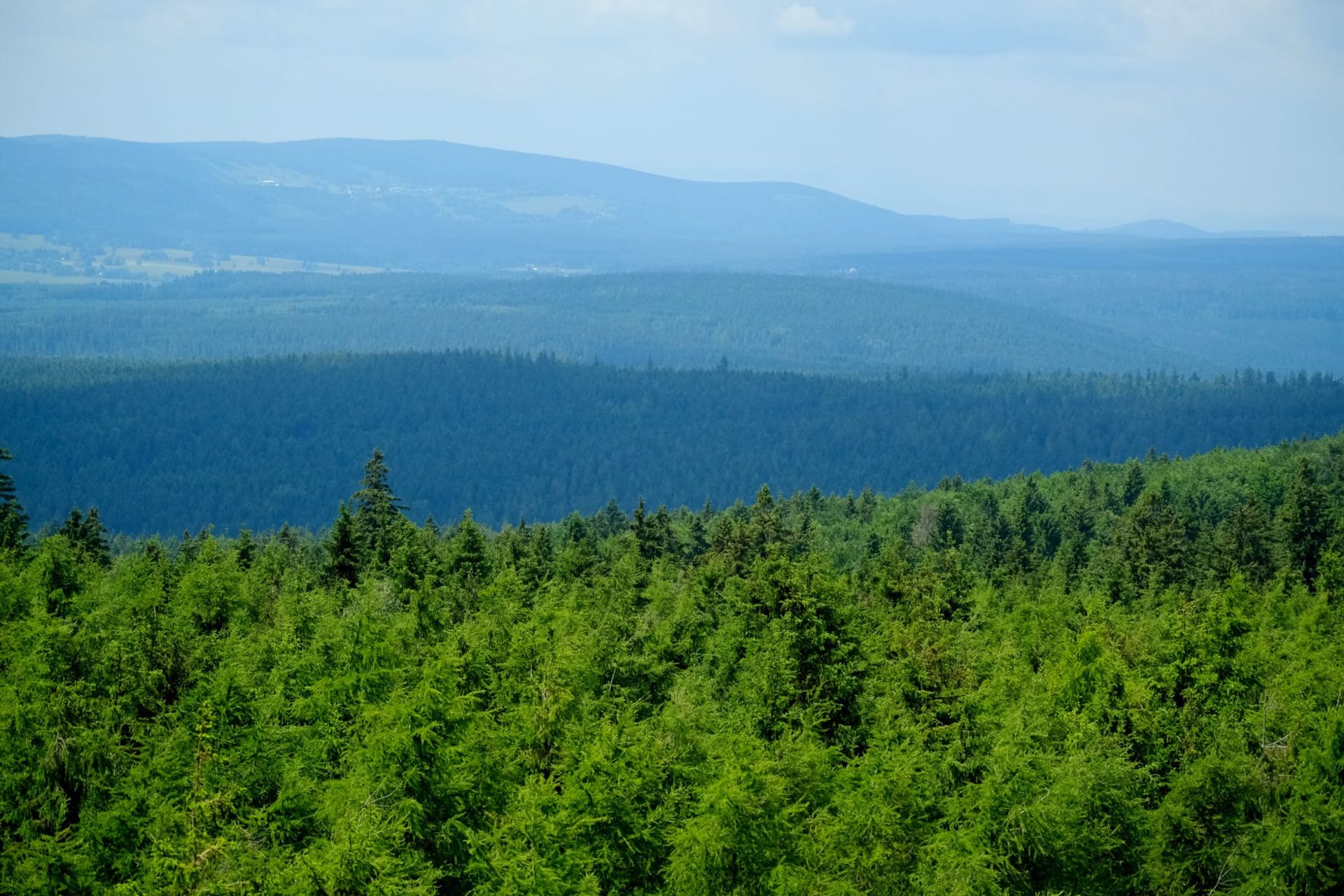
Day Forest National Park
"I had come to see a desert country and here was a forest. Djibouti keeps doing this to you."
The road up to Day Forest climbs through the Goda Mountains from the Gulf of Tadjoura coast, gaining 1,500 meters in about forty kilometers of switchbacks that offer increasingly vertiginous views back toward the sea. At the base, at sea level, the vegetation is thorn scrub and bare rock, the heat absolute. As the elevation climbs, things happen gradually and then all at once: first the thorn scrub thickens, then small trees appear, then larger ones, then suddenly — so suddenly it stops you — there is a forest, cool and dim and fragrant with something resinous, the light filtered through a canopy of juniper trees that are old enough to have been here before any of the borders on the map around them existed.
Day Forest is the only native forest in Djibouti, and its existence is something of a climatic anomaly — moisture from the Indian Ocean hits the Goda massif and rises, cooling as it climbs, and the resulting mist that pools in the highlands for much of the year has sustained this woodland through centuries when the surrounding landscape was becoming progressively more arid. The junipers are Juniperus procera, East African pencil cedar, and the oldest specimens reach forty meters and are draped in beard lichen. Walking among them feels less like a national park in a small African country and more like something from a fairy tale — cool, quiet, full of birds, the fog moving through the canopy in slow horizontal sheets.

The birds are the reason birders come specifically to Day Forest. The forest holds a population of the Djibouti francolin — a partridge-like bird found nowhere else on Earth, listed as endangered, and virtually invisible despite your best efforts. I spent two hours on a trail trying to spot one based on its call, which the guide described as “like someone tapping a stone with a smaller stone.” I never saw it. The guide had seen it five times in fifteen years and considered this good odds. I also saw sunbirds, Abyssinian wheatears, hornbills, and a raptorial species the guide identified in Afar and I couldn’t find in any field guide I had. The forest holds more than you can see in a day.
The park has a small visitor center at the entrance that is staffed irregularly and a network of trails that are maintained with varying degrees of enthusiasm. The best walk is the two-hour loop that goes to the highest point of the massif and back — on a clear morning you can see both the Gulf of Tadjoura and, in the other direction, the beginning of the Ethiopian highlands. When it’s misty, which is often, you see about fifty meters and the forest closes in around you and it is perfectly fine.

I stayed the night at a small guesthouse in the village of Randa at the edge of the forest — a concrete room, a bed with a good blanket, and a dinner of goat stew that the woman running the place made without asking what I wanted, which was the right approach since she knew far better than I did what was available. The temperature that night dropped to 15°C, which felt extraordinary after Djibouti City. I slept under two blankets and had the first genuinely cold night I’d had since arriving, and woke to the sound of francolin calls and fog and a forest that looked exactly as implausible in the morning light as it had the evening before.
When to go: October through April, when the highland mist is most persistent and the forest is at its most atmospheric. The access road from Randa village is a reasonable gravel track in dry conditions but can become difficult after rain. A local guide is worth hiring — both for the birds and because the unmarked trail system is genuinely confusing.