
Ghoom
"Two monks were performing a puja and I felt, by comparison, like a hummingbird — all motion, no stillness."
A cloud-wrapped village at the top of the world's highest narrow-gauge railway, built around a monastery and entirely indifferent to being a destination.

Ghoom is four kilometres from Darjeeling and sits at 2,258 metres, which makes its railway station the highest narrow-gauge station in India. This is a distinction the town wears lightly. The streets are narrow and often cloud-wrapped, the market stalls sell vegetables alongside yak butter and prayer flags, and the overall impression is of a place that has continued its own life without much modification for the benefit of people passing through. I liked it immediately.
The monastery is the reason most people come. Yiga Choeling Gompa, built in 1875, sits just off the main road behind a low gate, its entrance courtyard strung with prayer flags that have faded from primary colours into something gentler, more washed, more permanent-looking. Inside the main prayer hall is a five-metre-high golden statue of Maitreya — the future Buddha — painted in the specific gilt that somehow always looks warmer than regular gold, as if the colour itself is radiating patience rather than reflecting light. The air inside smells of butter lamps, old incense, and wood smoke drifting in from somewhere outside, and you become aware almost immediately of the quality of silence the building is holding.
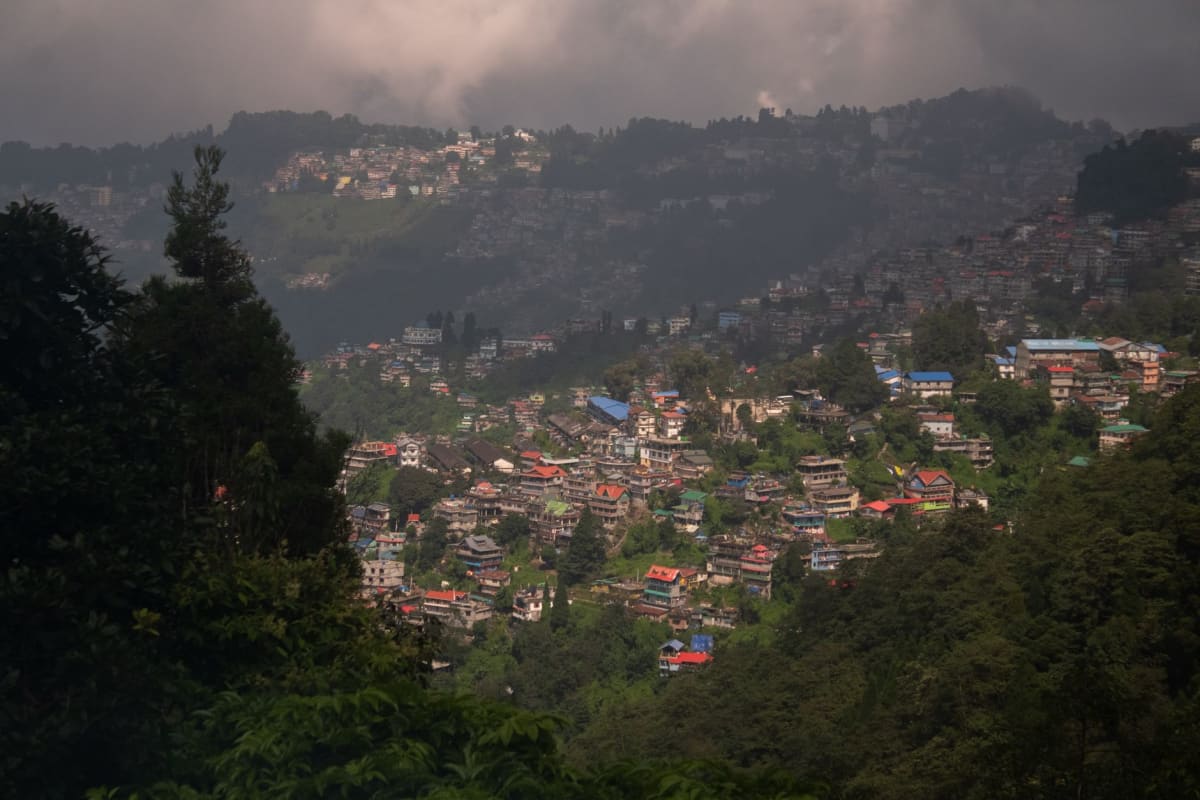
I arrived on a Tuesday morning, nobody’s special schedule, and found two monks performing a puja in the side chapel with a level of focused calm that made me feel, by comparison, like a hummingbird — all motion, no stillness. The bells came at irregular intervals. One monk looked up at me once, nodded, returned to his texts. I stayed for twenty minutes trying not to let my boots creak on the boards. The walk back to the main road passes through the lower market, where a woman was selling dried mushrooms from a basket the size of a bathtub and a man had arranged oranges on a cloth with geometric precision, each placement seemingly requiring a separate decision.
Up the hill behind the gompa, the forest thickens into something close to silence. The fog that rolls in from the valleys by mid-morning swallows the tree line, and Ghoom disappears into itself in the particular way that small Himalayan towns do — not withdrawn, just enveloped, going about whatever business has been going on here since long before the railway arrived.

When to go: Ghoom is accessible year-round and worth a half-day from Darjeeling at almost any point in the calendar. October to November offers the clearest light and the best chance of a mist-free morning in the monastery courtyard. The prayer hall is open to visitors every morning — remove your shoes before entering and leave any camera in your bag unless explicitly invited to photograph.
Keep exploring
More from Darjeeling
 darjeeling
Happy Valley Tea Estate
One of India's oldest working tea estates, close enough to walk to from town, where the factory smell alone explains everything about Darjeeling.
Explore darjeeling
Jungpana Tea Estate
A high-altitude estate accessible only by intention, producing a Muscatel Darjeeling so specific to its valley that there is simply no substitute.
Explore darjeeling
Kalimpong
A former trading crossroads between Tibet and Bengal where orchid nurseries line the hillsides and the Sunday market still smells of everything at once.
Explore darjeeling
Kurseong
A fog-draped ridge town between Darjeeling and the plains where some of the world's most awarded tea grows and a viewpoint shows you two worlds at once.
Explore darjeeling
Lloyd Botanical Garden
A quiet, misty pocket of orchids and Himalayan conifers just steps from Darjeeling's busy Chowrasta square.
Explore darjeeling
Mirik
A lake town at lower altitude where the oranges are extraordinary, the thukpa is made from scratch, and nobody is performing for tourists.
Explore