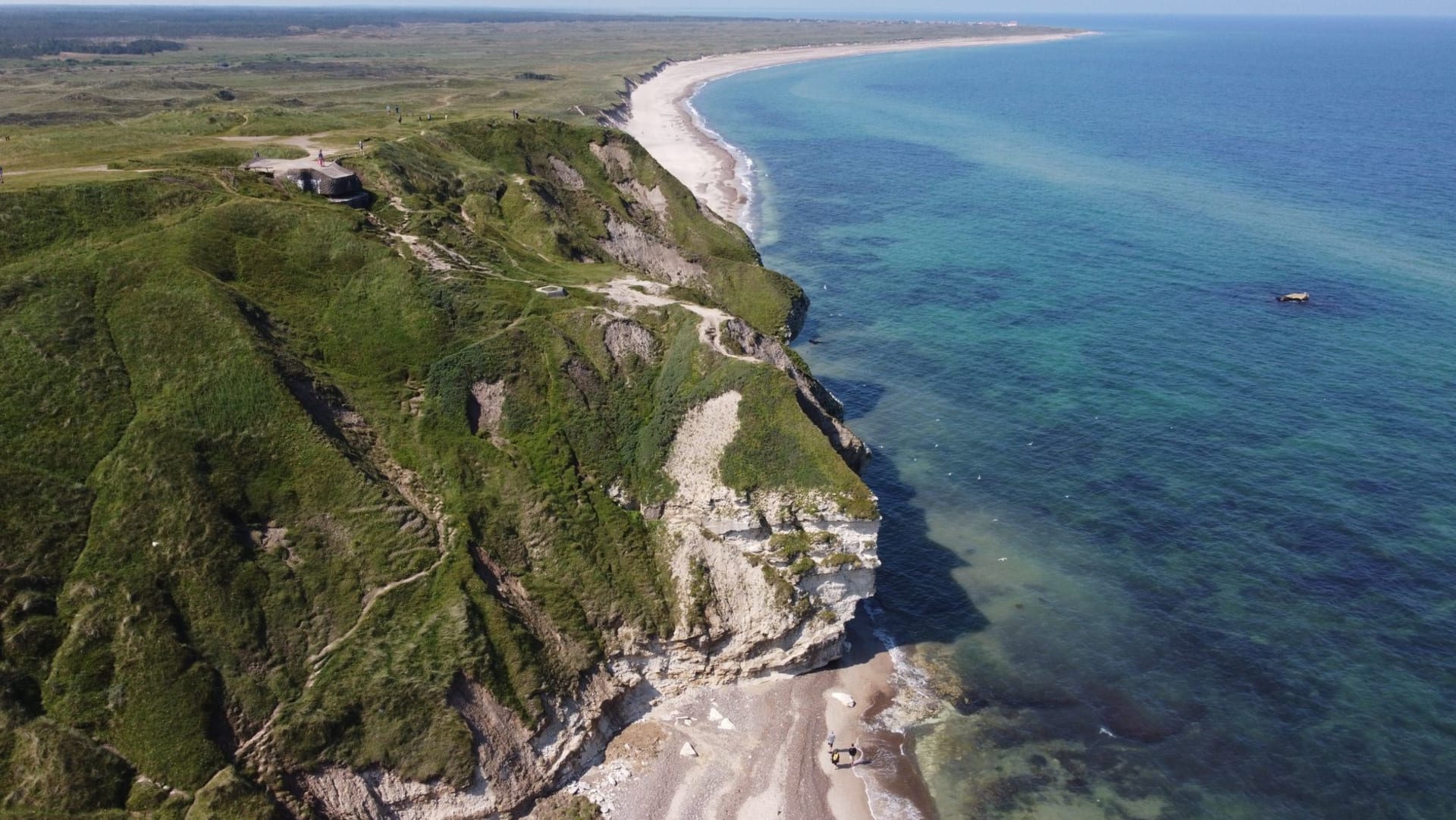
Møns Klint
"Standing on the cliff edge, I finally understood why the Danes paint light the way they do."
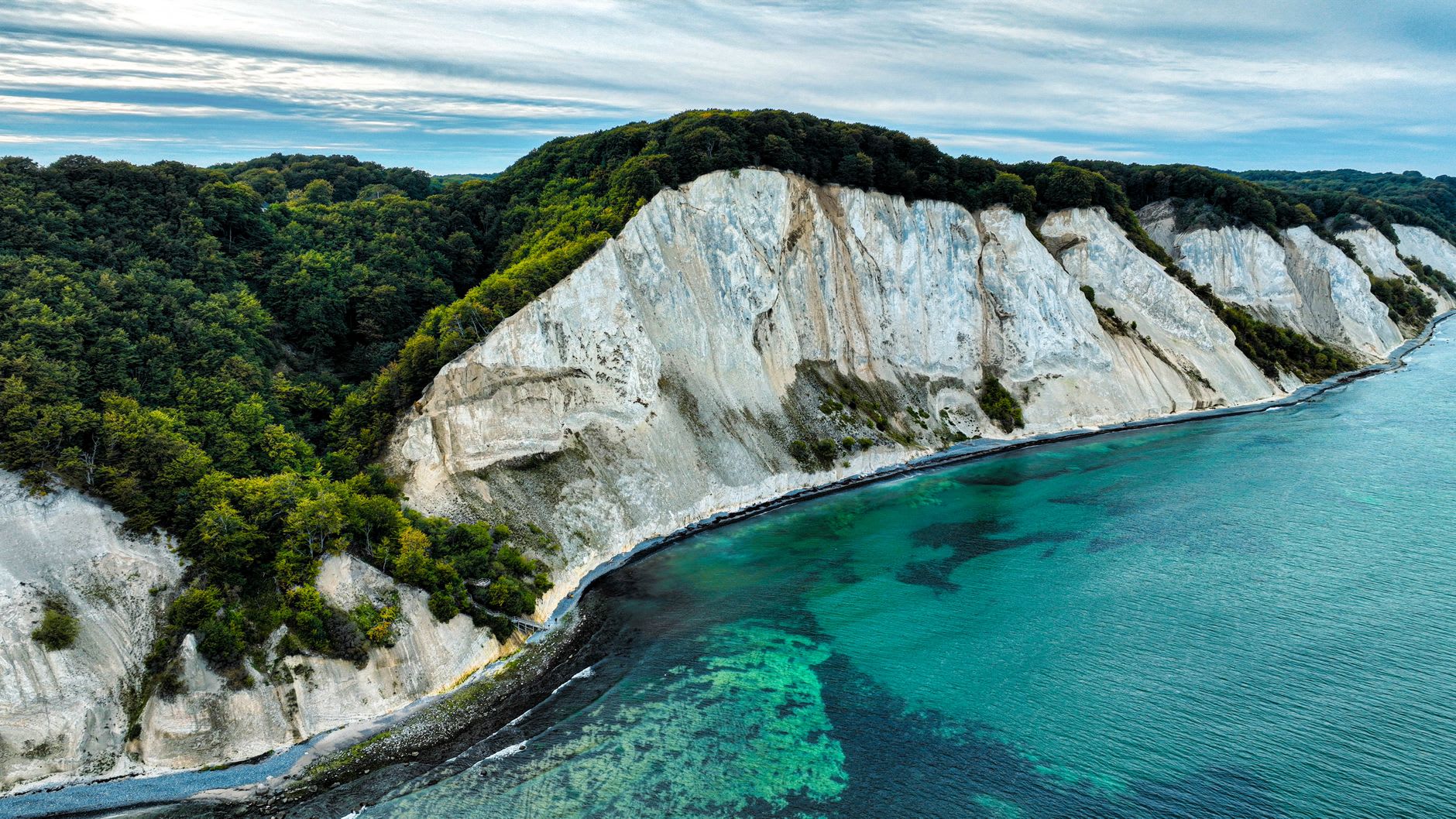
The forest comes first. You park somewhere on the island of Møn and walk into a beech forest so dense and green that the light filtering through turns the colour of fresh limes — a strange, luminous quality that has nothing to do with what you’re expecting. The cliffs are invisible from here. You can hear the sea faintly, a low persistent sound beneath the birdsong, but you could convince yourself you were imagining it. Then the forest opens, the ground drops away, and there it is: seventy metres of pure white chalk falling almost vertically into water that, against all probability given you’re in the southern Baltic, runs a colour between turquoise and jade. I made a sound I didn’t plan to make. A couple next to me did the same thing. We exchanged a look of mild embarrassment and then went back to staring.
Møns Klint runs for seventeen kilometres along the eastern coast of Møn, and the dramatic section — the high, sheer-faced cliffs that feature on every Danish tourism poster — covers about eight of those. The chalk was formed sixty-five to seventy million years ago, laid down in a warm shallow sea as the shells of microorganisms accumulated with geological patience. During the Ice Age, glaciers pushed the chalk upward and folded it into the cliffs you see today. The result is a landscape so anomalous for Denmark that the Danes treat it with an almost proprietary pride — this is what we have that you wouldn’t expect from us.
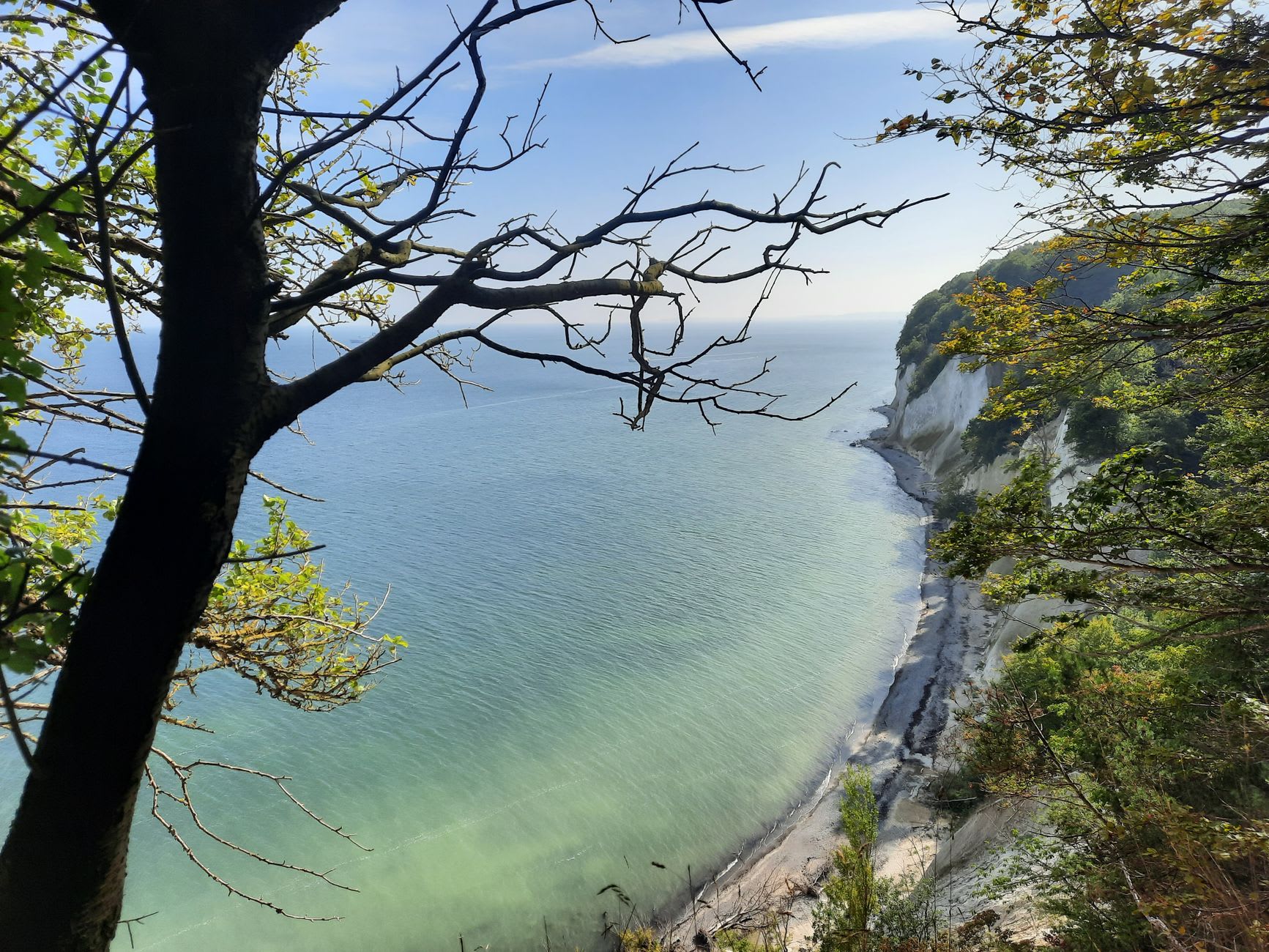
The descent to the beach is the best part. Steps cut into the cliff face lead down in long zigzags, and at each landing you stop, catch your breath, and look back up at the white face above you — chalk striped with dark flint layers, veined with fossil impressions, occasionally stained a faint amber by iron. At the bottom, the beach is not really a beach in any comfortable sense. It is a narrow strip of rubble, chalk fragments and flint, littered with what the sign near the steps cheerfully describes as “excellent fossil hunting material.” I crouched there for twenty minutes, turning over pieces of chalk in my hands, and found the impression of a sea urchin from sixty million years ago. The fact that this is a normal thing that happens here — that a person can just pick up sixty-million-year-old sea urchins from a beach in Denmark — struck me as genuinely extraordinary, the way certain obvious things become extraordinary when you let them land properly.
The beech forest at the top of the cliffs is, in a quieter way, just as remarkable as the cliffs themselves. It’s ancient woodland, and in May the floor is carpeted in wild garlic and wood anemones. In late spring and early summer, some forty species of wild orchid bloom here — including several that are rare in Denmark and flower only under particular combinations of chalk soil, light, and temperature that this forest happens to provide. I walked the cliff-top path in early June and the orchids were exactly where someone at the visitor centre had told me they’d be, small and improbable, growing between the tree roots as if entirely sure of their right to be there.
In clear conditions, and particularly at the northern end of the cliff walk near Sommerspiret, you can see the Swedish coast across the water — a faint low line that on certain evenings takes on a blue-purple quality that makes the distance feel both immense and oddly intimate. I sat on a bench there for an hour and watched three cargo ships pass in single file, heading northwest toward the narrows. The Baltic has that quality: simultaneously enormous and contained, a sea that feels managed.
When to go: May and early June for the orchids and wild garlic. July and August for the warmth, though crowds peak on weekends. October is underrated — the beech forest goes gold and the cliff top walks are often deserted. Avoid descending to the beach after heavy rain, when the chalk face becomes unstable and small falls are possible.