Fanø
"The wind on Fanø doesn't blow — it argues with you until you stop arguing back."
The ferry from Esbjerg takes twelve minutes, which is just enough time to watch Denmark’s flattest city recede and to begin to feel the wind. Not feel it in the polite meteorological sense — register its presence, note the direction — but feel it the way a physical force makes itself felt: persistent, directional, utterly indifferent to your preferences. By the time the ferry docks at Nordby, the wind has made its position on things clear. You are in its territory now. It will determine the pace and angle of everything.
Fanø is twelve kilometres long and four kilometres across at its widest point, and its western shore faces the North Sea with no shelter whatsoever — just dunes, then beach, then the open grey water stretching northwest toward Scotland. The beach itself is astonishing in scale: at low tide it can be a kilometre wide, pale sand packed hard enough to drive on (which the Danes do, in a tradition that has outlasted several attempts to regulate it), stretching in both directions to the point where the curvature of the earth is actually visible. I walked out toward the waterline on my first morning and kept walking past the point where I felt I should stop. The horizon pulled at me in a way that horizons in enclosed spaces never do.

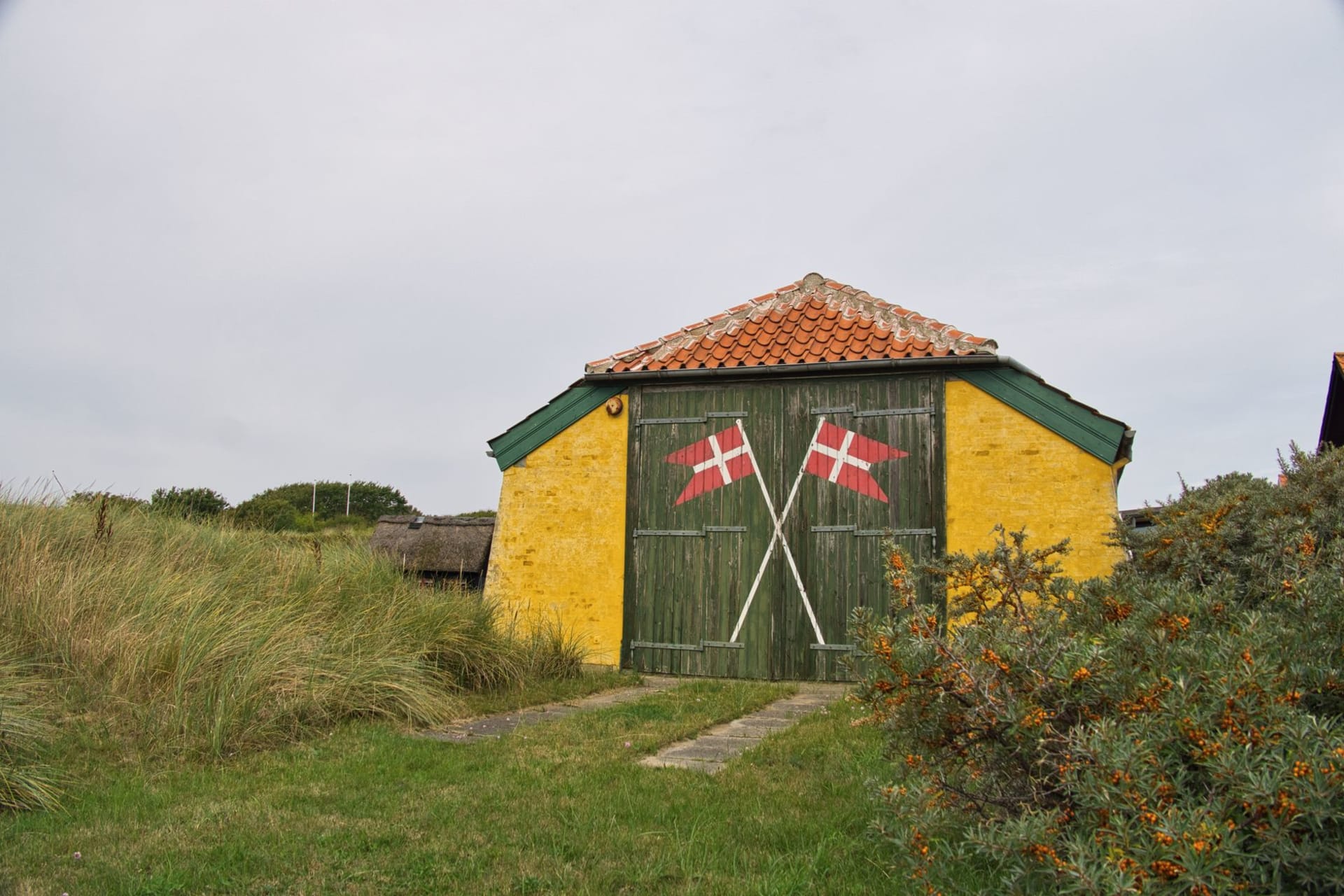
The villages of Fanø are its other argument for existence. Nordby, in the north, has retained the intimate scale of a fishing community — low houses with shutters, narrow lanes, a church that looks like it was built in a single determined weekend. But Sønderho, at the southern tip, is something else. It is one of the most beautifully preserved maritime villages in Denmark, a cluster of thatched houses built low against the wind, painted in the dark reds and yellows and greens that the island’s seafaring families favoured in the eighteenth and nineteenth centuries. The seamen who built these houses were away for much of their lives, sailing from Hamburg to Havana to Hong Kong, and their wives ran the island’s economy in their absence. The houses reflect this — they’re not grand or showy; they’re carefully made, practical, built to last by people who understood the value of something built to last.
In Sønderho I ate fiskesuppe in a small inn near the church — a fish soup so thick with chunks of North Sea cod and root vegetables that it qualified more as a stew, served with dark bread and a glass of something cold and pale. The woman who brought it told me, without particular prompting, that the recipe had been in the same family for four generations. I don’t know if that was true or just the right thing to say, but it tasted like it was true. The broth had a depth that requires time rather than technique.

The dune landscape between the villages and the western beach is the island’s most unexpected pleasure. The dunes are not the pale shifting hills of Mediterranean beaches — they are older and more established, colonised by marram grass and heather, cut through by paths that lead to sudden viewpoints where the beach appears below you as a ribbon of pale impossibility. In the dune hollows, out of the wind, the silence is sudden and complete. I sat in one of these hollows on my second afternoon, the grass angling overhead, the sound of the sea present but muted, and had the clearest sense I’d had in weeks of being entirely somewhere.
When to go: May and September are the sweet spots — the wind persists but the light is extraordinary, the beach crowds thin out, and the dune flowers are at their best. July and August bring kite festivals and beach crowds. January through March is for the genuinely committed: the North Sea in winter is a serious proposition, but the island empties out entirely and the light turns pewter and magnificent.