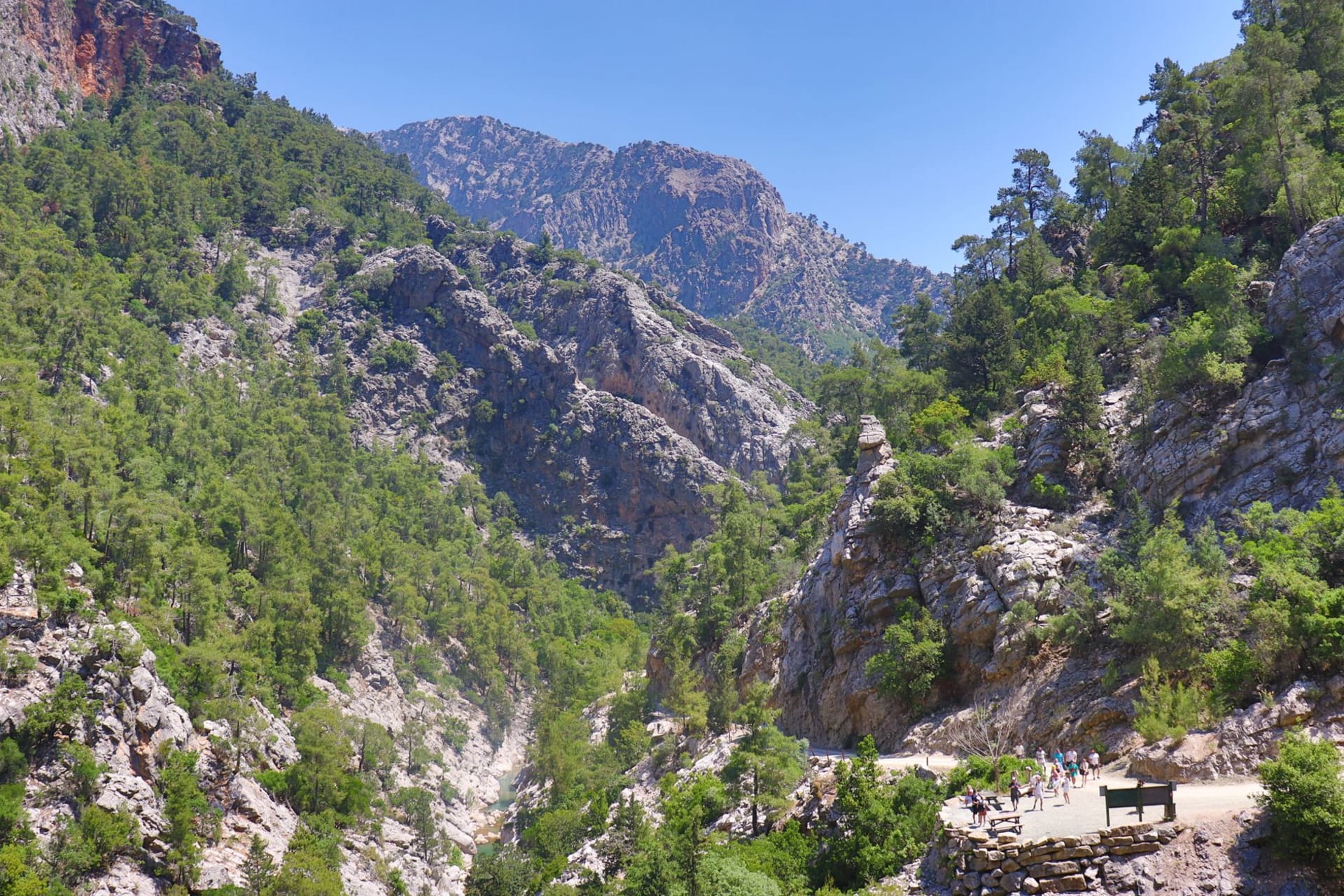
Samaria Gorge
"At the Iron Gates the walls close to four meters apart and the sky becomes a blue line 300 meters above. You stop talking."
The bus from Chania leaves in the dark, headlights cutting through mountain switchbacks for an hour before depositing a crowd of headlamp-wearing hikers at the trailhead of Xyloskalo at first light. I had signed up for this cliché deliberately, with no illusions about its famous status, and what struck me first was the quality of the cold. The White Mountains here reach above 2,000 meters and hold their chill until well into May; at 1,200 meters above sea level, with the gorge gaping ahead of me in the half-dark and the pine-resin smell sharp in the air, the cold had a presence to it — a mountain solidity that felt like a statement about where you were and what was about to happen.
The descent from Xyloskalo is steep and rocky for the first few kilometers, the path switching back through pine and cypress forest where the resin is so strong it feels medicinal. Then the gorge begins to open and close around you as you drop — widening into sun-filled meadows where oleanders grow and narrowing again into shadow where the rock walls press close enough to touch both sides simultaneously. The Samaria Gorge is sixteen kilometers in its entirety, but the character of the walk changes so many times in those sixteen kilometers that it never feels like repetition. It feels like a series of entirely different places that happen to be connected by a thread of water.

The Iron Gates are the gorge’s defining moment: the point where the walls rise 300 meters above and close to less than four meters apart. I had read about them and seen photographs, and I was still unprepared for the actual experience — the way the light goes blue and indirect at the bottom, the way the temperature drops by several degrees, the way the sound of the stream beside the path becomes the only sound and amplifies against the rock until it is more presence than noise. Griffon vultures work the thermals above, visible as distant specks wheeling on nothing. Somewhere in the high terrain, the Cretan wild goat — the kri-kri — lives in its stubborn solitude. I heard one scrambling on rocks above the Iron Gates and saw nothing, which felt exactly right.
The abandoned village of Samaria, midway through the gorge, was evacuated in 1962 when the area became a national park. Its stone houses are softly ruined now, roofless and growing herbs from their walls. There is a small church dedicated to Saint Maria of Egypt whose name the gorge carries. I stopped here and ate the lunch I’d brought from Chania — a sandwich and a peach, nothing impressive — and it tasted better than it deserved to, the way food always does after several hours of physical effort in the open air.

Agia Roumeli, at the gorge’s southern end, is a small settlement that exists almost entirely to service people who have just walked sixteen kilometers. The pebble beach and the Libyan Sea beyond are your reward, and I waded in without ceremony — clothes and boots left on a rock, the cold water removing whatever the walk had left on me. There is a ferry from Agia Roumeli east to Hora Sfakion because there is no road out of here, which is part of why the gorge feels like a genuine experience rather than a managed attraction. You have to earn the exit in some direction.
When to go: The gorge opens in May when snowmelt makes the path safe, and closes October through April. May and early June are best — the wildflowers are out, the stream still runs full, and the crowds have not yet peaked. September works well too. July and August are possible but the midday heat inside a south-facing limestone canyon is not to be underestimated.