Loutro
"No cars because no roads. The only sounds are the water, a distant engine, the clatter of plates from a kitchen. That's enough."
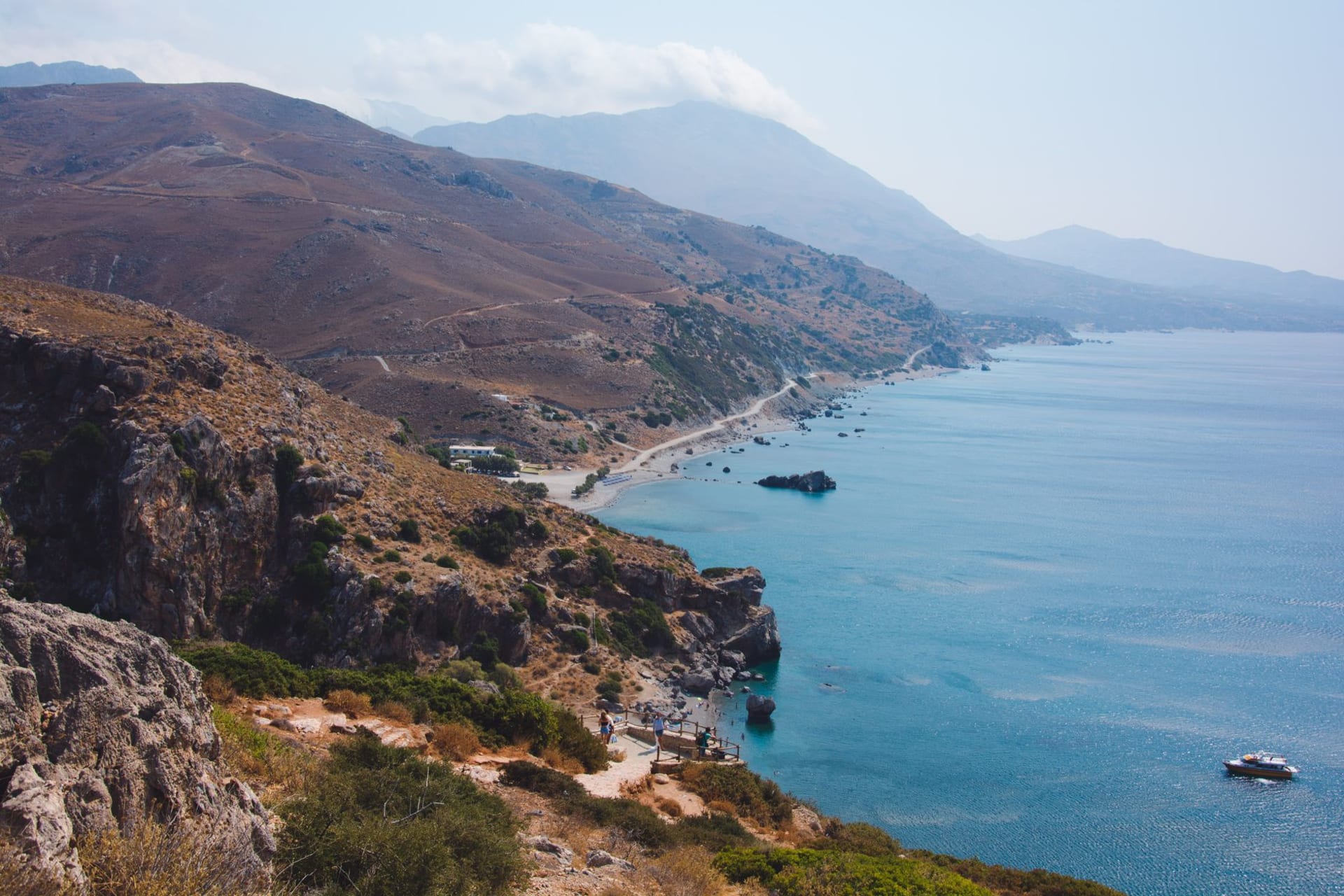
You arrive at Loutro by boat. There is no road, no car park, no way in except from the water or on foot over the White Mountains. The ferry from Hora Sfakion takes twenty minutes, rounding a headland and then depositing you on a small stone quay at the edge of a horseshoe bay so perfectly shaped it looks deliberate. The first time I saw it from the approaching boat, I had the distinct sensation of having arrived somewhere that had not changed fundamentally since the fishermen who first settled it — not because it was primitive, but because what it offered had always been exactly this: the bay, the clarity of the water, the mountains pressing down to the shore, and the enforced quiet that comes from the absence of roads.
The village is small enough to walk end to end in five minutes: a curve of white-washed houses and small hotels along the water, a few tavernas with plastic chairs arranged on the quay, cats sleeping on the moored boats. The sounds at Loutro — assuming you arrive outside the narrow summer peak — are the water, the occasional engine of a passing ferry, and the distant clatter of plates from a kitchen. The quiet has a specific quality here, the quality of a place where silence is structural rather than incidental, where it is not the absence of noise but the presence of something else.

The swimming is extraordinary. The water in the bay is so clear that from the surface you can see the bottom at eight meters with complete definition — individual pebbles, small fish moving over the sand, the anchor chain of a moored boat lying in a perfect coil below. I swam every morning before breakfast, out past the entrance of the bay to where the sea opened into the Libyan depths, the temperature dropping by two degrees and the color changing from turquoise to dark blue. To the east along the coast, accessible by a path that follows the cliff face, lies Sweetwater Beach — named for the freshwater springs that well up through the sand at the waterline, so that swimming there involves an alternation of cold and warmer layers that is one of the more unusual physical sensations I have experienced in the sea.
The hiking options from Loutro are serious. The Aradena Gorge runs north from the coast, a narrow limestone canyon that rivals Samaria in atmosphere if not in length, ending at the plateau village of Anopolis from which you descend back to the coast by a different path. I did this in a single day — eight hours of walking with a water bottle and a lunch bought the evening before — and arrived back at the Loutro quay at dusk in the state of mild depletion that always feels, somehow, like satisfaction. You earn the evening meal differently here.

The tavernas are not ambitious, which is correct. The food at Loutro is simple Cretan: fresh fish grilled with olive oil and lemon, dakos, village salad, lamb stewed with artichokes in spring. The ingredients are good and the preparation is without pretension and the setting — the quay at dusk, the mountains going dark above, the sea going silver — makes everything taste better than its category might suggest. There is a woman near the eastern end of the village who makes her own cheese and sells it by the piece from a small refrigerator at the edge of her property. I bought half a kilo of her fresh mizithra, ate it with honey and walnuts, and felt I had solved something important.
When to go: May and June, or September and October. The village fills completely in July and August and the peace that defines it evaporates entirely. The boats run from April to October; in winter Loutro is accessible only on foot over the mountains.