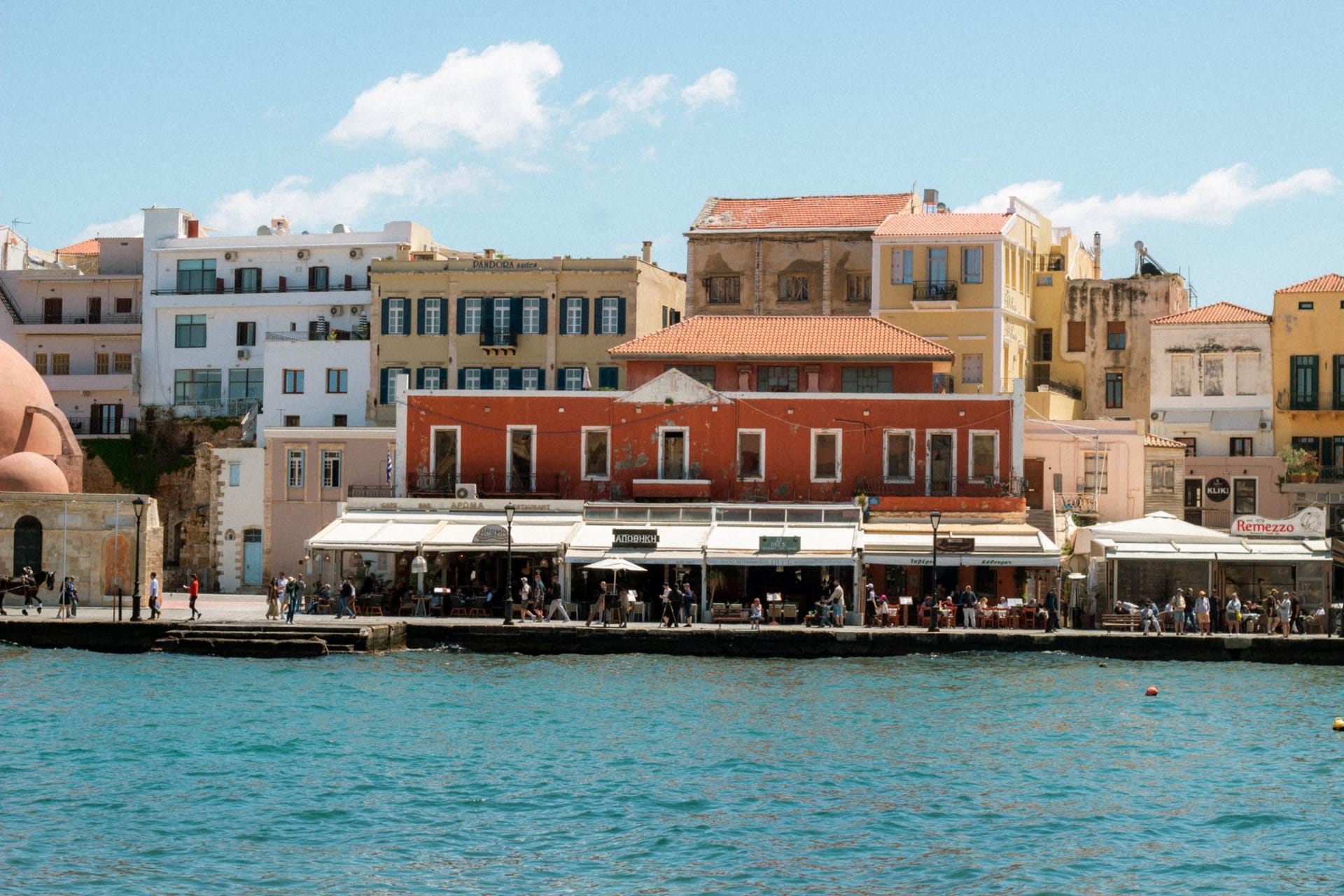
Chania
"The harbor appeared around a corner like a held breath finally released — I stopped walking and just stood there."
I came to Chania on a bus from the east and arrived at the old town with an hour of daylight left. That was enough. The harbor appears around a corner of white buildings and bougainvillea like a held breath finally released: the Venetian lighthouse standing at the tip of the breakwater, the domed Ottoman mosque squatting at the harbor’s edge, the curved waterfront of pastel-colored buildings reflected in water that turns from turquoise to deep blue as the shadows lengthen. I stood there longer than was strictly necessary, my bag at my feet, just watching the light change. There are views in travel that you prepare yourself not to be moved by, having seen the photographs too many times. Chania’s harbor at dusk is not one you can innoculate yourself against.
The narrow lanes of the Splantzia district, behind the harbor, are where the city’s layered history feels most immediate: a Venetian arched doorway opening into a Greek family home, a Turkish fountain set into a wall, the dome of a mosque repurposed into a gallery. History here is not sequenced or curated — it simply accumulates, one civilization building on the physical remains of another without ceremony or explanation. Chania was Minoan before it was Greek, Greek before it was Roman, Roman before it was Byzantine, Byzantine before it was Arab, Arab before it was Venetian, Venetian before it was Ottoman, Ottoman before it was Greek again. Each phase left something in the stone. The lanes of the old town are the record.

The leather market on Skridlof Street runs perpendicular to the harbor in a lane of narrow shops that have been selling sandals since at least the Ottoman period. The craftsmen work with the offhand precision of people who have done this particular thing ten thousand times. I watched one man cut leather with a single stroke and sew it to a sole in movements so practiced they looked effortless. He didn’t look up while he worked. When he finished, he held them out to me and turned back to his bench. The sandals are made to last, designed with no particular regard for fashion, and I have worn mine ever since.
The municipal market, a cross-shaped covered hall built in 1913, is the right place for food. In the morning it fills with locals buying what their parents bought: Cretan cheeses, olives from every corner of the island, dried herbs, spiced apaki sausage smoked with aromatic wood until it becomes dense and extraordinary. I ate dakos at a counter inside — the barley rusk softened with tomato and olive oil, crumbled feta on top, a single cured olive — and it was more satisfying than anything more elaborate I’d eaten that week.

In the evenings the harbor belongs to everyone: families with children, old men playing backgammon at kafeneio tables, couples sharing tsipouro and watching the lighthouse catch the last light. The restaurants on the waterfront serve fresh seafood at waterfront prices, which is to say expensive, but two streets back into the Splantzia the prices halve and the food improves. I found a small taverna where a woman in her sixties cooked whatever she’d bought that morning, wrote nothing on the menu, and served the best slow-braised lamb I have eaten anywhere. She brought the pot to the table and let me take what I wanted, which is both the most efficient and the most generous form of service.
When to go: Late April and May for warm evenings not yet crowded, jacaranda in bloom, and the old town at its most navigable. October is equally rewarding — the sea still warm from summer, the light extraordinary, and the town breathing more naturally after the summer pressure.