Odzala-Kokoua National Park
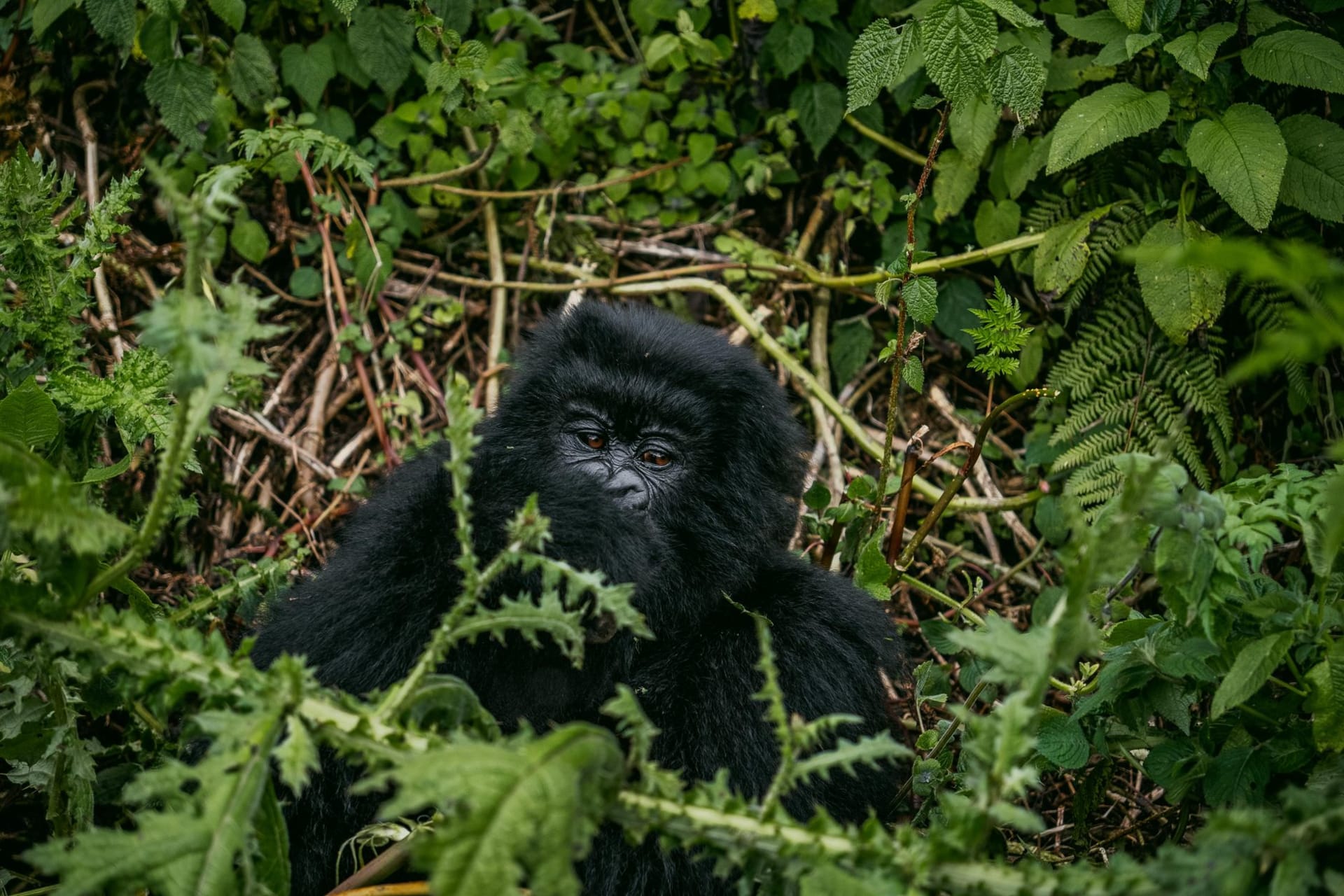
"The silverback looked at me for a long time. I don't know what he concluded."
The forest at Odzala doesn’t begin gradually. One moment you’re on a laterite track in secondary growth and then, without announcement, the trees close in — sixty, seventy metres of canopy overhead, the light going green and particulate, the sound of the world outside simply stopping. My tracker, a man from Mbomo named Alphonse who had worked these paths for fifteen years, didn’t slow down or say anything. He just walked, reading the forest floor the way other people read text messages, stopping occasionally to touch a broken stem or press a knuckle into the mud.
We found the gorilla family — the Neptuno group, nine individuals including a silverback and two juveniles — ninety minutes into the forest. Finding them is the wrong word. You smell them first, a rich, close animal smell, somewhere between cattle and something older. Then you hear a rustle in the undergrowth that resolves into a shape, and then the shape moves and becomes recognizable, and then it looks directly at you. The silverback was eating wild ginger. He stopped eating briefly to assess whether we were worth caring about, decided we weren’t, and went back to the ginger. One of the juveniles came closer than he should have and got redirected by a female with a short bark. Forty-five minutes. I counted them because it seemed important to know how long the world had been reorganized.

Odzala is also a park of bais — forest clearings where mineral-rich water collects and animals gather to feed. The bais work like slow-reveal theatre: you sit in a hide or on an elevated platform, very still, and the forest edge presents its contents at its own pace. Forest elephants appear from the tree line, smaller and more rounded than their savanna relatives, moving with a cautiousness that suggests they haven’t forgotten what humans have done. Sitatungas — spiral-horned antelopes built for swamp walking — wade through the shallows with the gravity of clergy. Once, at dusk, a group of forest buffaloes came down to a bai while I was watching, and the sound of their hooves on the mud was the loudest thing I’d heard all day.
The camps along the Lekoli and Mambili rivers — Camp Lango, Ngaga Camp, Mboko Camp — are genuinely impressive operations. Comfortable, solar-powered, staffed by people who know the park intimately and talk about its ecology with a passion that isn’t performed. In the evenings, with kerosene lamps on the table and the forest churring and creaking outside, the camps feel less like tourist infrastructure and more like outposts of genuine attention being paid to a place that deserves it.

What I wasn’t prepared for was the birds. The forest canopy at Odzala holds over four hundred species and several of them — the African pied hornbill, the red-billed dwarf hornbill, the black-casqued wattled hornbill — appear so improbably designed that you keep thinking they must be something else. My ornithological knowledge is modest at best, but I spent two days at Odzala barely watching mammals because the birds were more demanding of my attention.
When to go: June through September is the optimal dry season window — forest tracks are more navigable, the bais are more concentrated, and gorilla tracking is at its most reliable. The park is operational year-round but the wet season tracks can make moving between camps genuinely difficult. Book several months ahead — camp capacity is intentionally small.