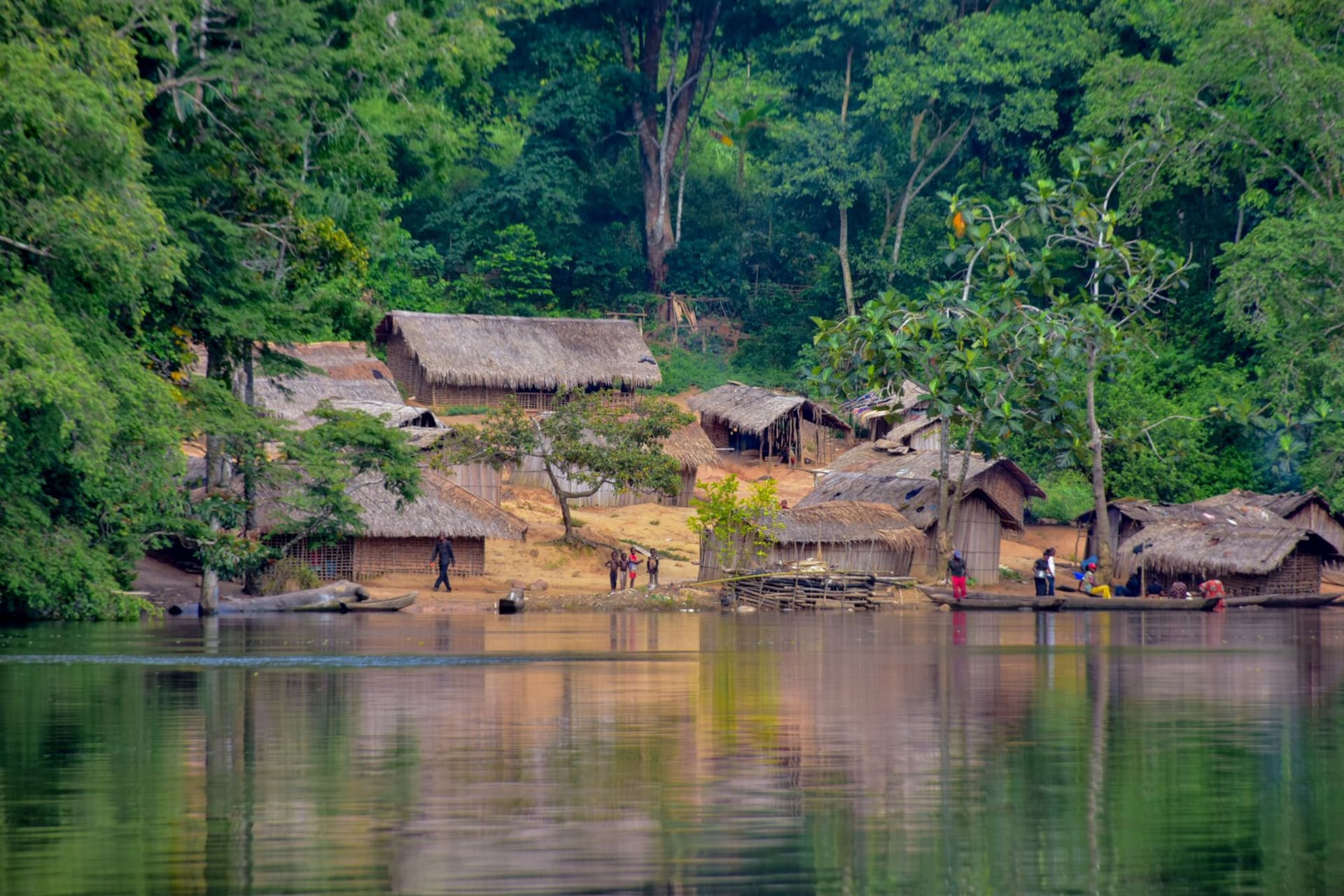
Nouabalé-Ndoki National Park
"This forest has never been logged. You feel the difference the moment you step into it."
Getting to Nouabalé-Ndoki involves a small plane from Brazzaville to Ouesso, followed by a pirogue journey up the Sangha River, followed by another pirogue up a narrower tributary, followed by a walk through forest that begins politely and then doesn’t. By the time I reached the research camp at Mondika — one of only a handful of access points to the park’s interior — I had been traveling for the better part of two days and my shoes were mud to the ankle. I sat down on a log and a yellow butterfly the size of my palm landed on my knee and stayed there long enough for me to feel, unreasonably, that I was being welcomed.
Nouabalé-Ndoki is different from Odzala in a way that’s difficult to articulate without having experienced both. Odzala is a managed wildlife experience — excellent, genuinely moving, but organized. Nouabalé-Ndoki is a research park run by WCS, where gorilla habituation at Mondika is a long-term scientific project. The gorillas here — the Mondika family — have been followed by researchers for over twenty years. Visiting them is permitted, tightly regulated, and feels correspondingly serious. You wear a mask. You stay ten metres back. You speak, if you speak at all, in something below a whisper. The forest is heavy with a quality of attention that runs in both directions.

The elephant population at Nouabalé-Ndoki is extraordinary. Forest elephants move through the park in numbers that no longer exist in most of Central Africa, and at the Mbeli Bai — a vast forest clearing in the park’s south where a river spreads into shallow pools — I watched something I’d never expected to see: over forty elephants in one clearing, moving in shifting groupings, calves stumbling after mothers, bulls sparring with a halfheartedness that suggested they weren’t really angry. The bai at dawn, before the heat has fully established itself, produces a quality of light that turns the water gold and the mud violet and makes everything look like a painting of itself.
Chimpanzees move through the trees above the path between the camp and the forest clearings, tracking the researchers’ movements with an interest that isn’t quite curiosity and isn’t quite fear. The birdsong here is a continuous, layered thing — different calls occupy different heights in the canopy, and at night it transitions into a soundscape of insects so dense it becomes almost textural. I lay in my camp cot on the first night and could not distinguish individual sounds from the general sound, which was the sound of everything that was alive doing what it was alive to do.

The park covers more than four thousand square kilometres and the vast majority of it is effectively inaccessible. Only a small area around Mondika and the Mbeli Bai is open to non-researcher visitors, and the numbers are strictly limited. This isn’t a drawback — it’s the point. What Nouabalé-Ndoki offers is not the experience of visiting a park but the experience of being briefly allowed into a place that exists for reasons other than your presence.
When to go: June through September, when river levels are lower and the overland approach is most manageable. Access requires advance coordination with WCS Congo — this is not a show-up-and-buy-a-ticket destination. Email them months before your intended travel dates.