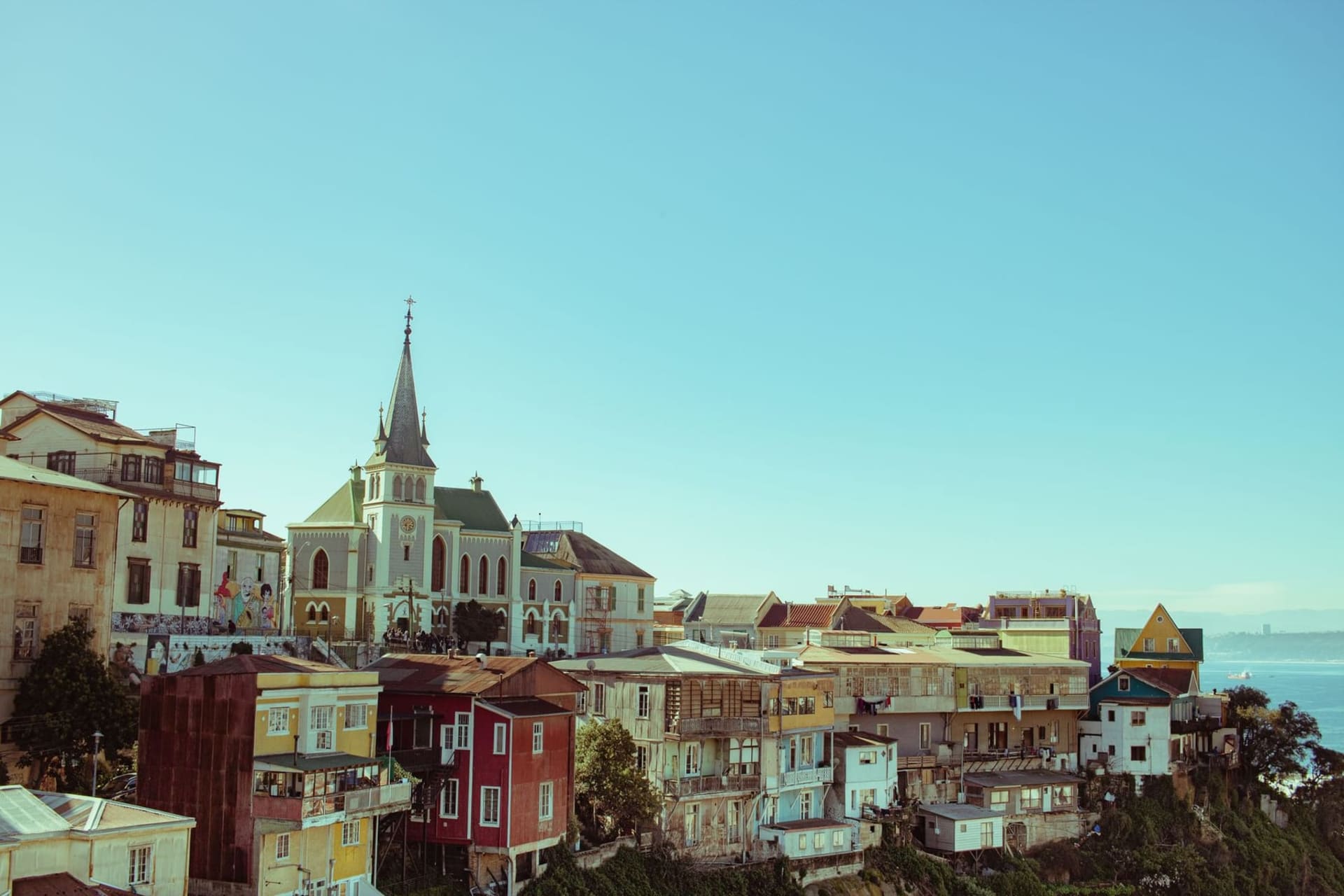
Valparaiso
"Valparaiso is what happens when a port city stops caring what anyone thinks of its paint choices."
A hillside port city of Victorian funiculars, vivid street murals, and bohemian cafes with Pacific views.
There is a smell to Valparaiso that I didn’t expect — salt and diesel and frying dough, undercut by something faintly floral, possibly the jasmine that spills over garden walls on Cerro Alegre. It hit me the moment we stepped off the bus from Santiago, before I’d seen a single mural, before I’d registered the hills rising above the harbor in tiers of improbable color. The city announces itself through your nose first.
The Cerros
The hills are everything here. Valparaiso’s famous cerros — there are more than forty of them — are connected to the port below by ascensores, Victorian cable funiculars that creak and tilt at angles steep enough to make your stomach revise its commitments. We rode the Ascensor Reina Victoria up to Cerro Alegre on our first afternoon, the wooden cabin groaning reassuringly, and stepped out into a street that looked like someone had given a surrealist painter a city-planning contract and unlimited budget.
The murals here are not decoration. They are the walls. On Pasaje Gálvez, I stood for a long time in front of a floor-to-ceiling portrait of a woman with sea-foam hair, rendered in blues that shifted depending on where the light caught the concrete. Lia photographed it from six different angles and still said she hadn’t gotten it right.
What the Port Quarter Hides
I had assumed the lower city — El Plan, the flat commercial district near the waterfront — would be the utilitarian part, something to pass through on the way back to the cerros. I was wrong. Down near Mercado Puerto, where fishing boats still unload in the early morning, I found a cevichería the size of a broom closet tucked beside a chandlery. The ceviche was Peruvian-style, heavy on the leche de tigre, served in a plastic bowl with a single soda cracker balanced on top. It cost almost nothing and tasted like a reasonable argument for staying forever.
The surprise came later, climbing back up through Cerro Concepción at dusk. Between two peeling apartment buildings, I stumbled onto a mirador I’d found on no map — a concrete ledge barely wide enough to stand on, overlooking the entire bay. The container ships below were turning orange in the last light. For ten minutes, I had it completely to myself.
Eating and Staying Slow
Lunch in Valparaiso is chorrillana if you’re eating like a local: a heap of french fries buried under caramelized onions and sliced beef, served in cast iron at places like J. Cruz M. on Calle Blanco. It is not subtle food. It is port-city food — generous, caloric, unapologetic — and it matches the architecture perfectly.
When to go: October through March brings the warmest and driest weather, though Valparaiso’s coastal fog rolls in regardless of season and gives the city its characteristic moody light. Avoid the height of January if you prefer the city without tour groups stacked on every mirador.