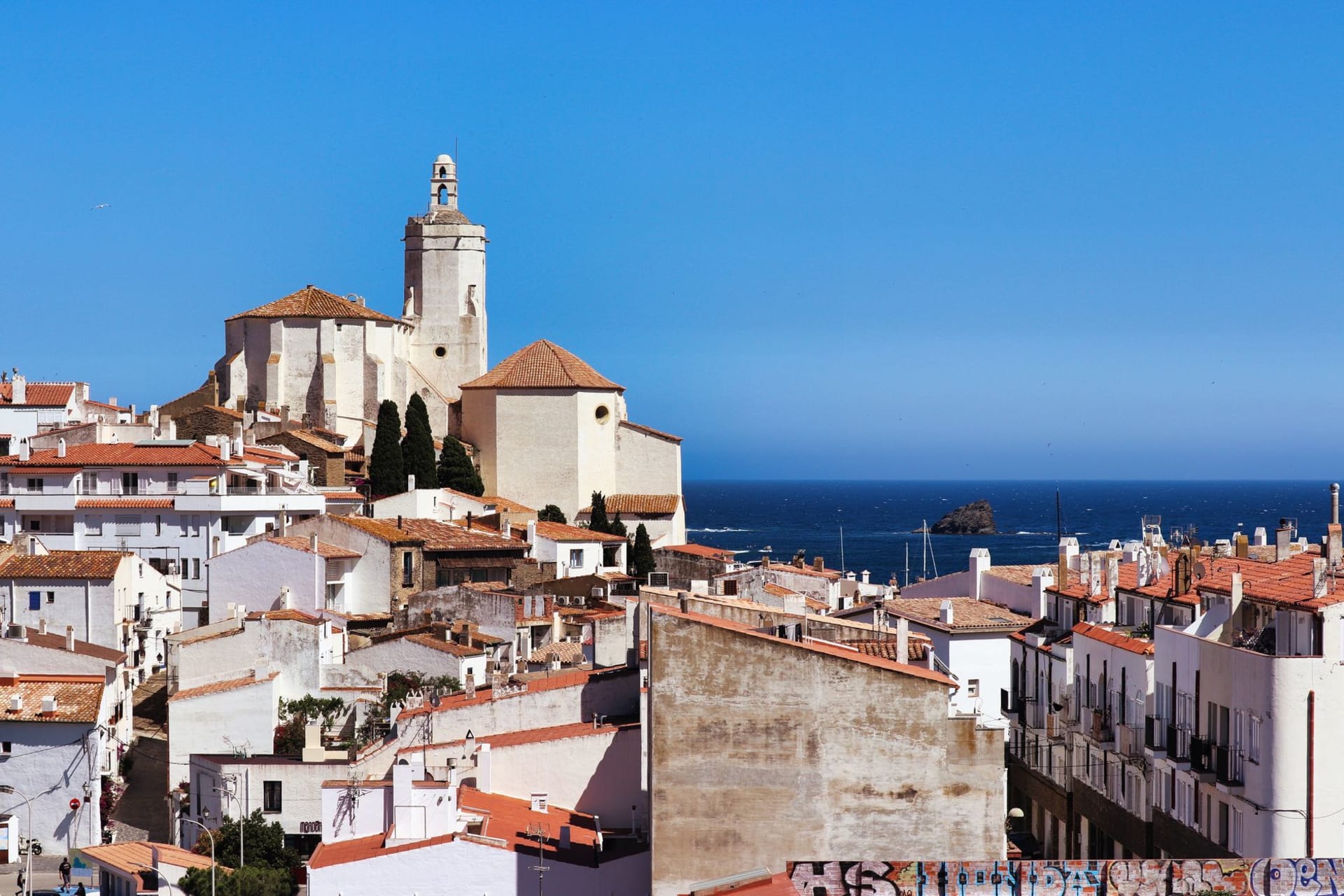
Sitges
"Barcelona is forty minutes north and might as well be on another planet. Sitges has decided, collectively, to enjoy itself."
Sitges is what Barcelona pretends it is too busy to be. Forty minutes down the coast by train — a cheap, frequent ride that hugs the sea most of the way — it is a town that has made a deliberate, century-long decision to be charming, and somehow pulls it off without curdling into a theme park. The image everyone knows is the church of Sant Bartomeu i Santa Tecla, a tawny-stoned bulk standing on a rocky point directly above the Mediterranean, with the old town’s whitewashed lanes piling up behind it and beaches falling away on either side. We arrived on a bright spring morning when Barcelona had felt overheated and overrun, and the moment we stepped off the train into Sitges’s lighter, looser air, both of us relaxed without discussing it.
The old town and the painters
Behind the seafront, the old quarter is a tangle of narrow white streets, wrought-iron balconies dripping with bougainvillea, and the kind of small squares where you sit down for one coffee and leave an hour later. Sitges has been an artists’ town since the late nineteenth century, when the painter Santiago Rusiñol set up here and turned the place into a hub of Catalan modernisme, and that bohemian inheritance still flavours it — galleries, a couple of genuinely good museums in old mansions, and a general atmosphere of a town that takes beauty seriously without being precious about it. We spent a happy hour in the Cau Ferrat, Rusiñol’s own house stuffed with his collections, where two El Greco paintings hang almost casually among the wrought iron and blue tiles, as if someone had simply liked them and put them up.

A town that knows how to enjoy itself
What I liked most about Sitges, though, is harder to photograph: it is a place entirely without anxiety about pleasure. It has been a famously gay-friendly, open, party-loving town for decades, host to a wild Carnival and a film festival, and even on an ordinary spring weekday there was a current of good humour running through the cafés and the beachfront promenade. We ate seafood rice at a table on the front, watched a parade of dogs and rollerbladers and impossibly chic retirees go by, and Lia declared it the most relaxed she had felt in Spain. The beaches themselves are clean, golden, and right at the foot of the town — you can spend the morning in a museum, swim before lunch, and never walk more than ten minutes. There is something almost suspicious about how easy Sitges makes everything, until you accept that some towns are just good at this.

When to go: Late spring and early autumn — May, June, September — are the sweet spot, with warm sea, comfortable heat, and the worst of the summer crowds either side of you. July and August are hot, packed, and expensive, though the energy is undeniable if that is what you want. February brings the famous Carnival, one of the liveliest in Spain, and October the film festival; both transform the town and are worth planning around or deliberately avoiding, depending entirely on your temperament. Come by train from Barcelona and skip the parking misery altogether.