Girona
"The stairs to the cathedral never seem to end. The view from the top makes the climb disappear."
I’ve been to Girona four times and each time I take the same walk: over the Pont de Pedra from the new town, into the old quarter, along the Rambla de la Llibertat with its cafes under the stone arcades, and then through the Barri Vell until I’m standing in the Call — the medieval Jewish quarter — in a lane barely wide enough for two people to pass without turning sideways. Something about the compression of the place, the way the streets collapse in on themselves, always brings me to a particular kind of attention. You cannot walk fast in Girona’s old town because the streets won’t allow it, which turns out to be part of the lesson.

The Call is one of the best-preserved medieval Jewish quarters in Europe. The community here, the Kehila Kedusha, was intellectually distinguished — the Kabbalist Isaac the Blind taught here in the twelfth century, and the quarter produced philosophical and mystical scholarship that influenced Jewish thought across the Mediterranean. The Centre Bonastruc ça Porta, housed in what was once a synagogue courtyard, traces this history with an attention to detail that the larger tourist cities often lack. I spent two hours there in the company of an elderly volunteer guide who spoke Catalan, Spanish, and what turned out to be remarkably good English, and whose knowledge of medieval Kabbalistic thought was both vast and quietly exciting to encounter. He had been doing it for twenty years, he said, because he found it impossible to stop.
The cathedral is approached up ninety steps from the Plaça de la Catedral, a climb that sorts visitors by enthusiasm. At the top, the Baroque façade presents itself over the earlier Gothic structure, and inside, the nave is the widest Gothic nave in the world — wider than Notre-Dame, wider than anything in Spain. It is a single space without lateral aisles, the vault rising twenty-two meters above the stone floor, and the effect is extraordinary: you feel simultaneously inside and exposed, the scale working on your sense of proportion in a way that takes a moment to resolve. The cathedral treasury holds the Tapestry of Creation, a twelfth-century Romanesque embroidery depicting the Book of Genesis in concentric circles around a Christ Pantocrator. It is among the finest pieces of medieval textile art in existence and it is somehow here, in Girona, in a small room off the nave.

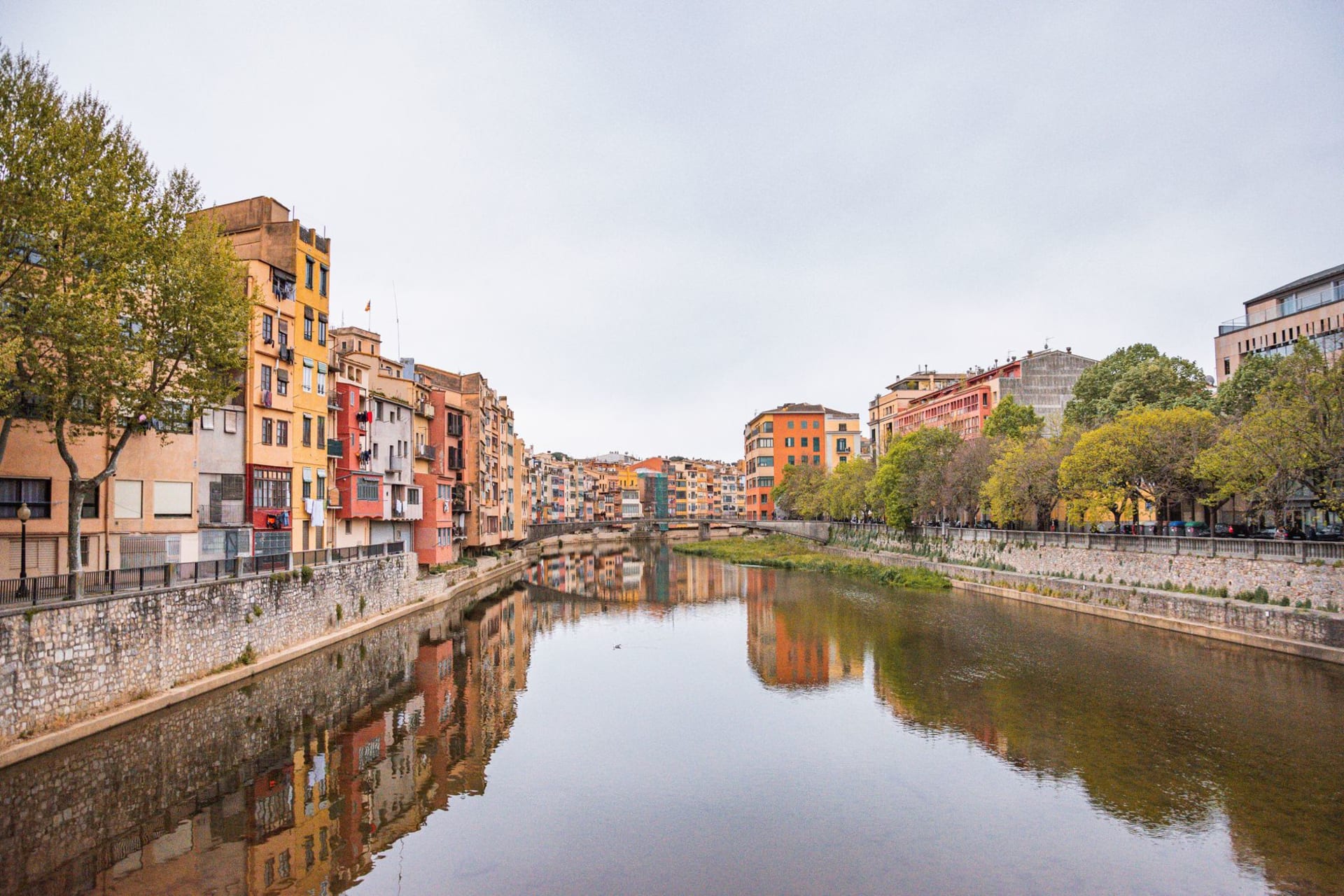
Below the cathedral, the city runs along the Onyar river, and the painted houses that lean over the water are Girona’s most photographed image. What the photographs never quite capture is the smell of the river on a warm evening — green, slightly mineral, mingling with grilled meat from the restaurants along the embankment — or the quality of sound that bounces off the water in the early morning when the market vendors are arriving. The Mercat del Lleó, just back from the Rambla, is Girona’s covered market and one of the serious ones: the fish stall has the morning catch still iced, the vegetable stalls change weekly with the seasons, and the woman who sells the local farmhouse cheese has been there since before anyone can remember. Girona has extraordinary fine dining — El Celler de Can Roca holds three Michelin stars and draws pilgrims from everywhere — but the trattorias and smaller places around the market serve the daily reality of Catalan cooking with equal conviction and considerably less advance planning required.
When to go: May is extraordinary — the Temps de Flors flower festival fills the old town’s courtyards, staircases, and streets with elaborate floral installations that feel genuinely surreal. September and October offer warm weather without crowds. Winter brings a particular quietness to the old town that reveals its architectural bones.