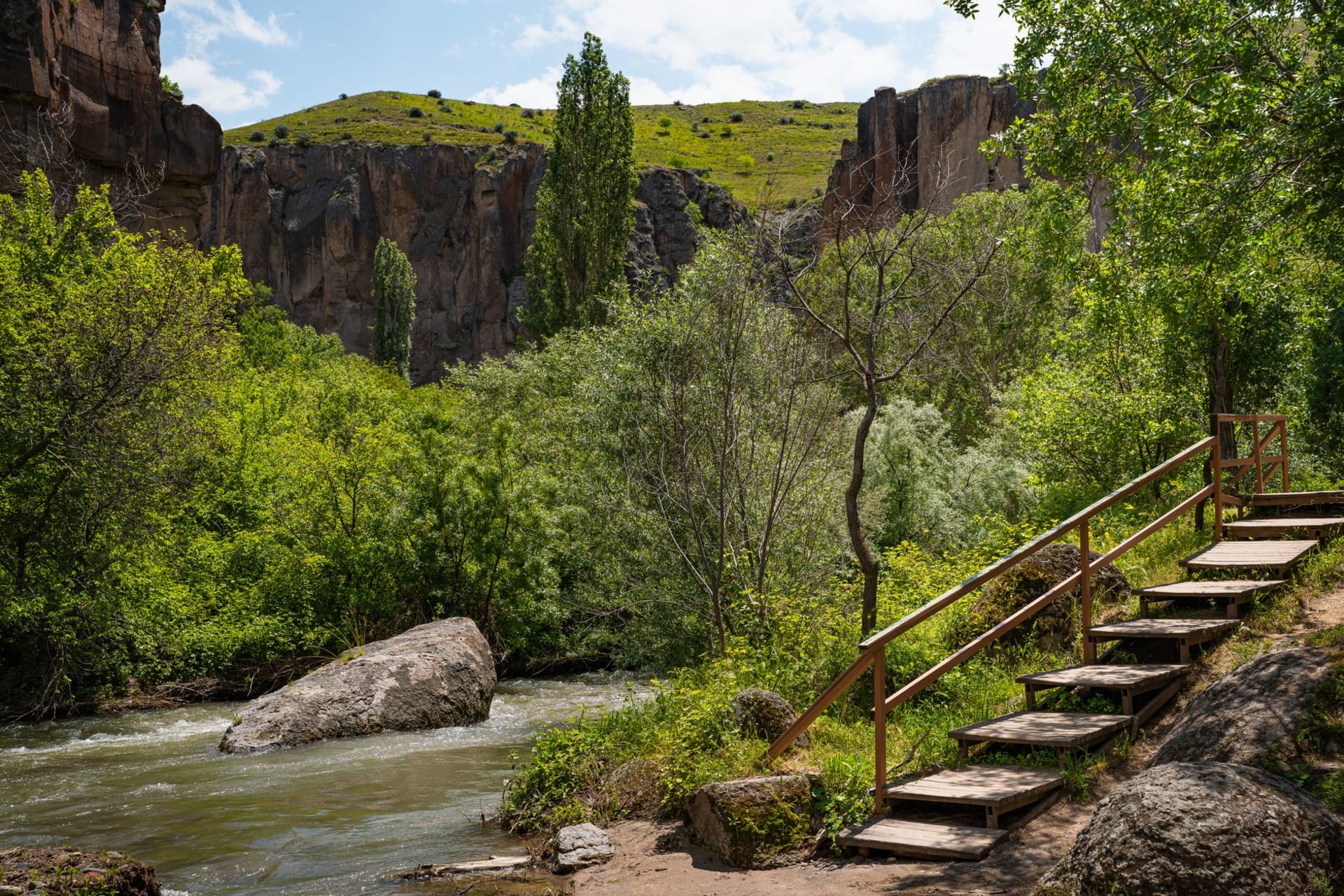
Ihlara Valley
"The gorge opens and the river runs cold over smooth stones and every church on those walls feels like a secret still being kept."
You descend into Ihlara Valley by a steep metal staircase bolted into the cliff face, four hundred steps, and by the time you reach the bottom the world above has disappeared. The rim, with its car parks and souvenir stalls and the inevitable çay tent, is gone. What remains is the Melendiz River, running fast and clear over smooth volcanic stones, and on either side the vertical walls of the gorge rising sixty metres, honeycombed with cave chapels and churches carved directly into the cliff.
I walked the valley on a morning in May when the cottonwood trees along the river were heavy with new leaves and the light came in fragments through the canopy. The path follows the river through the gorge for about fourteen kilometres, though most people walk a central section of four or five. The churches come at irregular intervals — some marked with small signs, others visible only as dark openings halfway up the cliff that you reach by carved footholds in the rock. Many still have frescoes inside: saints, apostles, donors in Byzantine court dress, Nativity scenes where the figures have the solemn flat expressiveness of icons. The colours are faded but the compositions remain clear. Millennium-old images in caves that flood occasionally, reached by scrambling up loose rock — and somehow still there.
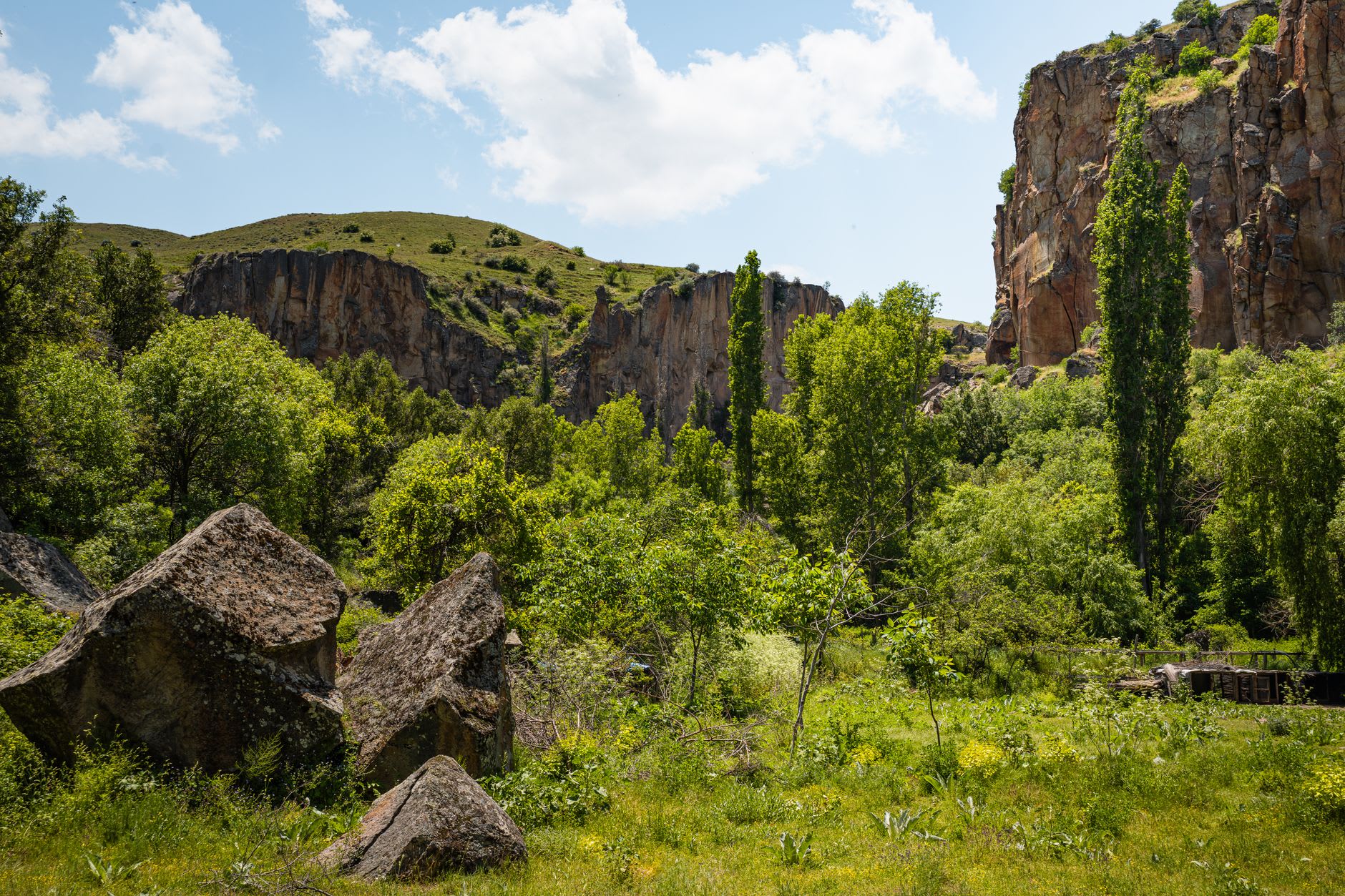
The churches have names that the guidebooks translate in various ways: the Church of the Crooked Stone, the Church Under the Tree, the Serpent Church. They were carved between roughly the ninth and thirteenth centuries, largely by Armenian and Greek Christian communities who used the gorge for its natural defensibility. I sat in one for a long time — a small chapel with a low ceiling and benches cut from the rock — and thought about what it meant to build a place of worship inside the earth itself. The rock was cool and dry. Outside, the river made a continuous sound that was completely neutral about human history.

At the midpoint, the village of Belisırma sits at the edge of the river with a collection of garden restaurants extending wooden platforms over the water. I stopped for trout — which comes from local river farms — grilled simply with lemon, and ate it with bread and ayran while watching the current move below my feet. Two ducks navigated around a submerged rock with a pragmatism I admired.
When to go: Spring (April to June) is the best time — the river is full, the vegetation is green, and the light inside the gorge is warm without the summer heat. October is also excellent. The hike is doable year-round but heavy rain can make the riverside path muddy and some sections impassable. Start at the northern (Ihlara village) entrance and walk toward Selime for the best sequence of churches.