Muizenberg
"Every surfer in Cape Town learned to stand up at Muizenberg. Most of them are happy to admit it."
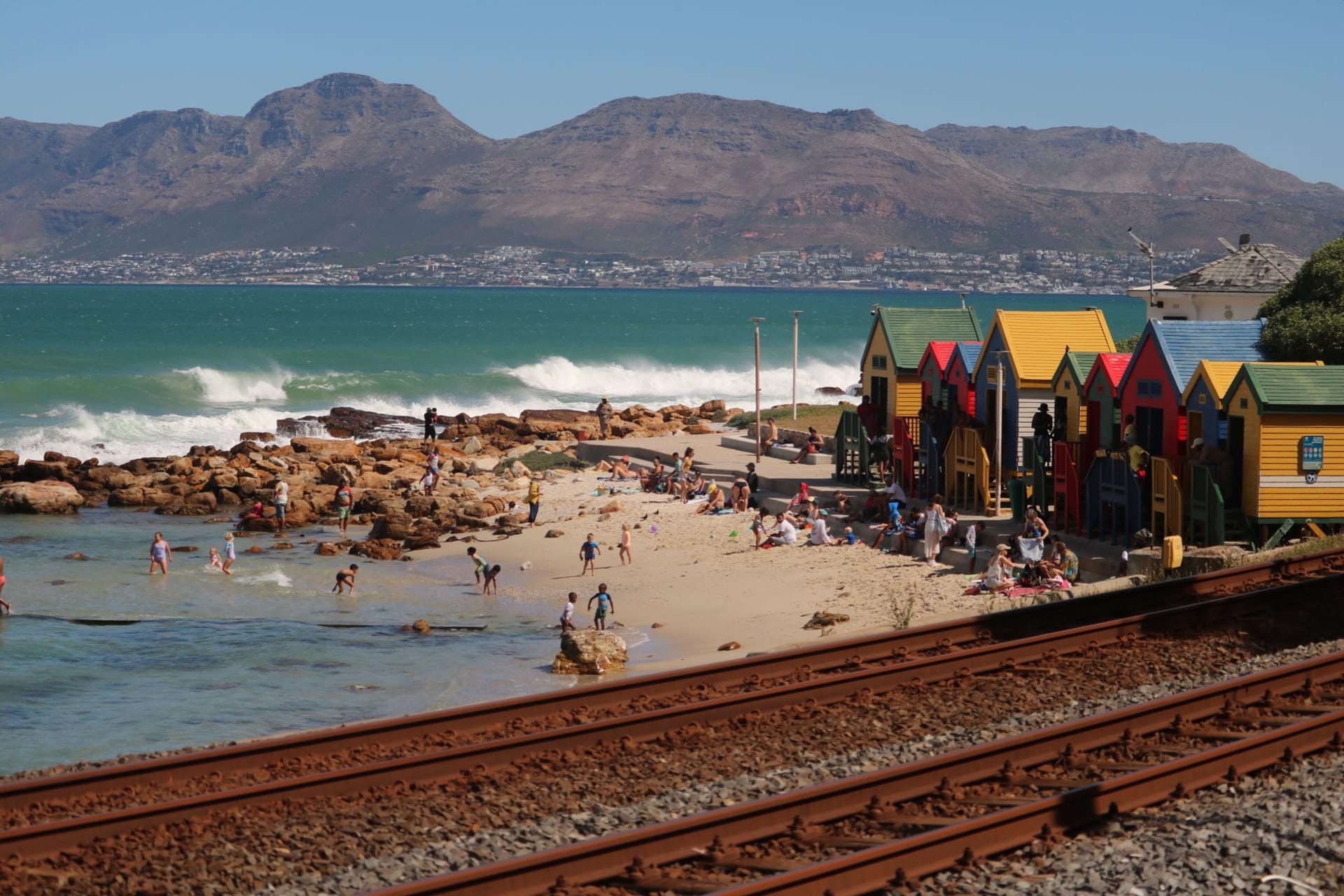
The bathing boxes are the first thing — a row of wooden huts painted in stripes of red, yellow, blue, green, arranged along the beachfront in a sequence that looks too cheerful to be accidental. They date from the Victorian era, these changing rooms, built for bathers who came from Cape Town by train and needed somewhere to change before entering the water with the appropriate modesty of the period. They’ve been repainted and maintained as heritage structures, and they’ve become the image of Muizenberg that appears on every travel photograph: bright horizontals against the white sand and the mountain behind.
I came to Muizenberg for the first time on the train, arriving at a station that opens directly onto the beach road. It was a November morning and the surf was chest-high and the beach was already occupied by several dozen learner surfers in various stages of difficulty, their instructors holding the backs of boards, shouting encouragement. Muizenberg’s waves are famous for this: they break gently, they roll long and predictable, and they are, by the consensus of surf schools from Cape Town to Kommetjie, the best place in the Western Cape to learn to stand up for the first time.

The town behind the beach has a different energy from the rest of the Peninsula’s villages — younger, more creative, slightly scruffy in the way of neighborhoods that haven’t been fully gentrified and are more interesting for it. The main street runs parallel to the beachfront and carries independent cafes, second-hand record shops, a surf heritage museum devoted to South African surfing history, and the kind of small businesses that appear in places where the rent hasn’t yet caught up to the appeal. Surfer’s Corner — the informal gathering point at the beach end of the main street — is where everyone converges before and after sessions, boards under arms, wetsuits unzipped to the waist, talking about the next swell.

The mountain behind the town — Muizenberg Peak, rising above the suburb of Boyes Drive — gives access to a ridge path that looks down on the entire curve of False Bay, from the Strand in the northeast to Cape Point in the south. I walked a section of this in the late afternoon and came to a point where the bay was laid out entirely below me, the light going flat gold on the water, and a paraglider drifted past at about the same altitude. Neither of us spoke, which seemed appropriate.
Historically, Muizenberg has its own gravity: the Battle of Muizenberg in 1795 was where the British took the Cape Colony from the Dutch Batavian Republic, a pivot point in the history that followed. There’s a small monument near the beach road. The beach continues regardless, and the morning surfers paddle out past it without thinking about any of this.
When to go: September to April for surf lessons — the water is at its warmest in False Bay through summer, and the consistent small swells make the beach reliable for beginners. The bathing boxes are photographed year-round but look most spectacular in clean morning light. Winter brings the surf to new levels of quality and the crowds down to almost nothing — the serious surfers arrive and the visitors disappear, and it becomes the best possible version of itself.