
La Palma
"La Palma goes straight up from the sea and keeps going until you hit the stars — and the stars here are genuinely unreasonable."
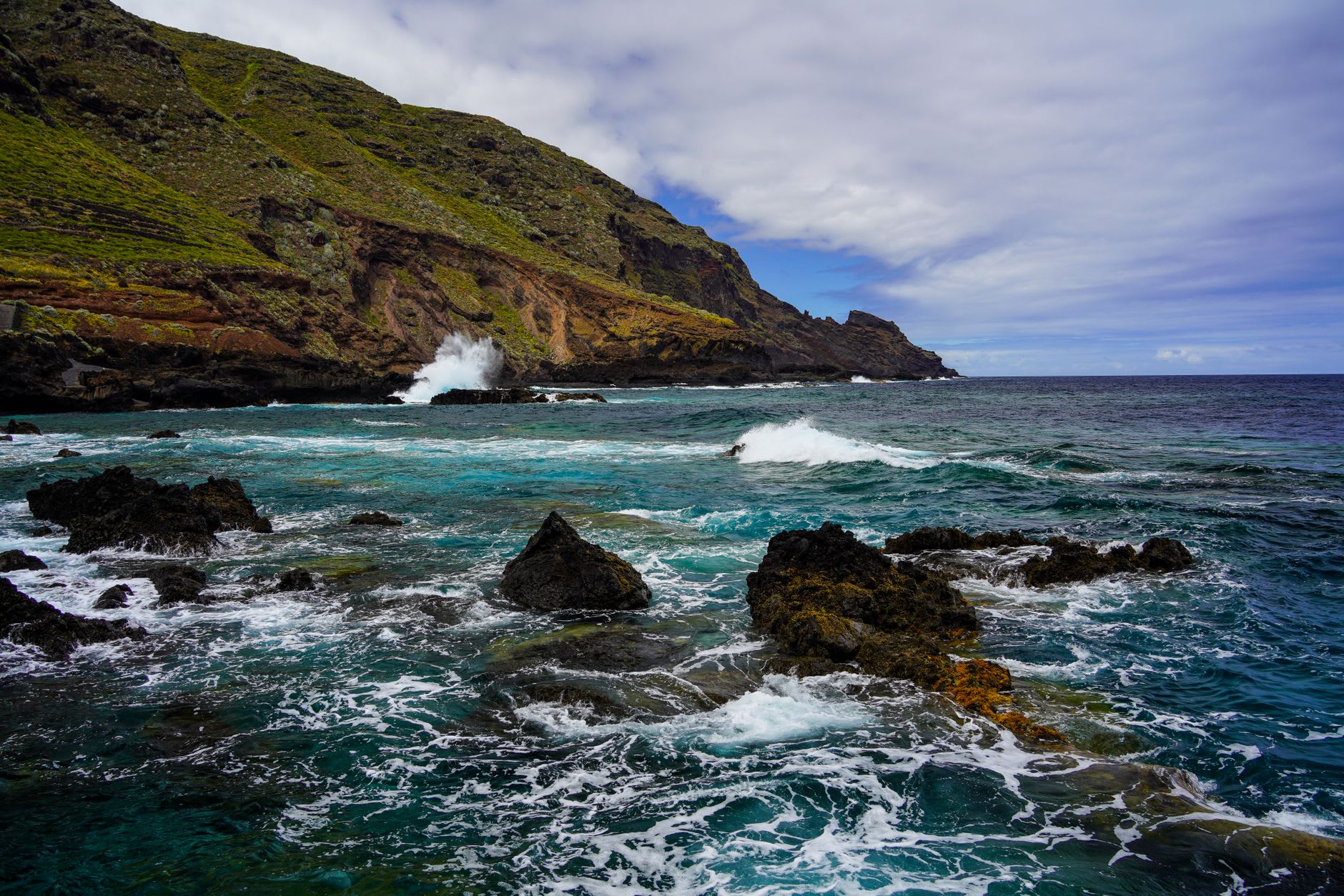
The ferry from Tenerife approaches La Palma from the south, and the island introduces itself in the most direct way possible: a wall of dark green cliffs rising from the ocean, no coastal flatlands, no gentle slope up from the shore, just mountain from the waterline. La Palma is the steepest island in the world relative to its base, a geological fact that explains everything about how it feels to be there — the compressed microclimates, the way you gain altitude so fast that your ears pop on the road out of Santa Cruz, the sense of verticality that never entirely leaves you.
I spent most of my time in the Caldera de Taburiente, a circular depression nine kilometres across and nearly two thousand meters deep, formed not by a volcanic collapse but by erosion over millions of years of the island’s steep interior. National Park status protects it, and camping inside the caldera is permitted at the Playa de Taburiente campsite — a sandy flat beside the river that drains the caldera floor. I hiked in from the rim, a descent of about 1,200 meters through pine forest and then laurisilva and then the bottom, where the river ran clear and cold over red volcanic rocks and the walls of the caldera rose on all sides like a cathedral that had forgotten to put on a roof.
The capital Santa Cruz de la Palma is one of the least-visited capitals in the Canaries and arguably the most architecturally coherent: a compact colonial port with a seafront promenade, a clutch of Renaissance-era churches, and a street — Calle O’Daly, named for an Irish merchant who set up here in the 1700s — lined with colonial houses that have barely changed since the seventeenth century. I ate at a bar on the port where the owner brought me a glass of local ron miel — honey rum — without being asked, then asked where I was from, then gave me a second glass when I said France.
The top of the island, the Roque de los Muchachos at 2,426 meters, hosts the Observatorio del Roque de los Muchachos, one of the world’s best optical astronomy sites. The skies above La Palma are protected by law — street lighting is regulated, advertising neon is banned, windows must be covered — which means the night sky here is among the darkest in the northern hemisphere. I drove up at midnight on a moonless night with no expectations and found myself standing in a parking lot looking straight into the Milky Way as a physical structure above me, not a smear of light but an actual depth of stars that went further back than I could process. I stayed for two hours. I lost track of which direction I was facing. Both of those things felt correct.
In 2021 the Cumbre Vieja volcano erupted in the south of the island, covering a significant area in new lava and displacing thousands of residents. The lava field is still raw and black and extraordinary when you stand at its edge — new earth, cooling, a landscape that didn’t exist five years ago. The communities affected are rebuilding. The island is not done with its own story.
When to go: March through May is outstanding: wildflowers on the caldera rim, clear nights for stargazing, no crowds. Winter brings cloud and rain to the north but clear skies over the summit. Avoid the August peak when the island fills with Peninsular Spanish visitors.