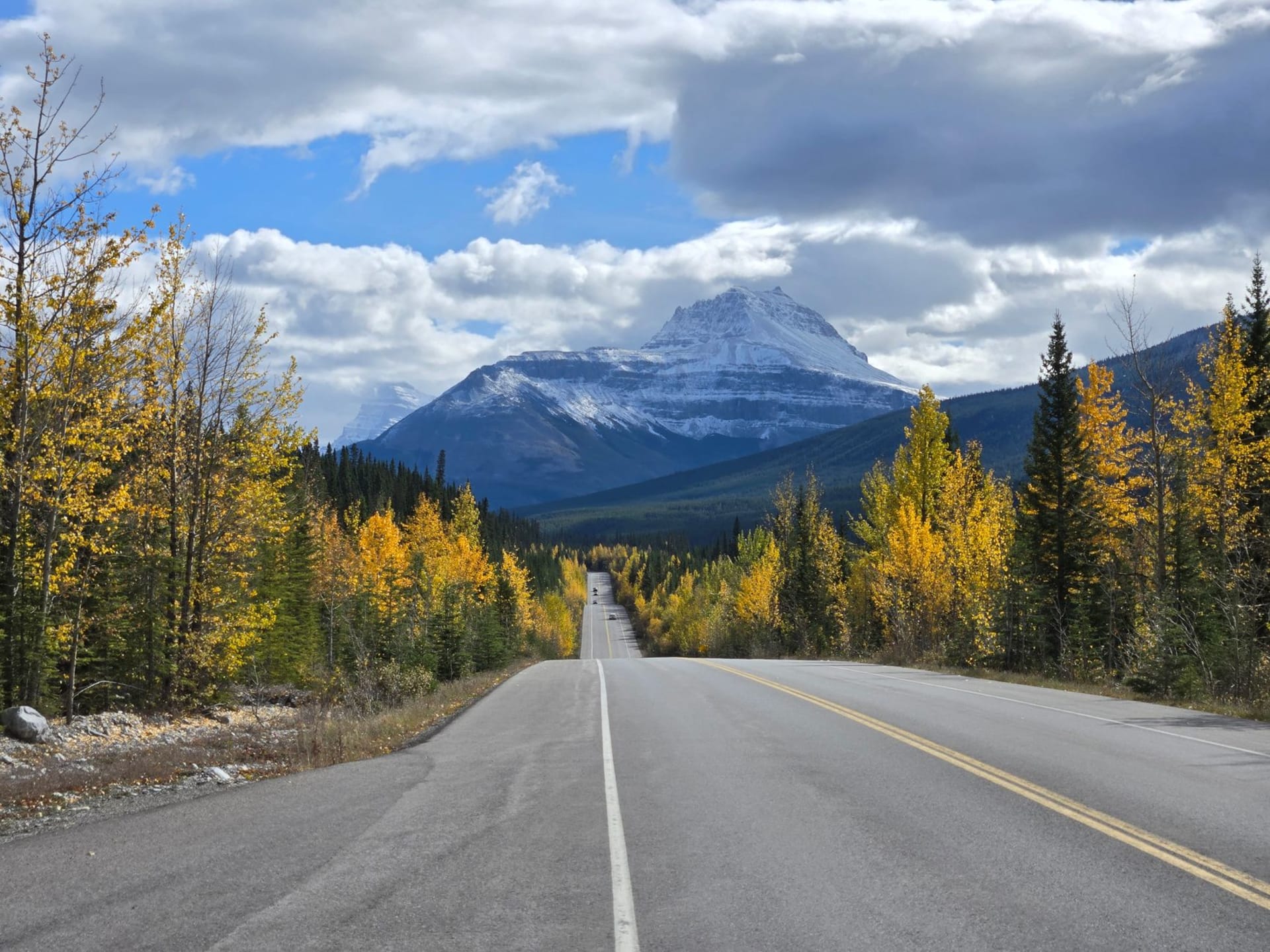
Icefields Parkway
"I planned to drive it in four hours. It took eight, and I skipped half the stops."
There is no sensible way to drive the Icefields Parkway without stopping constantly. I tried once, in my first hour, and gave up somewhere around Bow Lake when a scene so completely unruly in its beauty appeared that I simply left the car in the middle of the shoulder and stood there until it passed. It hadn’t passed. It had become something else. That is the rhythm of this road: you commit to moving, something extraordinary appears, you stop, you think you’ve seen it, you drive on, and something else extraordinary appears within ten minutes. Repeat for 230 kilometres.

The road runs between Banff and Jasper, north to south, through a corridor of national park that has been essentially untouched since the glaciers retreated. The first notable stop heading north is Bow Lake — a wide, shallow body of blue-green fed by the Bow Glacier above, with Num-Ti-Jah Lodge on the shore, a place that has been accepting guests since the 1920s and that smells of pine smoke and wool and old wood. Peyto Lake comes after, reached by a short uphill walk to a viewpoint where the wolf-shaped lake appears below — turquoise shading to cobalt toward the far end, ringed by dense spruce forest, mountains closing it in on three sides. I have photographs of Peyto Lake that I genuinely cannot stop looking at, and I took them with my phone.
Athabasca Falls appears without warning south of Jasper — not tall, as waterfalls go, but violent. The Athabasca River narrows into a slot of pale grey quartzite and crashes through with the force of something that doesn’t tolerate hesitation. The spray reaches the railings and in cold weather freezes into elaborate formations on the rocks. I watched the whole performance from the bridge at eye level with the water and felt the mist on my face and decided that “not particularly tall” was doing a lot of work to diminish something genuinely frightening.

The parkway in September smells of cold air and pine and something indefinably glacial — a mineral cleanness that has no city equivalent. The light at that time of year comes at a low angle all day, and the golden larches at elevation catch it in a way that makes the valleys glow. I drove the road both north-south and south-north on successive days and found them different enough that both were worth doing — the light changes, the shadows fall on different faces of the same peaks, and things you missed one way reveal themselves the other.
When to go: Late June through October when the road is fully open. September is the canonical answer — larch season, clear skies, dramatically reduced traffic, and the cold making everything sharper. The full road is sometimes closed in winter between snowstorms; drive it then only with proper tires and awareness. Allow a full day minimum. Two days if you plan to stop anywhere properly.