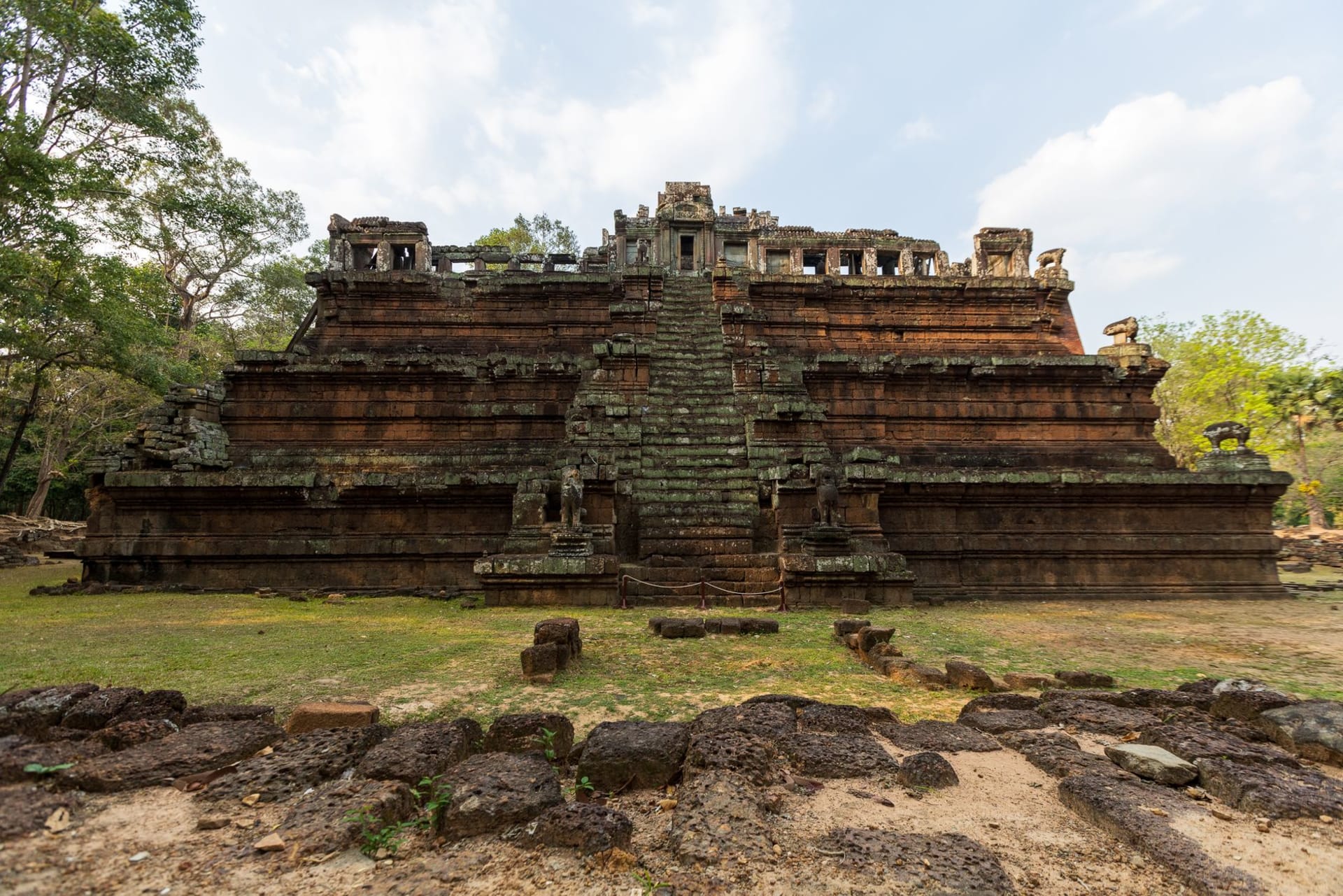
Koh Ker
"I climbed a thousand-year-old pyramid in total silence, and the only thing watching me from the top was a hornbill."
Two and a half hours northeast of Siem Reap, past the point where the tour buses turn around, the road runs out into a quiet province of dry forest and red dust, and there sits one of the strangest ruins in Cambodia. For a brief, frantic twenty years in the tenth century, Koh Ker — not Angkor — was the capital of the Khmer empire, the seat of a king named Jayavarman IV who decided, for reasons lost to history, to move the whole apparatus of state out here into the middle of nowhere and build at maniacal speed. Then it was abandoned almost as quickly, and the jungle moved back in for a thousand years. It only became fully safe to visit relatively recently; the area was mined during the war years, and you still stick to the cleared paths.
The pyramid in the forest
The centrepiece is Prasat Thom, and it does not look like the rest of Angkor at all. Instead of the spreading horizontal galleries of Angkor Wat, it is a steep seven-tiered sandstone pyramid, thirty-six metres tall, rising in sharp stepped terraces straight out of the forest floor. The first time it appears through the trees, I genuinely thought of Tikal or Chichén Itzá rather than anything Khmer. A modern wooden staircase has been bolted to one side, and you climb it to a flat summit that once held an enormous lingam and now holds nothing but wind, a few scattered stones, and a 360-degree view over an unbroken green canopy that stretches, flat and silent, to every horizon.

Lia and I had the entire summit to ourselves for forty minutes. After the careful crowds of Angkor, where you queue to photograph the sunrise alongside three thousand other people, the emptiness here is almost shocking. The only sound was the dry rattle of leaves and, at one point, the unmistakable heavy whoosh of a great hornbill flying across the clearing below us. I have rarely felt the actual age of a place so physically — a thousand years of abandonment pressing down out of the silence.
The scattered prasats and the looting
Koh Ker was a complex of over thirty temples, and the smaller ones are scattered through the forest along a loop you can walk or drive between. Many are collapsed into spectacular heaps of tumbled blocks strangled by strangler figs, the stone and the wood now fused into a single organism. Prasat Pram, near the entrance, is the photogenic one — a tower being slowly eaten alive by a tree, its roots flowing over the lintels like wax. There is also a darker history here: Koh Ker was heavily looted during the chaotic decades, and several of its most famous sculptures ended up in foreign museums and private collections. Some have only recently been repatriated, and the empty pedestals where they once stood are a quiet, pointed reminder.

It was inscribed as a UNESCO World Heritage Site in 2023, which will inevitably bring more visitors, so go now if you can stand the drive. The road from Siem Reap is good for the first half and then ordinary; most people combine it with the river-carving site of Kbal Spean or the great temple of Beng Mealea in a long day trip.
When to go
The dry season, November to March, is far the best — the forest tracks turn to soup in the rains and the heat in April is punishing. Leave Siem Reap early to beat both the midday sun and the few minibuses that arrive around eleven. Bring water, a hat, and proper shoes for the pyramid steps, and stay strictly on marked paths in the outer areas.