
Mendocino
"Mendocino looks like someone airlifted a New England fishing village to a California headland and decided the joke had gone far enough."
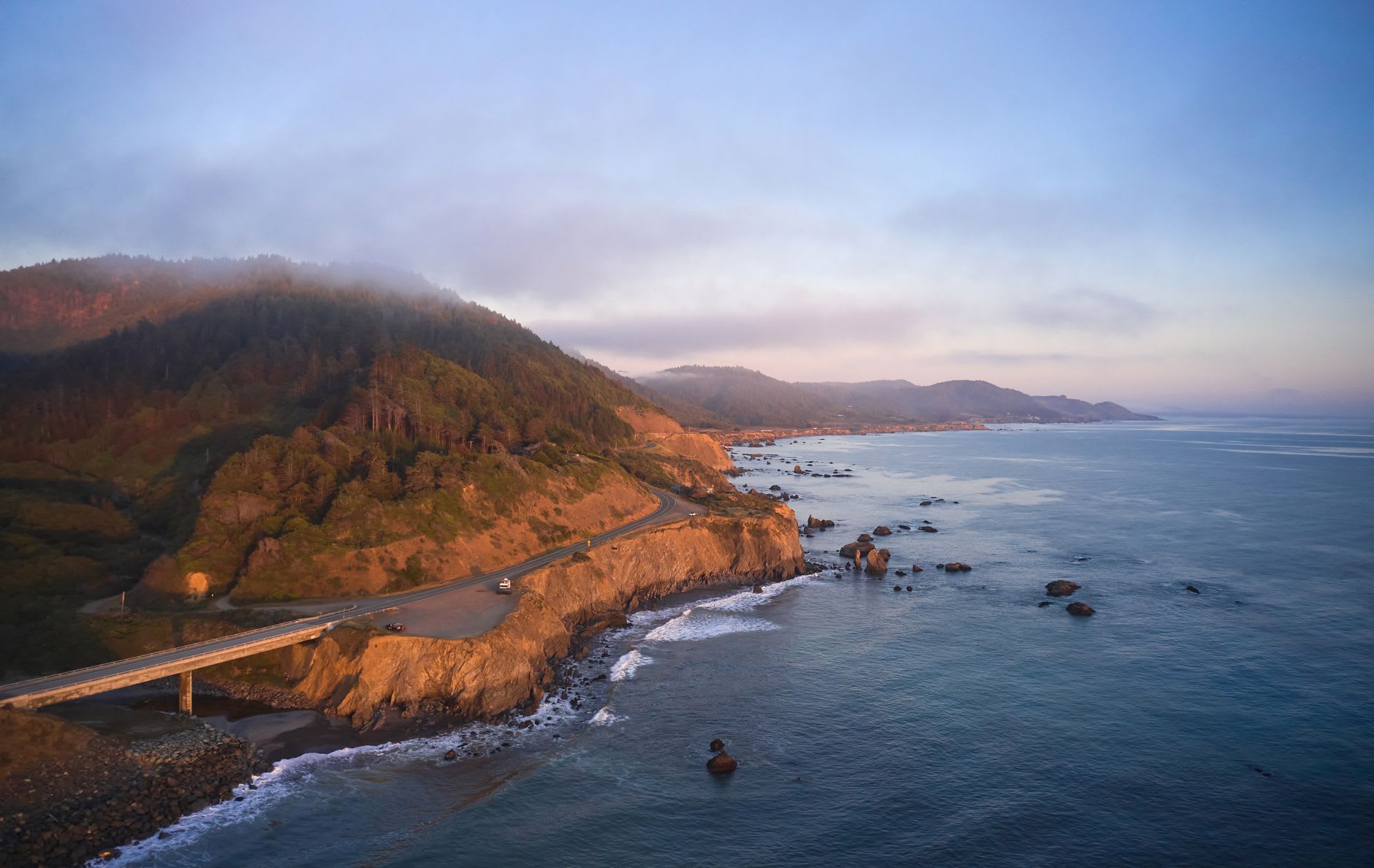
Highway 1 north of San Francisco takes a long time to become Mendocino — about three hours of two-lane road through the Marin headlands and Bodega Bay and Sea Ranch, the ocean appearing and vanishing behind the coastal hills, the redwoods beginning to crowd in as you get north of Jenner. I arrived in Mendocino in the late afternoon when the sun had just dropped behind the marine layer and the whole town was lit in that grey-pink quality that happens on the coast when the direct light is gone but the sky still has colour. The white clapboard buildings on the bluff came into view first, their windows starting to glow orange, and I stopped the car on a pullout to look at them and the sea stacks below and the surf throwing itself against the rocks. There was nowhere I needed to be.
Mendocino was a logging town in the nineteenth century, then a forgotten town, then discovered by artists in the 1950s and 1960s who found the cheap rents and the extraordinary coastal light conducive to working. The buildings they moved into — the water towers, the shotgun churches, the Victorian cottages — are still there, unchanged in the way that towns can be when they are too far from a city to attract the kind of investment that changes things. The main street has galleries and bookshops and a wine bar and a good bakery that opens at seven-thirty and smells of dark bread. By noon on a weekday in November, I could count the people on Main Street on my hands. The fog was coming in off the water.
The headland park that juts north of the village lets you walk out above the sea stacks and look back at the town from the water side. The sea stacks here are dramatic — isolated columns of rock severed from the headland by centuries of undercutting, some of them pierced by blowholes that send columns of spray up in a heavy swell. The bluff is covered with iceplant and a low coastal scrub that smells of salt and iodine. I walked the loop in light drizzle and didn’t mind. There’s a kind of cold-and-damp that the coast of Northern California does that is atmospheric rather than miserable, particularly when you know there’s a fire somewhere at the end of it.

The restaurants in Mendocino are better than the size of the town suggests they should be. This is a place that has attracted a particular kind of person who takes food seriously — the farmers’ market tradition of Northern California, the wine from the Anderson Valley just inland, the Dungeness crab brought in at Fort Bragg to the north. I ate oysters one evening at a restaurant on the bluff that had seven tables and a view of the ocean turning black and a wine list made exclusively from Mendocino and Anderson Valley vineyards. The oysters were from Tomales Bay to the south. I ate eight of them with mignonette and a glass of Alsatian-style Pinot Gris grown twenty miles inland.
When to go: September and October for warmth and clear light. Spring is green and wet and wildflower-covered. The town’s peculiar melancholy is most itself in winter — fewer visitors, more fog, the bookshops more inhabited, the fires in the restaurant hearths more necessary. Avoid summer weekends when the Bay Area pours north and the accommodation fills three months in advance.