Americas
California
"Nothing prepares you for the moment Big Sur actually opens up in front of you."
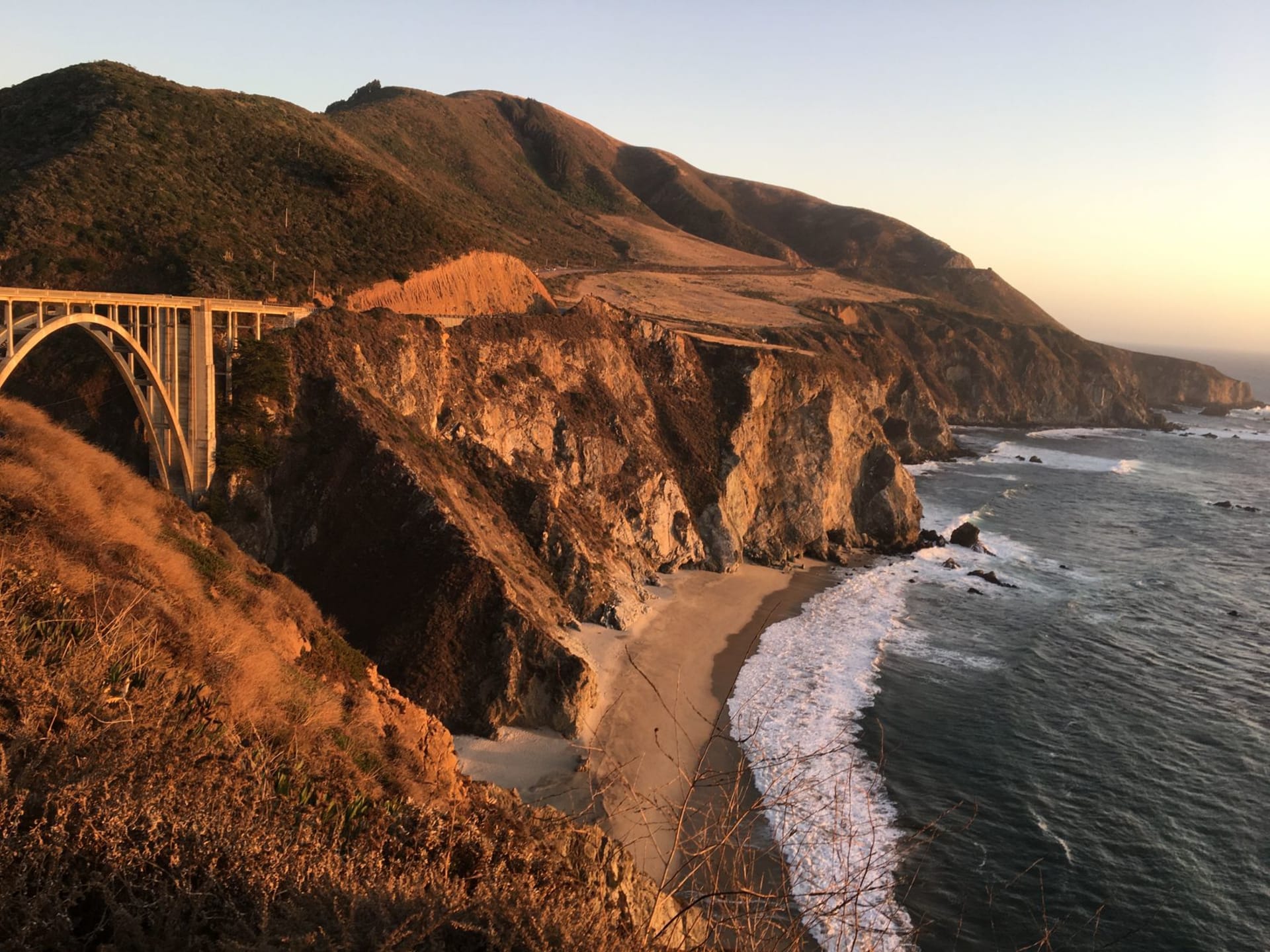
I drove into California from Mexico on a Tuesday morning, crossing the border at Tecate with a thermos of coffee and no particular plan. By the time I reached Highway 1 north of San Simeon, the road had narrowed to a single thread of asphalt stitched along cliffs five hundred feet above the Pacific, and I understood immediately why people talk about Big Sur the way they do. It is not a place you can summarize. The light changes every twenty minutes — marine layer burning off at noon, then flooding back at four, then that brutal golden hour at six when the whole coast turns the color of old copper. I pulled over at every turnout and still felt like I was missing something.
California makes no sense geographically and total sense culturally. In a single day on a diagonal drive from Death Valley to the Mendocino coast you cross desert playa, the agricultural flatlands of the Central Valley, the wine country of Sonoma, and finally those coastal headlands where Bishop pines grow sideways from the prevailing wind. The cities are equally discontinuous. Los Angeles is a hundred neighborhoods that never quite agreed to become a metropolis — Silver Lake and Boyle Heights and Leimert Park each feel more distinct from each other than most European capitals feel from their suburbs. San Francisco is a city built on hills so steep the municipal buses struggle on them, and the fog that rolls through the Golden Gate every afternoon turns the whole peninsula silver-grey and intimate in a way that no photograph has ever captured correctly. Sacramento is agricultural California made urban, quieter and hotter and more honest than either coastal city.
The food is the thing I come back to. Californian cuisine in the sense of Alice Waters and Chez Panisse and the farmers’ market religion that spread from Berkeley to the rest of the world — that is genuinely one of the most important culinary ideas of the last fifty years. But the food that matters to me on the ground is different: the Korean barbecue strips of Koreatown on Olympic Boulevard at midnight, a breakfast burrito from a Salvadoran truck in the parking lot of a Home Depot in Oxnard, a bowl of tonkotsu ramen in the San Gabriel Valley at a counter with no English menu, fresh Dungeness crab on a plastic tray at a seafood shack in Bodega Bay. California’s kitchens absorb the whole Pacific Rim and the whole of Latin America and turn it into something that belongs entirely to here.
When to go: September and October are California’s best-kept secret — crowds thin after Labor Day, fog retreats from the coast, and the Central Valley light turns golden. Spring (March to May) is green and mild everywhere. Summer works for the Sierra Nevada and the desert evenings but avoid coastal fog disappointment in June along the central coast.
What most guides get wrong: They treat California as a road trip you can knock out in two weeks. You cannot. The state is larger than most countries, and the distances are real even when Google Maps makes them look manageable. Plan around one or two regions properly rather than driving yourself exhausted chasing everything — the person who spends four days on the Lost Coast sees more of California than the one who drives LA to San Francisco to Yosemite in ten days, stopping only for gas.