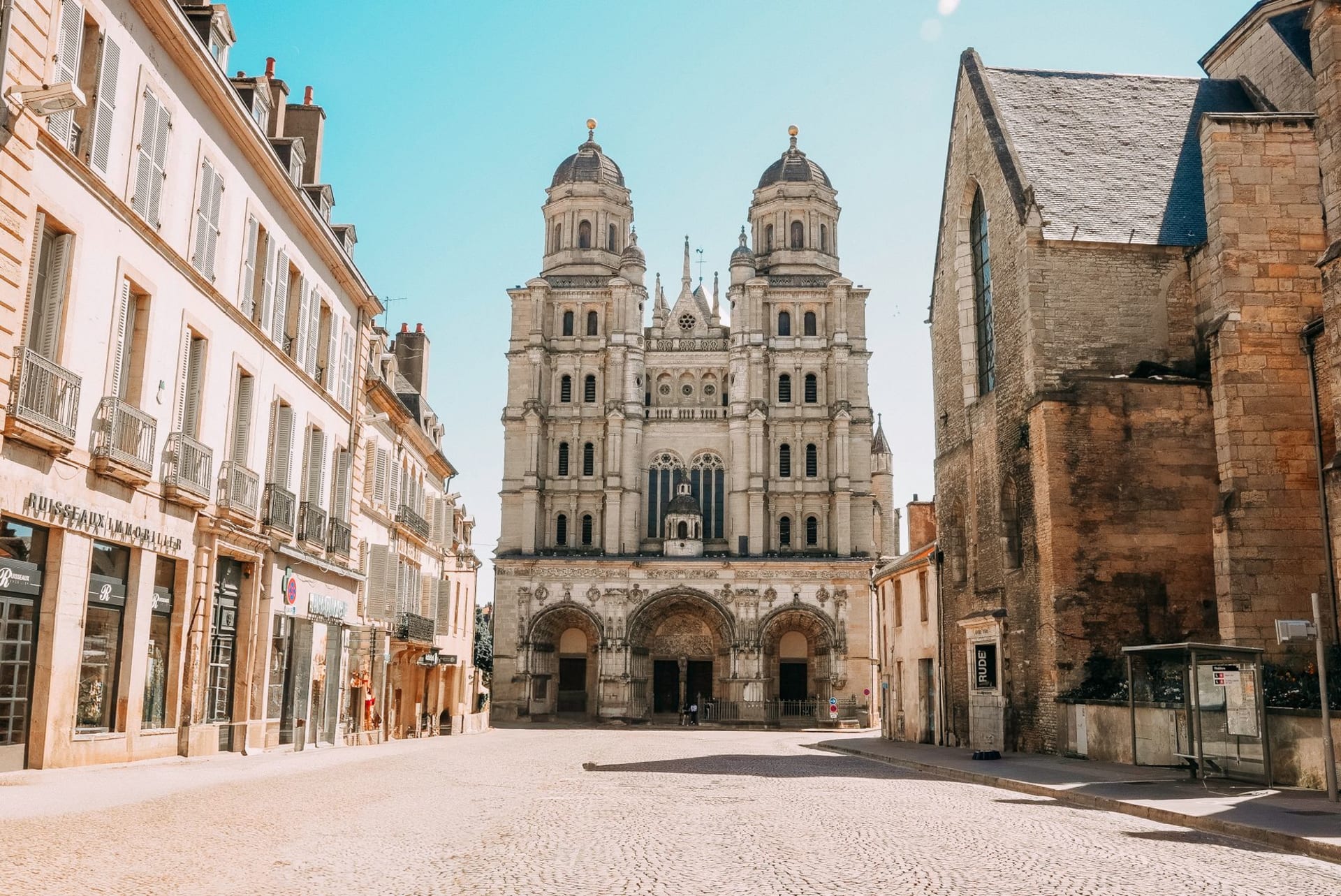
Vézelay
"I am not religious, but the light inside that basilica on a June morning rearranged something in me."
Vézelay is an uphill walk, which is appropriate for a place of pilgrimage. The village is strung along a single main street that rises steeply to the basilica, and on a summer morning the street is full of tourists and pilgrims and the odd cyclist — Vézelay is one of the four traditional departure points for the Camino de Santiago. I arrived early, before the morning tour buses, and walked up through the silence of the stone houses, past a cat on a windowsill, past a boulangerie just opening its shutters, the bread smell reaching the street before the door did.
The Basilica of Sainte-Marie-Madeleine sits at the top with the solid confidence of a building that has survived Viking raids, religious wars, neglect, and over-zealous nineteenth-century restoration by Viollet-le-Duc. Inside, the nave is long and barrel-vaulted, the columns carved with capitals depicting biblical scenes and monsters and human figures caught in strange poses — theologians spend careers cataloging these capitals, and the variety of them keeps you moving slowly, head tilted back. What stopped me, though, was not the sculpture but the light. The windows at Vézelay are plain glass, not stained. The stones are warm cream and pale gold. On a clear morning the light that comes through the upper windows is extraordinary — it falls at angles that seem almost orchestrated, illuminating one section of nave at a time. The effect is not mystical if you don’t want it to be. It is simply beautiful.

Bernard of Clairvaux preached the Second Crusade here in 1146. Thomas Becket took refuge here. Richard the Lionheart and Philip II of France met here to launch the Third Crusade. The weight of medieval European history in this small hilltop building is genuinely disorienting — Vézelay was, for several centuries, among the most significant pilgrimage destinations in Christendom, the relics of Mary Magdalene drawing hundreds of thousands of pilgrims a year. The relics were eventually disputed, the pilgrimage traffic moved to Saint-Maximin in Provence, and Vézelay began a long decline that left it, paradoxically, wonderfully intact. The crowds never got so large that the village needed to be rebuilt around them.
The view from the terrace beside the basilica looks out over the Morvan — the quiet, forested plateau that occupies the western part of Burgundy, a landscape completely different from the wine hillsides of the Côte d’Or. The Morvan is dark green and slightly melancholy, full of lakes and beech forests, and the view of it from Vézelay suggests a Burgundy that most wine tourists never find. I drove into it that afternoon and spent two hours on empty roads with no destination in particular.

The village has three or four good restaurants and a disproportionate number of artisan shops — potters, woodworkers, a bookshop that smells correctly of old paper. Romain Rolland lived here. Marc Chagall is buried in the village below. The cultural density per square meter is unusual for somewhere this small.
When to go: June 21, the summer solstice, is famous at Vézelay — the sun rises in perfect alignment with the nave axis, illuminating a series of medallions in the floor. It is documented, if not entirely predictable. Beyond that spectacle, May through September is beautiful. Avoid peak July and August if you want the basilica in reasonable quiet; a Tuesday morning in early June approaches perfect.