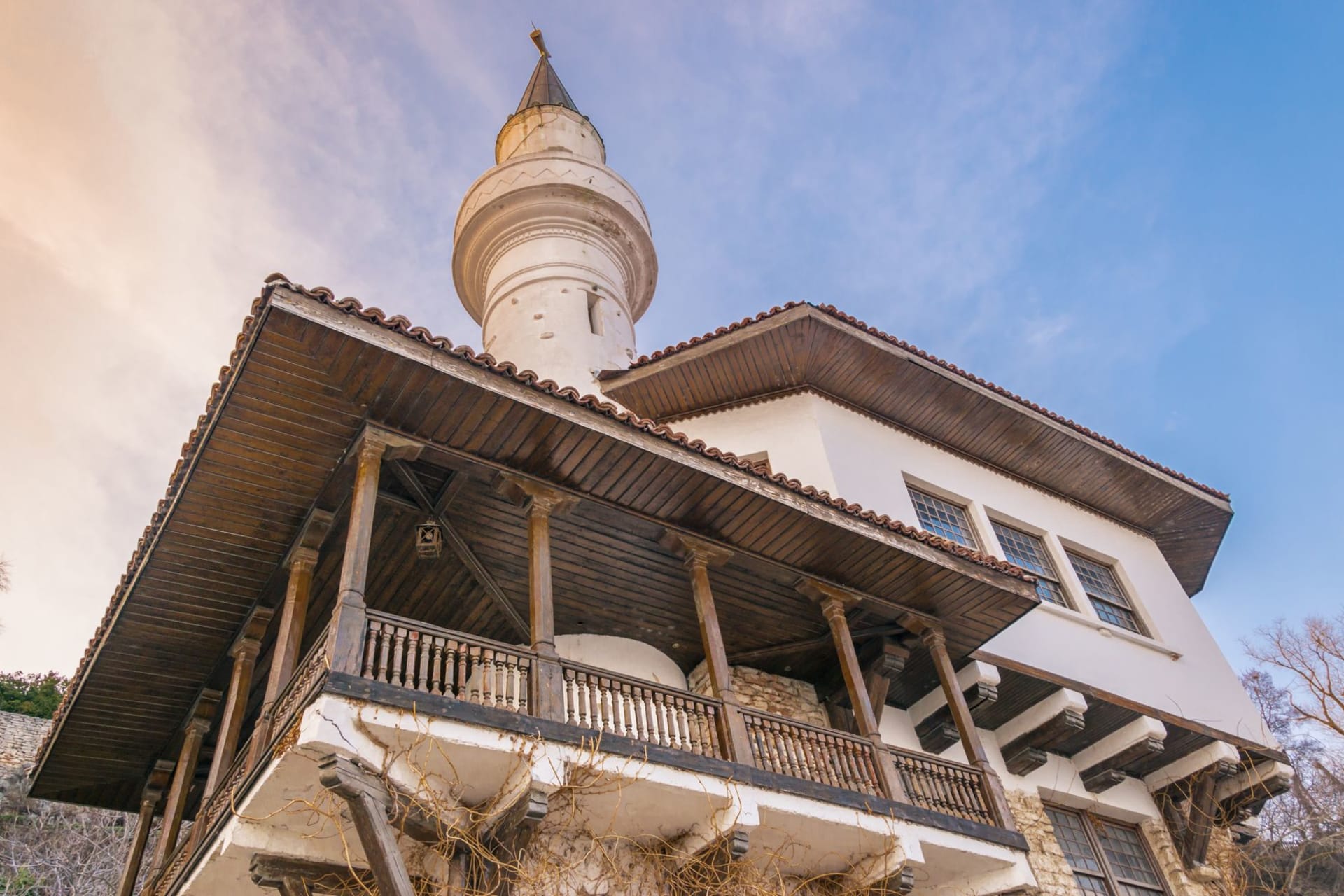
Varna
"The largest Roman baths in Bulgaria are just sitting in the middle of the city, and most people walk past them to get to the beach."
I’d been told Varna was a party town — Black Sea nightlife, beach resorts, Bulgarian stag weekends. That’s all true. But I arrived on a Tuesday morning in late September and found something else: a city that has been continuously inhabited since roughly 4500 BCE and still doesn’t quite know what to do with all the history it keeps turning up.
The Thermae and the Streets Around Them
The Roman thermae are the first thing I noticed because they’re impossible to miss — a five-story ruin of Roman brick rising from a city block in the center of town, with a palmtree growing inside one of the collapsed chambers. They were built in the second or third century AD and abandoned sometime in the fourth, which means they’ve been a ruin longer than Rome has been a city. You can walk around them for free and get into the accessible interior for a few leva. The scale is startling. This was not a small outpost.
The streets around them are the lived-in part of Varna: open-air restaurants with plastic chairs, Orthodox churches with their candle smoke drifting into the street, old Bulgarian women selling sunflower seeds in paper cones. I ate grilled fish three times in two days because every restaurant within two blocks of the water offered something that had been pulled from the Black Sea that morning.
The Archaeological Museum and the Gold
You can’t skip the Archaeological Museum, and not because of the collection broadly — because of one room specifically. In 1972, construction workers outside Varna dug up the world’s oldest known gold artifacts: a hoard from a Chalcolithic necropolis dated to around 4500 BCE. The pieces are on display here, behind glass, without the interpretive fanfare they’d get at the Louvre. A golden bull’s head. Pins and beads and pendants that have survived five and a half thousand years. The room is quiet. Other visitors passed through quickly. I stayed until a guard made eyes at me about closing time.
The rest of the museum is worth the additional hour — Thracian bronzes, Byzantine icons, medieval jewelry — but the gold hoard alone justifies the trip to this city.
The Sea Garden and the Waterfront
The Morska Gradina — Sea Garden — runs along the top of the cliffs above the beach, about eight kilometers of formal paths, flower beds, and old wooden benches with views over the water. In September it smells of late-season roses and the salt wind from the north. The Acquarium is at the southern end, a Soviet-era building that doesn’t disappoint in the specific way Soviet-era aquariums never do: dim lights, ancient tanks, fish you’ve never heard of labeled in Bulgarian only.
Below the garden, the beach itself stretches wide and clean. After the summer crowds clear, the sand is almost empty. I swam in water that was warm enough to stay in for forty minutes and watched a container ship make its slow way toward the horizon.
The Evening Cathedral
Before leaving, I walked through the Cathedral of the Assumption of the Virgin, the largest church in Bulgaria after Alexander Nevsky in Sofia. The interior is tall and gold and empty in the mid-afternoon — the kind of space where sound disappears before it can reach the ceiling. I sat in the back for a while and watched the candle light.
When to go: September is optimal — the sea is still warm from summer, the beach resorts have emptied, and the city returns to itself. Early June works too, before the peak arrives. Avoid July and August unless you want the full resort experience, which is perfectly valid but a different trip entirely.