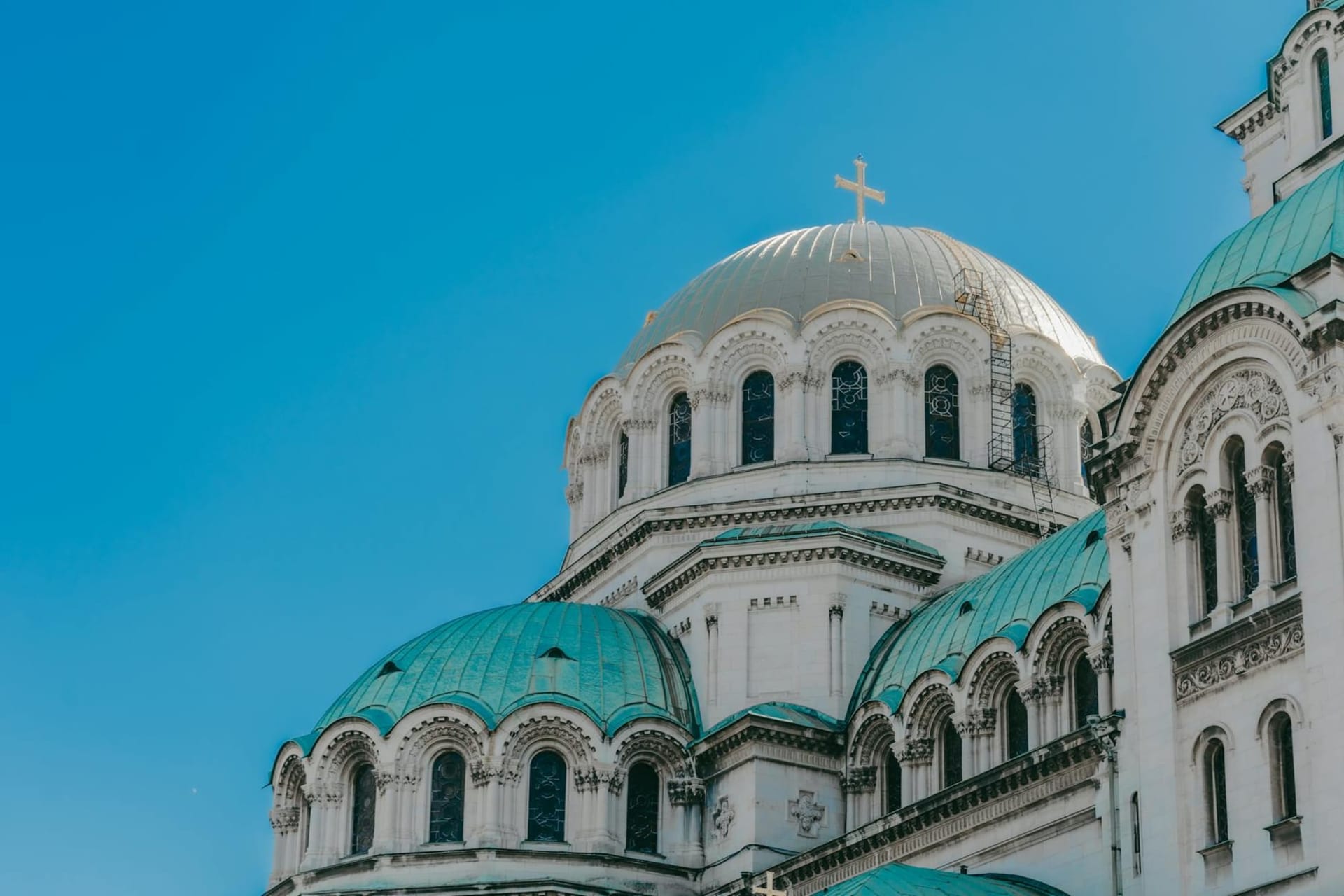
Eastern Europe's most underrated capital layers Roman ruins beneath Orthodox churches and Soviet-era grandeur, all at bargain prices.
I arrived in Sofia on a grey November morning and walked out of Serdika metro station directly onto a Roman street. Not a reconstruction, not a museum — an actual Roman street, a grid of worn stones pressed under glass panels in the station floor, pedestrians streaming past without glancing down. That indifference was the city’s first gift to me.
Layers Underfoot
Sofia has this quality of radical historical compression. On Vitosha Boulevard, the city’s main artery, you pass a Stalinist ministry building and then, thirty steps later, the red-brick curve of the Rotunda of St. George, a fourth-century church the size of a living room, tucked into the courtyard of a Soviet-era hotel like a forgotten thought. Lia stopped in front of it and wouldn’t move for a long time. The frescoes inside — layered across centuries, one painted over another — felt like a literal stratigraphy of faith.
The morning light in Sofia does something particular. It comes in low and lateral off the Vitosha mountain that anchors the city’s southern edge, and it makes everything look provisional, like the city is still deciding what it wants to be. I loved it for that.
What to Eat and Where to Sit
Breakfast was always banitsa — the flaky, feta-stuffed pastry pulled hot from a roadside stand on Graf Ignatiev Street — eaten standing, burning the roof of my mouth, washing it down with boza, the fermented grain drink that tastes like liquid bread. It is an acquired taste I acquired in about twenty minutes.
Lunch meant the covered market at the Women’s Market, Женски пазар, where stalls sold pickled peppers by the jar and shopkeepers argued at a volume that suggested genuine crisis but was probably just commerce. I bought a paper cone of roasted sunflower seeds and ate them on a bench, watching pigeons navigate the puddles with tremendous dignity.
The Surprise
I had not expected the mineral baths. The old Central Mineral Baths building near Banski Square — a yellow confection of Viennese Secession architecture — sits derelict and magnificent, scaffolded but barely touched. Beside it, free public mineral-water fountains run all day. Old men line up with plastic jugs. I filled my water bottle and drank sulfurous, hot, genuinely strange water in the October cold, and felt, for no reason I could name, completely at peace.
When to go: April through June for mild temperatures and blooming chestnut trees along Tsar Osvoboditel Boulevard, or September when the summer crowds are gone and the light on Vitosha turns amber by four in the afternoon.