Pont-Aven
"Fourteen mills and fifteen houses, the old rhyme goes. I counted neither and ate four biscuits."
There is an old Breton saying about Pont-Aven: quatorze moulins et quinze maisons — fourteen mills and fifteen houses — which is the kind of self-deprecating arithmetic that makes you like a place before you have parked. The town sits where the river Aven drops out of the wooded hills toward the sea, tumbling over a chaos of granite boulders that once turned the wheels of all those mills. Lia and I arrived mid-morning to find the river doing its noisy work right through the middle of town, and the smell of butter coming out of every second doorway, because the other thing Pont-Aven is famous for is biscuits, and I refuse to pretend that ranks below the painting.
Where Gauguin went flat
In the 1880s this small town became, improbably, one of the most important addresses in the history of European art. Paul Gauguin came in 1886 for the cheap living and the clean Breton light, and he stayed long enough to gather around him a loose school of painters — Émile Bernard among them — who threw out the careful shading of the academies and painted in flat blocks of pure color outlined in dark, a style they called synthetism. It looks obvious now, the way all revolutions do once they have won. Standing in the Musée de Pont-Aven looking at the small bright canvases, I kept thinking how strange it must have been to be here while it was happening, in a town of millers and farmers, watching a Parisian stockbroker decide that shadows were optional.
The real pilgrimage is a short walk uphill to the Chapelle de Trémalo, a low whitewashed chapel with a crooked roof, where a 17th-century wooden Christ hangs above the altar — yellow-skinned, simplified, oddly serene. Gauguin painted it almost exactly as it is and called the result The Yellow Christ, one of the founding pictures of modern art. The chapel was empty when we visited except for the carved figure and the cool stone smell, and seeing the actual object after a lifetime of seeing the painting was one of those quiet collisions of art and life that travel occasionally hands you for free.

The Bois d’Amour and the biscuit question
Behind the chapel runs the Bois d’Amour, the riverside wood where the painters set up their easels and where, the story goes, Paul Sérusier painted his little abstract panel The Talisman under Gauguin’s instruction. It is an ordinary, lovely wood — beeches, the Aven sliding past, dappled light doing the thing dappled light does — and walking it, you understand the appeal completely. You do not have to be a genius to want to sit here. We did sit, for a long while, and Lia sketched the water badly and happily.
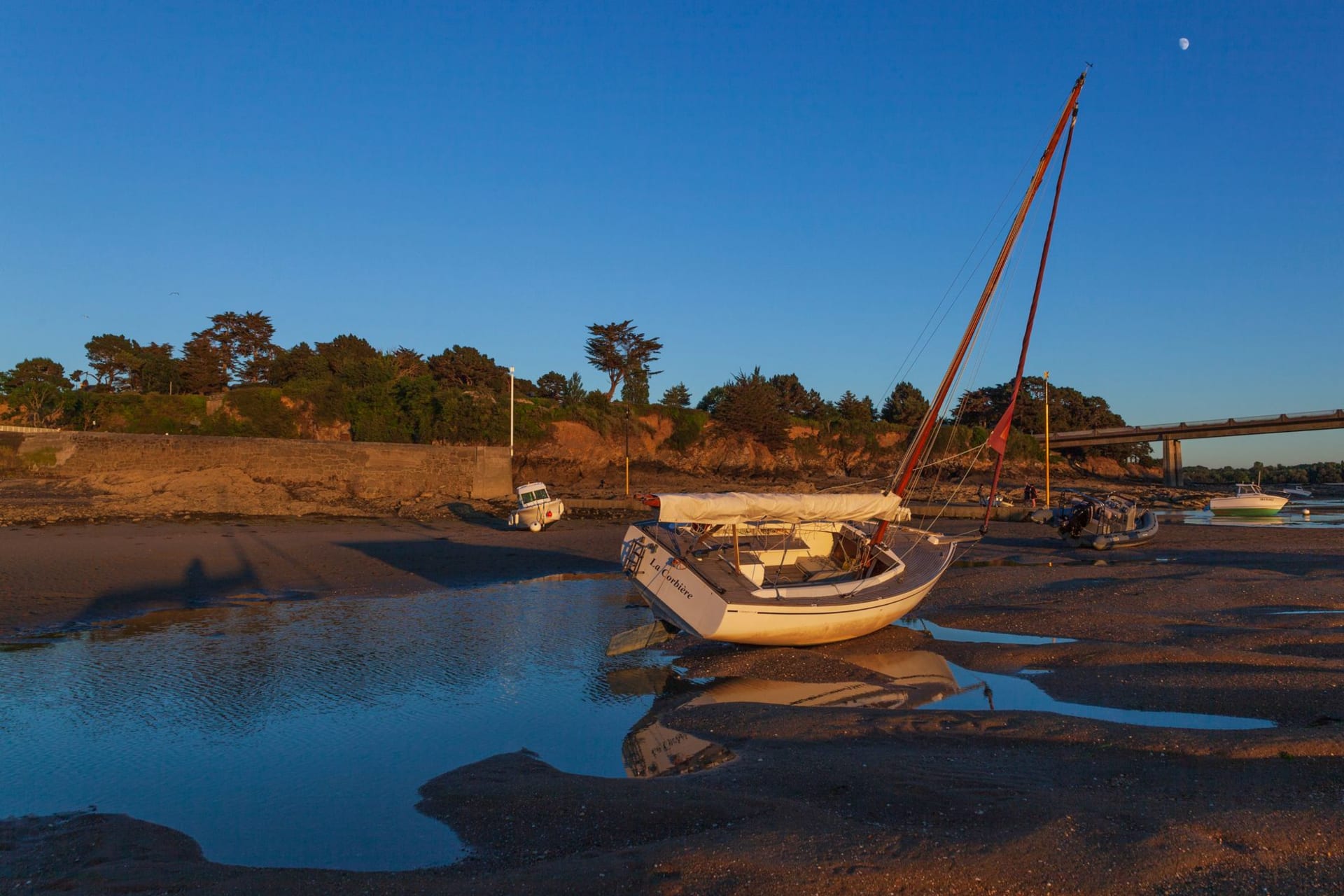
Back in town the biscuit shops were waging their gentle war. Pont-Aven invented the galette de Pont-Aven, a thin, intensely buttery shortbread, and the original maker, Traou Mad, still operates here alongside several rivals, each insisting on its primacy. We bought a tin to be polite and finished half of it on a bench by the river before lunch, watching the tide turn — the Aven is tidal this far up, and the water level visibly shifts while you sit. The biscuits, for the record, are exactly as good as the paintings suggested they would be. The light, the butter, the flat bright color: it all comes from the same place.

When to go: May and June, when the Bois d’Amour is at its greenest and the summer crowds have not yet arrived, or September for the same light Gauguin chased without the August coach tours. The museum is worth timing your day around; the biscuits are available at all hours and require no planning whatsoever.