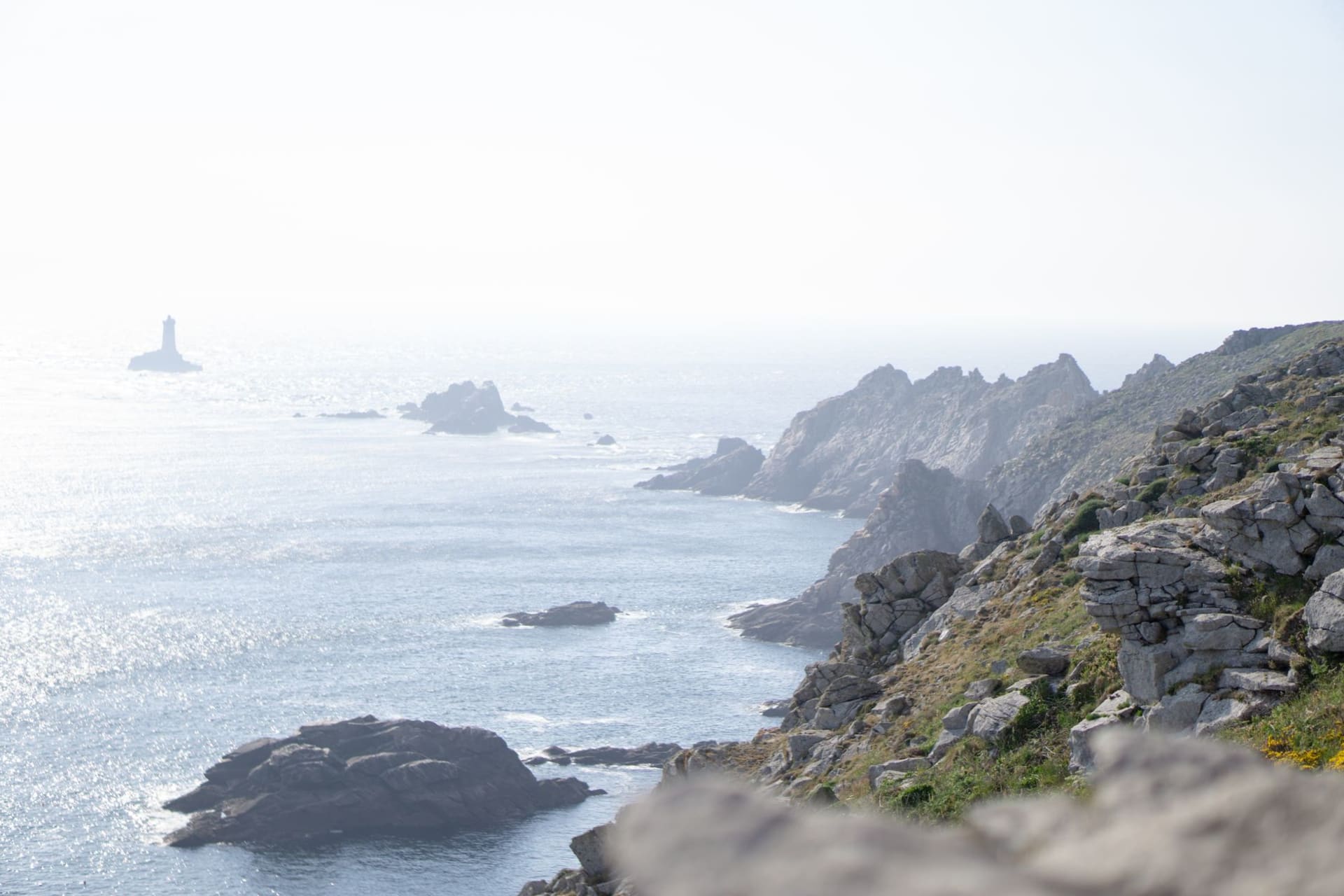
Pointe du Raz
"Standing at the Pointe du Raz you understand, finally, what 'Finistère' means — the end of the earth."
The name Finistère means end of the earth in Latin, and the Pointe du Raz is where that name earns itself. I drove through the village of Plogoff on an October afternoon, past the tourist shops that were already closing for the season and the car park at the end of the road, and walked the fifteen minutes out to the point along a path of bare schist and windburned grass. The headland narrows as you approach, the sea appearing on both sides, and then the path ends at the edge of nothing: vertical rock dropping to white water, and beyond that the open Atlantic, grey and enormous, all the way to the Americas.

The Raz de Sein is the strait between the point and the Île de Sein seven kilometres offshore, and the current through it runs at four to six knots — strong enough to have drowned sailors since before written records began. The Île de Sein is visible from the point on clear days: a thin line of grey and white that sits almost at sea level, so flat that the island was partially flooded during the great storms of the nineteenth century. During the Second World War, the entire male population of the island — a hundred and twenty men — answered de Gaulle’s June 1940 call and sailed to England to join the Free French. The island’s contribution was proportionally among the highest in France. De Gaulle visited after the war and said: “Sein is a quarter of France.” I thought about those men standing here, looking at England, and then sailing.
The statue of Our Lady of the Shipwrecked — Notre-Dame des Naufragés — stands at the lip of the headland, arms outstretched towards the sea, facing the Île de Sein. It has been there since 1904. The patina on the bronze is a deep verdigris from a century of salt wind. I stood next to it for a while and watched a cargo ship far out on the horizon moving slowly south.

There is almost nothing else here: a visitor centre set back from the cliffs that sells Breton biscuits and provides context about the marine environment, and a crêperie in Plogoff where I ate after the walk. The galette was good and the apple juice was from a farm five kilometres away. The woman who brought it said the storms at the Raz in winter are something different from any storm I might have seen. She seemed matter-of-fact about it in a way that was more convincing than any amount of hyperbole.
When to go: September and October for dramatic skies with manageable weather. The path is walkable year-round but the point is genuinely dangerous in high winds — the schist is slippery when wet and the wind at the tip can be shocking. In summer the car park fills; arrive before ten or after four to walk it without crowds.