Lençóis Maranhenses
"Between the dunes and the lagoons, Brazil decided to keep one secret for itself."
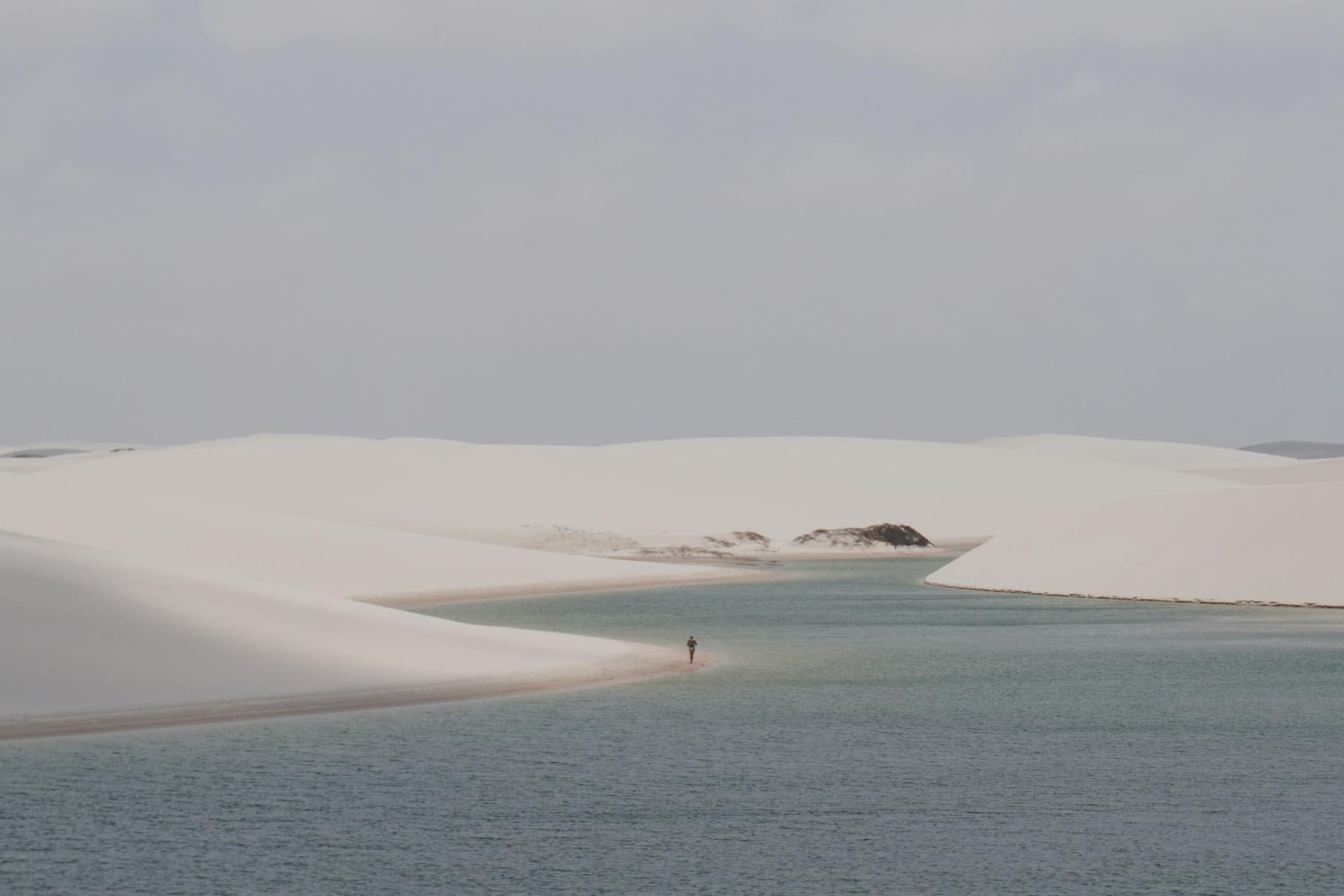
Endless white dunes filled with turquoise lagoons after the rains — a landscape that should not exist but does.
The map says desert. The eyes say ocean. Standing on the first ridge above Barreirinhas, with bare feet burning on white quartz sand and a lagoon the color of glacial ice no more than thirty meters below, I remember thinking that someone had clearly made an administrative error somewhere in the natural order of things.
Lençóis Maranhenses is not a place that prepares you. It simply arrives.
The Walk Into the Interior
We hired a local guide, Seu Zé, out of a small wooden office on Avenida Brasil in Barreirinhas — the town that serves as the main gateway into the park. He spoke only Portuguese, which was fine because after the first dune, none of us were talking anyway. The silence inland is physical. No wind, no birds, no traffic. Just the soft collapse of each footstep into sand so white it reads almost blue in the shade of a passing cloud.
The lagoons form between June and September, when rains fill the valleys between the dunes but the permeable rock beneath prevents drainage. By August, Lagoa Azul is deep enough to swim in, cold enough to make Lia gasp when she waded in past her knees. The water is fresh, perfectly clear, and carries a faint mineral smell — nothing like the sea two hours away. Standing waist-deep with dunes rising thirty meters on either side, I had the sensation of being inside a painting that hadn’t quite decided what climate it belonged to.
What Surprised Me
I expected the dunes. I did not expect the fish.
Seu Zé pointed down through the water at Lagoa Bonita and told us, in slow deliberate Portuguese I could mostly follow, that traíra fish appear in the lagoons every rainy season, carried in on floodwaters from rivers further inland. They survive the season, then vanish as the lagoons shrink. A temporary population in a temporary lake on top of a desert. Every year the same impossible act.
That evening, back in Barreirinhas, we ate peixe frito at a riverside stall on the banks of the Rio Preguiças — the lazy river that connects the town to the Atlantic coast. The fish came with farofa and a lime so sour it made my eyes water. Lia ordered a second plate. We watched herons work the shallows as the light went amber and the dunes somewhere beyond the tree line turned the color of old paper.
There is a particular quality to late-afternoon light in Maranhão — low, diffuse, almost hesitant — that makes everything look like it is being remembered rather than seen.
When to go: The lagoons are fullest between July and September, after the rainy season has had time to accumulate. Visiting outside this window means dunes but no water — still striking, but only half the miracle.