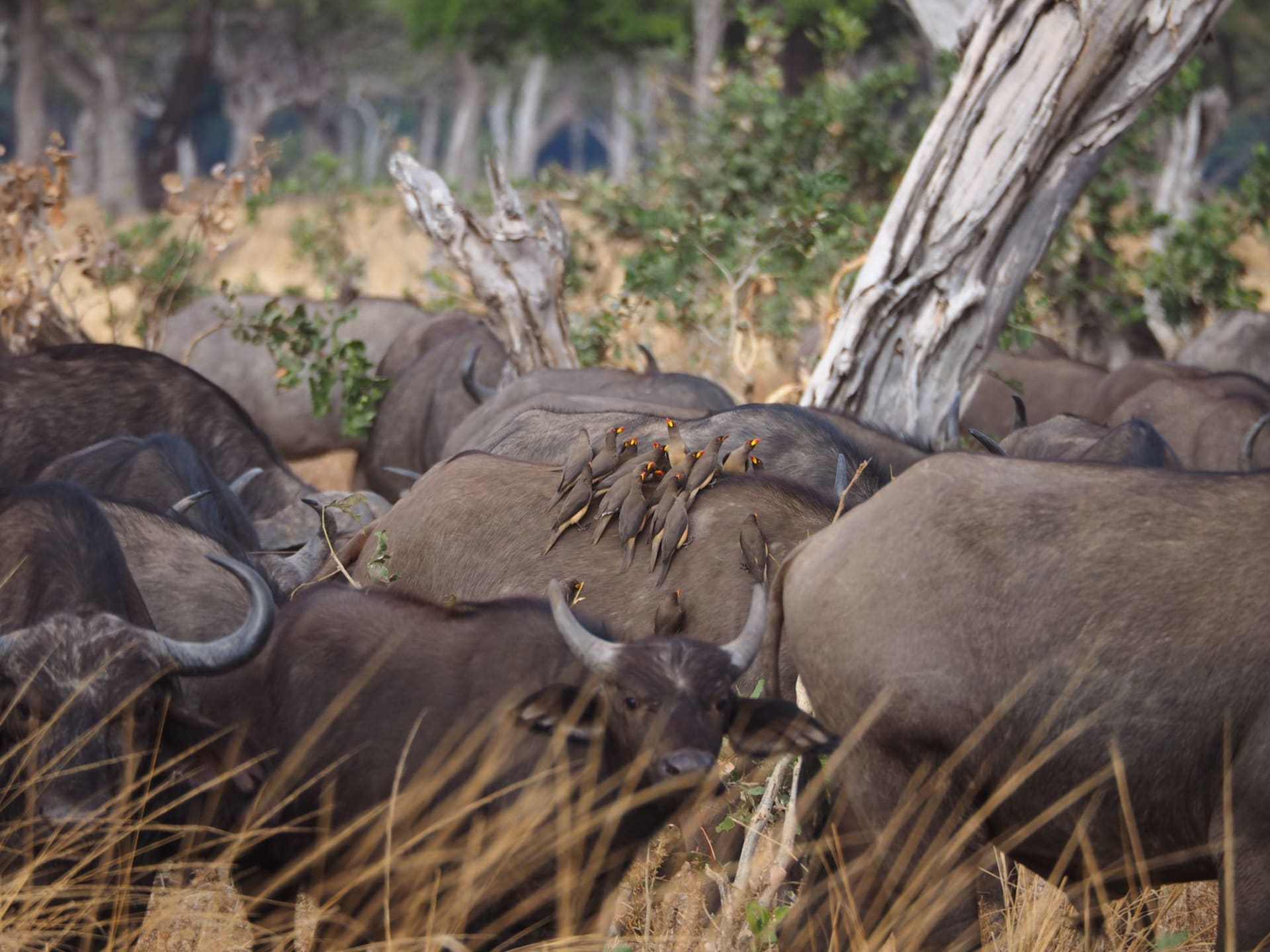
Moremi Game Reserve
"The leopard looked at me the way beautiful things sometimes do — briefly, without interest, and then away."
I saw my first leopard in the late morning, which the guides will tell you is the wrong time. By then the heat had settled hard on the Moremi floodplains and any sensible predator was deep in shade. But this one had not read the schedule. She was in a large strangler fig at the edge of a floodplain channel, her back legs hanging loosely over the branch, her spotted coat broken by patches of shadow so precisely that she vanished and reappeared depending on where exactly you looked. The guide spotted her first, stopped the vehicle without explanation, and pointed. It took me nearly a minute to see what he was showing me.

Moremi was Botswana’s first protected wildlife area and the only national reserve that incorporates part of the Okavango Delta’s permanent water system. What that means in practice is that you are in game-drive country and mokoro country simultaneously — a landscape that slides between open floodplain, dense riverine forest, dry mopane scrub, and the labyrinthine channels of the inner delta within the span of a single afternoon. The reserve’s famous area, Chief’s Island, is accessible only by air or boat. It feels like a place that has never been inconvenienced by the existence of roads.
The diversity here is not just about the big predators, though those exist in abundance. Moremi holds one of the healthiest African wild dog populations on the continent, and an encounter with a pack on the move — eight or ten of them, lean and painted and running with a purpose that feels more algorithmic than animal — is the kind of sighting that reorders your understanding of what a predator actually is. They do not stalk. They pursue, systematically, over distances that exhaust their prey by sheer endurance rather than speed. I followed one pack for twenty minutes at a speed that dented the chassis on the sandy track, and they were pulling away.

The southern entrance gate, Third Bridge, involves crossing a series of log bridges over deep channels, and the crossing itself is part of the experience — you see crocodiles from the vehicle windows, hippos resting half-submerged under the planks, herons standing motionless in the reed shadows. Each bridge is one vehicle wide and slightly precarious and nobody seems to regard this as a problem. The campsites at Third Bridge itself are among the most extraordinary I have found anywhere in Africa: no fences, no barriers, waterways on three sides, and the understanding that whatever wants to walk through at night is welcome to do so.
At the camp I met an older couple from Cape Town who had been coming to Moremi every dry season for twenty years. I asked them what kept drawing them back. The woman thought about it for a moment and said: “It changes. The same place is never the same place.” Her husband nodded and said nothing further, which I thought was the most accurate thing anyone said to me during the entire trip.
When to go: June through October for the dry season when wildlife is concentrated and the ground is firm enough for vehicle access. The weeks after the peak floods — July and August — offer the drama of water still high in the channels combined with good land-based game viewing. Avoid the rains if access is a concern; some areas become completely impassable. The wild dog denning season in June and July is worth planning around specifically.