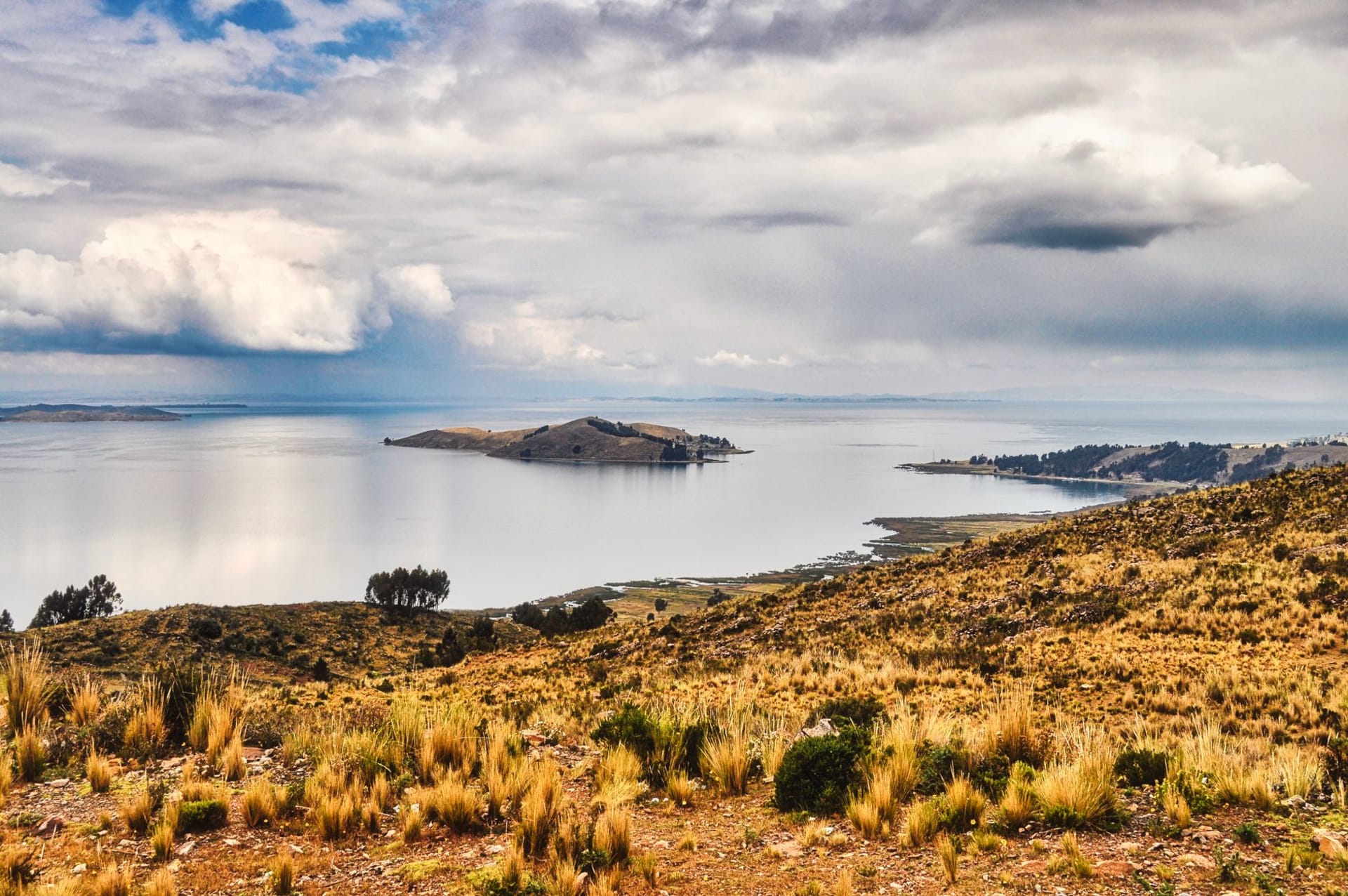
I didn’t fully believe in Lake Titicaca until I was standing at its edge in Copacabana, the cold coming off the water sharp as a blade even though the sun was directly overhead. At 3,800 meters the light behaves differently — harder, more insistent — and it hits that surface and turns it a shade of blue that doesn’t exist at lower elevations. Not ocean blue. Something colder, more mineral, more self-contained.
Copacabana and the Bolivian Shore
The town of Copacabana is small and slightly chaotic, wedged between hills with a white baroque cathedral at its center. On weekends Bolivians drive their cars down to be blessed by the priest — a real tradition, owners draping their vehicles in flowers and streamers before the holy water hits the hood. I watched three pickup trucks receive the sacrament on a Tuesday morning, the owners looking quietly satisfied afterward, like something important had been handled.
The food stalls along the waterfront serve trucha frita — fried trout pulled from the lake itself — with a squeeze of lime and more hot sauce than I intended. The fish tastes clean and cold. You eat it watching reed boats bob at their moorings, the kind built the same way for centuries, bundled totora reeds lashed so tight they still float after months in the water.
Isla del Sol
The boat to Isla del Sol takes about ninety minutes and deposits you at a rocky shore where the incline starts immediately. The island has no cars, few facilities, and a series of Inca ruins scattered across its terraced hills. The main site — the Sacred Rock, where the Inca believed the sun was born — is a lumpy sandstone formation that asks you to work a little at the meaning. But the view from the ridge above it, with the lake spreading in every direction and the snow-capped peaks of the Cordillera Real floating on the horizon, gives the mythology something to stand on.
I walked the spine of the island in the early afternoon. The air smelled like grass and dust and cold water. There were almost no other tourists. At one point I sat on a terrace wall and just looked at the lake for fifteen minutes, not photographing it, which felt like the right thing to do.
The Light at Dusk
Copacabana’s sunsets don’t announce themselves. The sky goes pale gold, then something deeper, and the lake surface turns the color of a bruise — purplish, darkening at the edges. The hills around town go violet. The cathedral gets lit from below and turns cream-white against the sky. It’s the kind of ending to a day that you don’t feel like explaining to anyone, which usually means it worked.
Lia thought the lake looked fake in photos — too blue, too still, too staged. She changed her mind standing there in the fading light, watching the color leave the water slowly, like something being folded away.
When to go: May to October is the dry season — clearest skies, coldest nights. June and July are peak but manageable. Avoid November through February when the rainy season brings muddy roads and poor visibility, though the clouds rolling over the lake have their own drama if you don’t mind the wet.