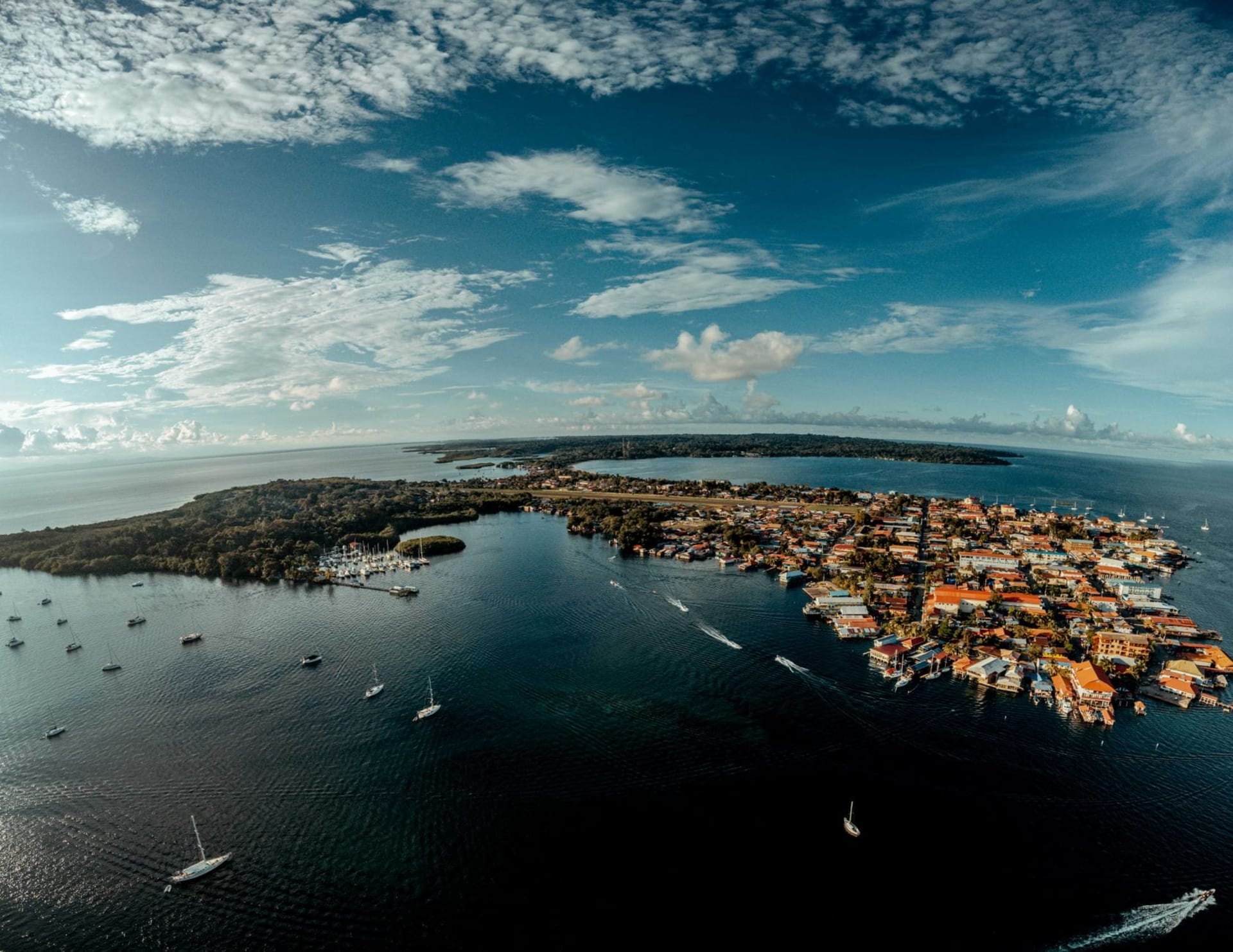
Belize City and Cayes
"From above, Belize's reef looks like a painter's first wash of blue on an empty canvas."
A string of Caribbean cayes sit atop the world's second-largest barrier reef, with the Great Blue Hole offshore.
Belize City greets you with salt and diesel — the smell of the Swing Bridge over Haulover Creek in the morning heat, pelicans perched on the railings, water taxis idling in clouds of exhaust. The city itself is rough-edged and humid, its wooden colonial houses listing under the weight of too many rainy seasons. It is not beautiful in any conventional sense. But it is alive in a way that polished destinations rarely are, and Buttonwood Bay at dusk — water going amber, frigate birds circling — has a beauty that takes you by surprise.
Out on the Cayes
The reef begins less than an hour east of the city by water taxi. Caye Caulker, the first stop, operates at a pace the locals describe simply as go slow — hand-painted on walls and fences and the hulls of boats. The main street is dirt. There are no traffic lights because there are essentially no cars. Lia and I arrived midafternoon and walked the length of the island in twenty minutes, which was all the orientation we needed. We ate stewed chicken and rice and beans at a plastic table beside the water, the sauce dark and smoky with recado paste, and understood immediately that we would not leave on schedule.
San Pedro, on Ambergris Caye, is larger and louder — golf carts instead of streets, bars stacked along the waterfront on Barrier Reef Drive, a kind of Caribbean main street where cruise passengers and serious divers and backpackers moving between guesthouses all intersect. The reef here is close enough to wade to at low tide from some spots, the water shifting from warm sand-green to cold dark blue at the wall’s edge, a threshold you feel before you see it.
Into the Blue
What I did not expect was the silence. I had anticipated the Great Blue Hole — that famous 300-metre circle of collapsed cave, 70 kilometres offshore — to feel overwhelming, cinematic, enormous. Seen from a small prop plane banking over it at dawn, it does. But in the water, hovering above the limestone columns that drop into the dark, what registers first is quiet. The reef above is noisy with parrotfish and wrasse. Down here, nothing moves. The stalactites hang from a ceiling of seawater. I stayed too long and had to be called back to the boat.
The reef snorkeling around Hol Chan Marine Reserve, just south of San Pedro, is less dramatic but more alive — nurse sharks sleeping on the sandy bottom at Shark Ray Alley, eagle rays passing overhead without acknowledging us, a green moray curled into a coral head the color of rust.
When to go: February through April offers the driest weather and calmest seas — ideal for diving and the 70-kilometre run out to the Great Blue Hole. Avoid September and October when hurricanes make liveaboard trips and small-plane flights to the atolls unpredictable.