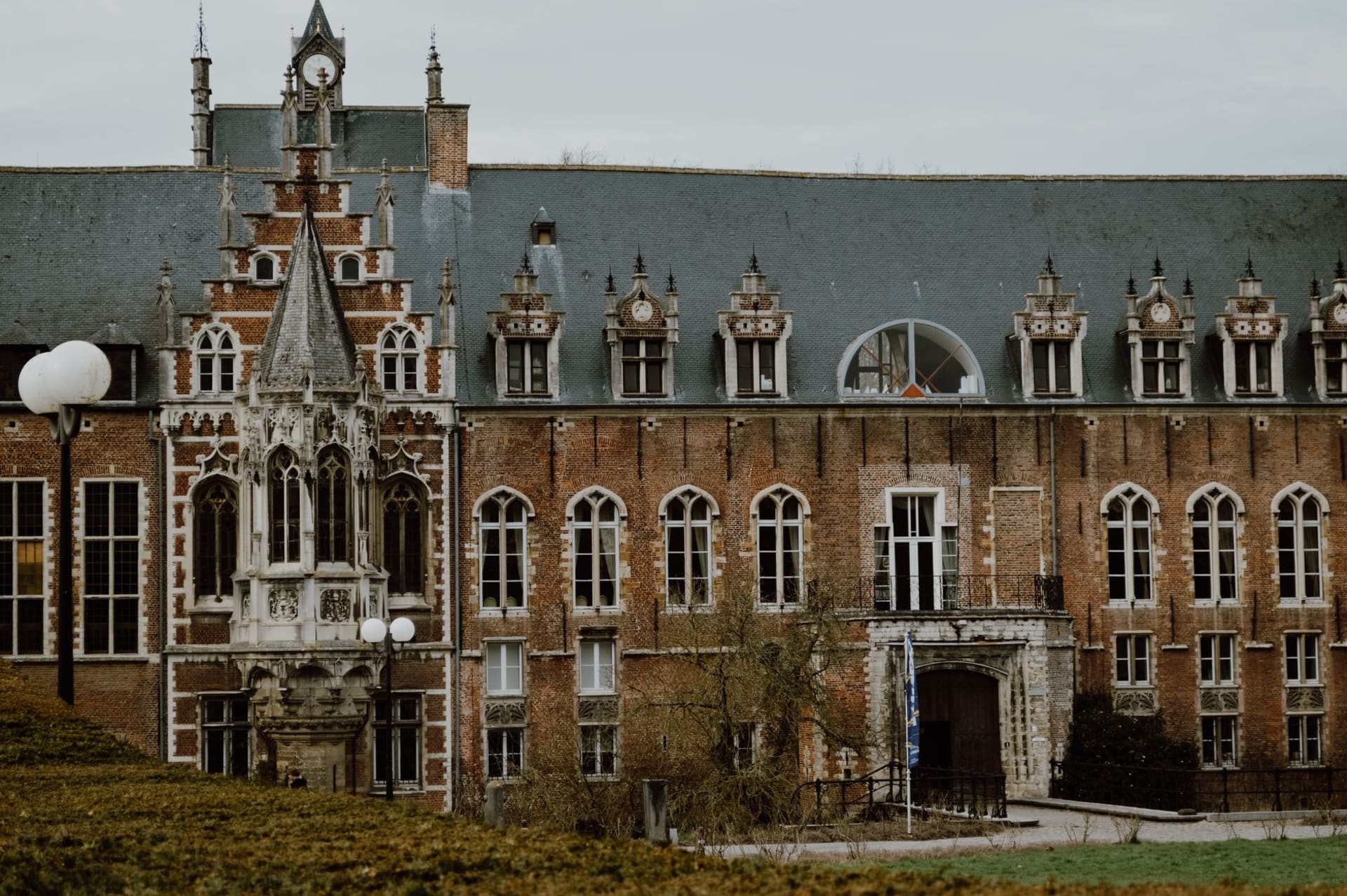
Leuven
"Brussels has the institutions and Bruges has the tourists, but Leuven has the students — and that, it turns out, is the better deal."
Most people barrelling between Brussels and the eastern cities never stop in Leuven, which is precisely their loss and was nearly mine. We only got off the train because Lia wanted a coffee, and we ended up staying two nights. It is a small city — you can cross the centre on foot in fifteen minutes — but it is home to KU Leuven, the oldest university in the Low Countries, founded in 1425, and the place has the particular energy of a town where roughly a third of the population is under twenty-five and convinced of its own immortality.
The town hall and the things around it
The Stadhuis, the town hall on the Grote Markt, is the reason most people who do stop, stop. It is a fifteenth-century Gothic building so densely encrusted with carved statues, pinnacles, and niches that it looks less constructed than grown, like a coral reef that decided to take up civic administration. There are hundreds of figures on the facade — saints, biblical scenes, local worthies — most of them nineteenth-century additions to niches that had stood empty for four hundred years. I stood across the square trying to count them and lost my place somewhere past sixty.
Across from it is St. Peter’s Church, plainer outside but holding two genuine masterpieces by Dirk Bouts, the fifteenth-century Flemish painter, including a Last Supper that I found more quietly devastating than half the more famous altarpieces I’d queued for elsewhere in the country. Almost nobody else was in the church. That, increasingly, is the Leuven trade-off — world-class things with no crowd around them.

The longest bar in the world
Leuven’s other great institution is the Oude Markt, a long rectangular square lined on every side, end to end, with bars and nothing but bars — locals call it the longest bar in the world, and while I cannot certify the claim, I can confirm I was in no condition to dispute it by the end of the evening. This is Stella Artois country; the brewery is right here in town, has been since 1366, and the beer in Leuven tastes, irritatingly, much better than the same beer does anywhere else.
We ended up at a table with three engineering students who insisted on explaining the difference between a proper Belgian pour and the catastrophe served abroad, then on demonstrating it repeatedly. Lia held her own admirably. I learned that the correct accompaniment is not frites but a bowl of radishes with butter and salt, which sounds wrong and is in fact perfect.
The next morning, slightly fragile, we walked it off in the Groot Begijnhof — a UNESCO-listed beguinage of brick lanes and walled gardens, once home to a community of lay religious women, now student housing of the most enviable kind imaginable. It was silent, green, and exactly what my head required.

When to go: Term-time, roughly October to May, for the full student atmosphere — the city empties out and goes oddly sleepy in the summer holidays. Late spring is loveliest, with the begijnhof gardens in bloom and the cafe terraces on the Oude Markt spilling out into the long Flemish evenings.