Nesvizh
"The Radziwills had everything and built more anyway — and the result is one of the most excessive and beautiful places I have sat in the grass and felt genuinely small."
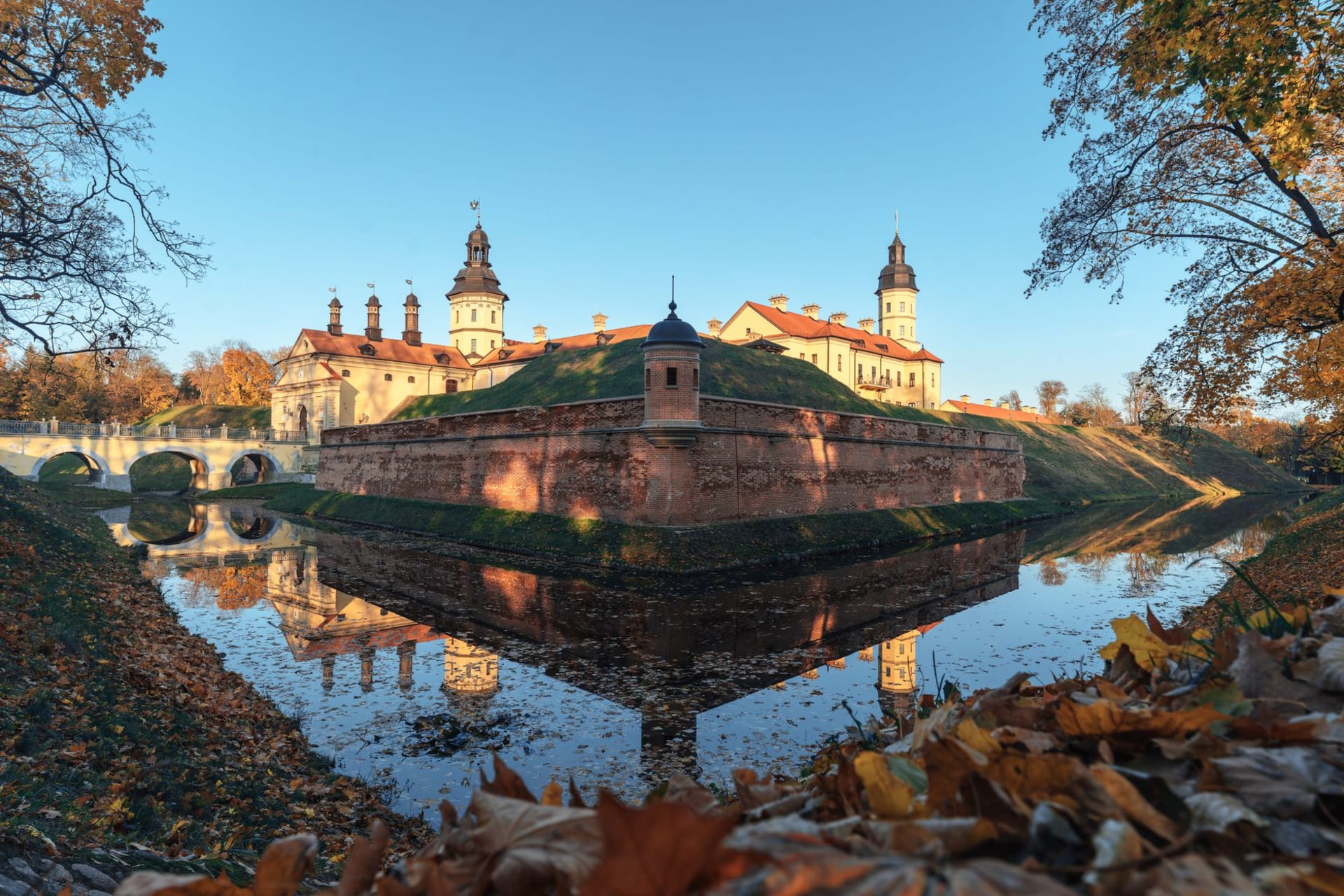
The Radziwill family ruled their portion of the Polish-Lithuanian Commonwealth with such ambition and wealth that their legacy is scattered across three modern countries. But Nesvizh was where they built their home, and sitting on the grass of the park on a warm May afternoon, looking at the palace’s Baroque façade reflected in the pond, I tried to comprehend what it would have meant to own all of this. The main building, the Italian-designed church next door, the formal gardens, the English landscape park behind, the fish ponds, the town gate, the market square — all of it was theirs. The town of Nesvizh existed, in a very real sense, because the Radziwills put it there.
The palace itself is one of the finest Baroque complexes in the region — a UNESCO World Heritage site shared with Mir Castle — and it has been restored with considerable care after decades of Soviet use as a sanatorium, which left certain rooms in questionable condition. Walking through the state apartments now, you encounter parquet floors, painted ceilings, rooms hung with reproductions of the family portrait collection (the originals were taken east during the war and have not all been returned). The scale of the private chapel across the square — the Corpus Christi Church, also Radziwill-commissioned, modelled on Il Gesù in Rome — is arresting for a building in a town this small. The family crypt underneath has been sealed for years, but the church’s interior is still fully intact and still in regular use.

What caught me most off guard was the park. I had expected formal gardens, and those exist — the Baroque parterres on the palace’s south side, laid out geometrically, with clipped hedges and a view toward the water. But beyond them the park opens into something larger and wilder, an English-style landscape designed in the nineteenth century, with paths winding along the edges of the lakes and through groves of ancient trees. I walked out there for over an hour, past a ruined Gothic hermitage commissioned, naturally, by a Radziwill who felt like having a Gothic hermitage in their park, through stands of oak and beech, until the palace was out of sight and I could hear only water and birds.
The town of Nesvizh beyond the castle walls is quiet and small — a few streets of traditional houses, a Saturday market that sells local honey and pickled cucumbers and strawberries in season, a café near the town hall where the coffee is served strong and the cheesecake is worth the trip on its own terms. The locals seem mildly accustomed to castle visitors wandering their streets looking slightly overwhelmed, which is the correct way to feel in Nesvizh.

When to go: May and early June when the park’s linden trees bloom and the gardens are in full colour. Autumn — September and October — brings golden light through the English park’s mature trees and is arguably more beautiful, with far fewer visitors than the summer peak.