Lake Naroch
"They call it the Belarusian Sea, and after three days I stopped finding that funny and started finding it accurate."
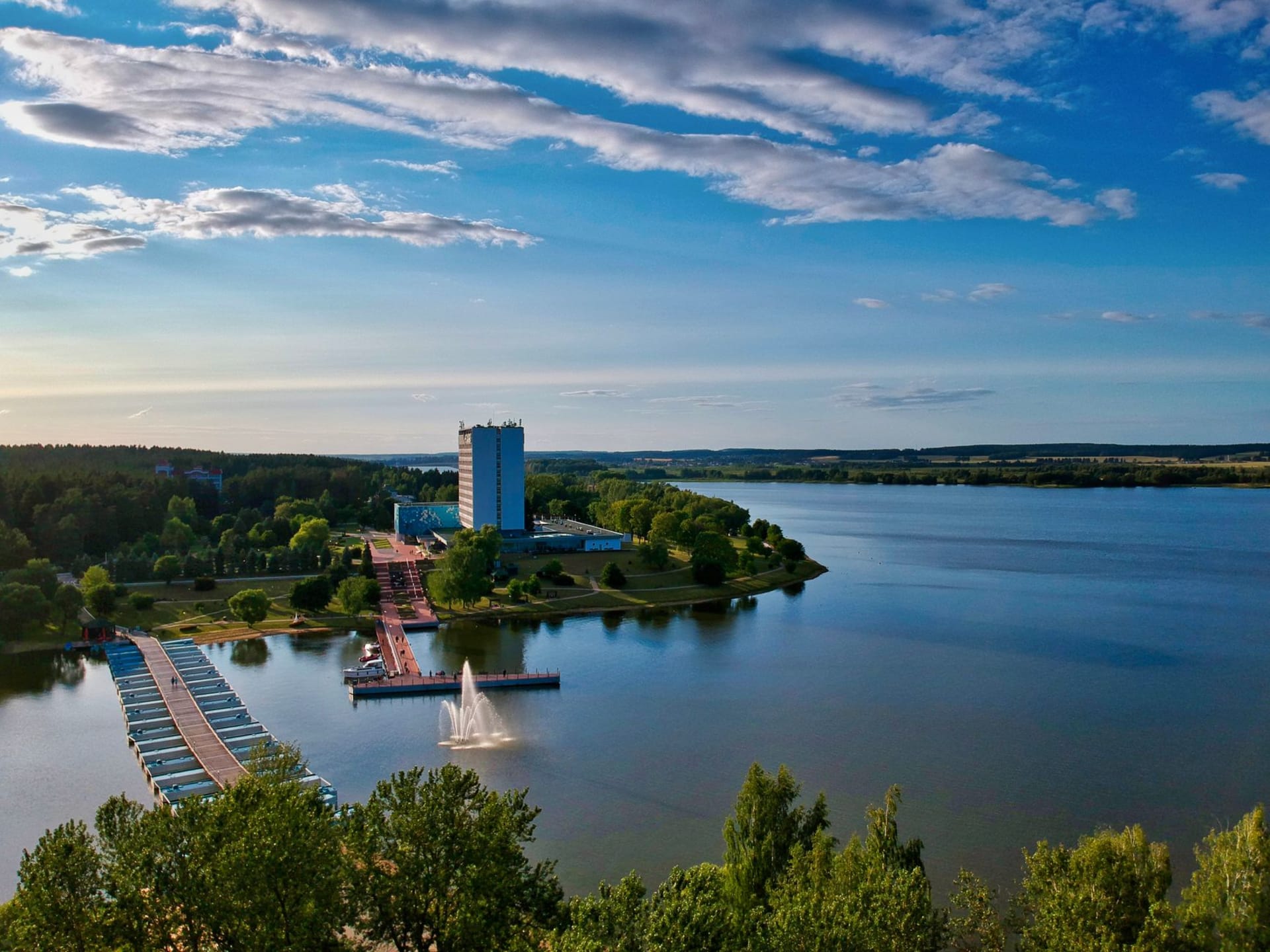
I went to Lake Naroch expecting a lake and found, instead, something the locals insist on calling a sea — and after three days walking its shore I stopped finding that funny and started finding it fair. Naroch is the largest lake in Belarus, nearly eighty square kilometres of pale, faintly mineral water sitting inside its own national park about two hours north of Minsk. On a still morning the far shore dissolves entirely, and you genuinely cannot tell where the water ends and the white sky begins. Lia, who grew up near actual seas, stood at the end of a wooden jetty with her coffee going cold and admitted that the comparison wasn’t as absurd as she’d assumed in the car.
The sanatorium coast
What makes Naroch strange and wonderful is that it was the Soviet Union’s idea of a holiday. The whole northern shore is lined with sanatoria — those enormous state health resorts where workers were once sent to convalesce on doctor’s orders, drinking mineral water and breathing pine air on a schedule. Many still operate, run with a seriousness that borders on the medical. I spent an afternoon wandering the grounds of one, past mosaic murals of muscular swimmers and a fountain that no longer ran, and was politely but firmly informed by a woman in a white coat that the salt-inhalation room was for guests only. I have rarely felt so gently rebuked.
The faded grandeur is the point, I think. These places were built to be optimistic, and a surprising amount of that optimism survives in the long shaded avenues, the rows of identical white loungers, the announcement bells. It is the least cynical kind of tourism I have ever encountered, and I found it oddly moving.

Water, pine, and smoked fish
Away from the sanatoria the lake belongs to fishermen and to the forest. I rented a bicycle from a man who also sold worms, and rode the flat track around the southern bays where the water turns clear over pale sand and herons stand in the reeds with infinite patience. The national park protects most of the shoreline, so the pine smell is everywhere — that hot resinous breath the trees give off in the afternoon sun, which is precisely the air the sanatorium doctors are prescribing.
The food, predictably, is fish. I ate smoked bream at a roadside stall from a man who would not tell me where he caught it, served on brown paper with rye bread and nothing else, and it was among the best things I ate in the entire country. Later, a glass of kvass and a plate of fried vendace, the small silvery lake fish eaten whole, head and all. Lia ate hers without flinching. I worked up to it.
What stays with me about Naroch is the quiet — not an empty quiet but a populated one, families wading at dusk, a brass band rehearsing somewhere in a sanatorium hall, the lake going pewter then pink then dark.

When to go: July and August for swimming and the full sanatorium-season atmosphere, when the shore is at its liveliest. Late May and early September are quieter and the light over the water is at its best. Bring insect repellent — the same forest that smells so good breeds mosquitoes with serious commitment.