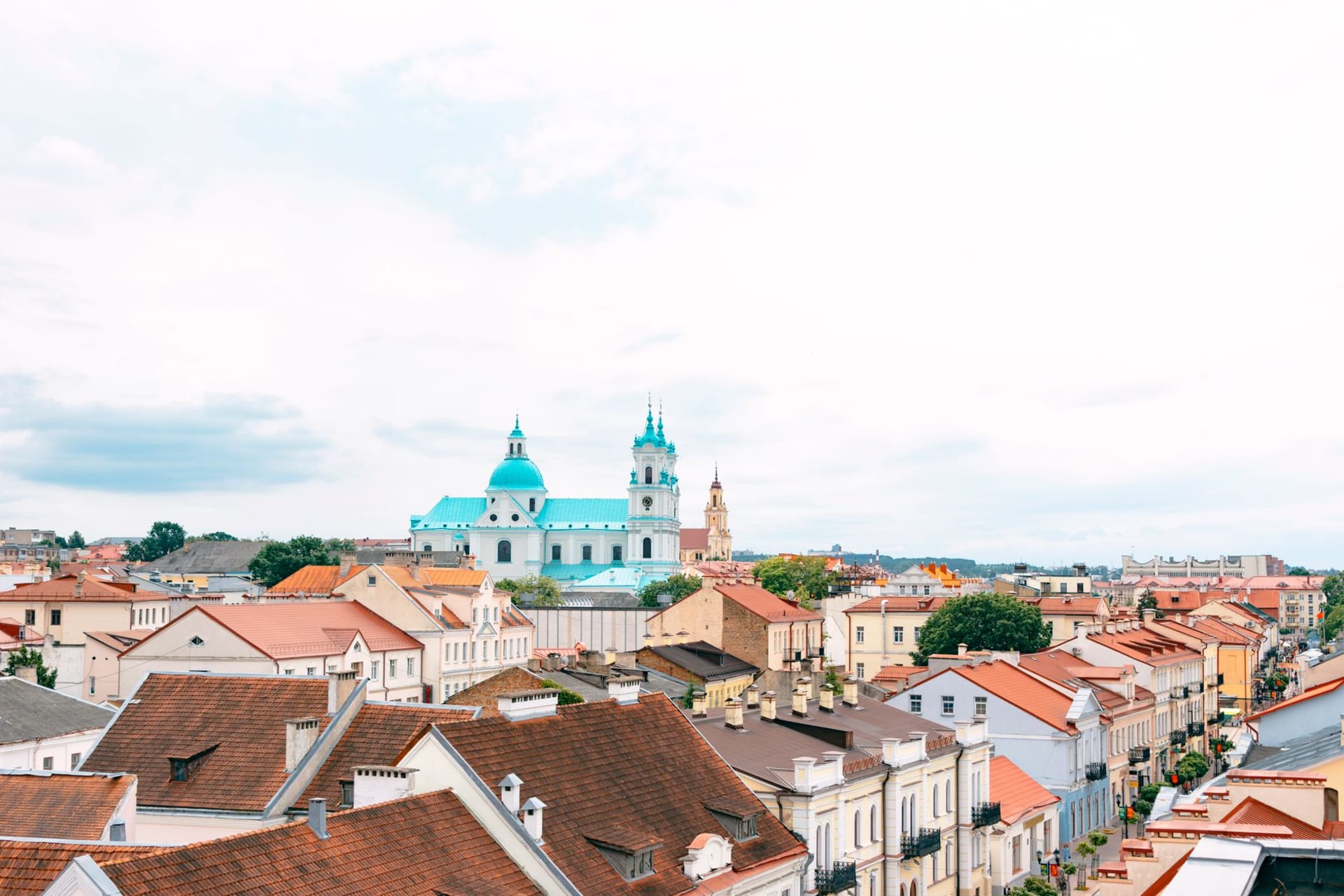
Grodno
"Every other Belarusian city was rebuilt by Stalin. Grodno mostly wasn't — which makes it the most surprising city in the country."
Grodno surprised me more than anywhere else in Belarus. The rest of the country — Minsk especially, but also Brest and Vitebsk — carries the visible evidence of wartime destruction and Soviet reconstruction. Grodno escaped relatively intact, partly because of its early capture and extended German occupation, which preserved the buildings while destroying the people. Walking through the old town, you encounter a layering of architecture that is unusual in this part of the world: sixteenth-century fortified houses beside Baroque Catholic churches beside nineteenth-century neoclassical merchants’ mansions beside Orthodox churches whose gold domes catch the afternoon light from the hill above the Neman River. It feels like a different country from Minsk, or rather it feels like several countries at once.
The old castle — actually two castles, old and new, on the hill above the river — overlooks the city with the authority of something that has been here since the twelfth century and is used to being looked at. The Old Castle now houses a museum with an excellent collection of local history, medieval weaponry, and archaeological finds from the surrounding region. The New Castle, a Baroque palace built for Polish-Lithuanian Commonwealth kings in the eighteenth century, was badly damaged during the war and is currently under restoration. From the terrace between the two, you get the view of the Neman River bend that appears on every postcard of the city — the old bridge, the Church of the Discovery of the Holy Cross rising white across the water, the rolling hills of Poland visible in the middle distance.

The old town has the kind of streetlife that comes from a city that actually lives in its historic centre rather than preserving it. The market on Sovetskaya Square is a real market — vegetables, bolts of cloth, hardware, home-preserved goods — not a tourist market. The Farny Cathedral, a Baroque Jesuit church of considerable grandeur, holds regular masses attended by genuinely devout parishioners who regard the occasional tourist with patient acceptance. The Jewish heritage is both present and painfully absent here: Grodno had a Jewish population of over forty percent before the war, and the pre-war photographs on display in the history museum make the current quiet streets feel haunted in a very specific way. The old Jewish cemetery on the edge of the city — overgrown and mostly untended, its stones leaning at angles in long grass — is one of the most moving places I visited in the country.
The food in Grodno runs toward the Polish-Lithuanian border traditions: cold beet soup, herring prepared in several ways, and a mushroom soup — thick with forest porcini, served in a clay pot — that I ate twice in the same day without any sense of having been excessive about it.

When to go: May and June for mild weather and the old town at its most lively. September is excellent for the quality of light and the reduction in the already-modest tourist crowd. Grodno is close to the Lithuanian and Polish borders, making it a natural start or end point for a wider regional route.