Hermel
"A Roman pyramid. In Lebanon. On a hill nobody guards. The world keeps having more texture than you expect."
Nobody had warned me about the pyramid. I was driving north through the upper Bekaa, the valley narrowing and the mountains closing in on both sides and the traffic thinning to almost nothing, when I saw it on a hilltop to the west — a stone tower with a pyramid on top, Roman, isolated, standing on bare rock with no fence around it and no sign that I could read from the road. I pulled over and climbed up through the scrub on foot, and stood next to it for twenty minutes trying to understand what I was looking at.
The Hermel Monument is a funerary tower from the first century BC — built by a local Ituraean ruler at a time when the region was transitioning from local dynastic control to Roman provincial administration. It is about twenty-seven meters tall, square in section, with carved reliefs of hunting scenes on the upper register: wild boar, deer, bears, dogs in pursuit. The carvings are worn but readable. The hunters are still running, the boar still turns. Above the carvings, the pyramid. There is nothing else like it in Lebanon, and very few things like it anywhere in the Roman world. I climbed back down to the road with the feeling of someone who has stumbled onto something the guidebooks forgot.

Hermel itself is a town with a particular frontier character. The northern Bekaa is border country — Syria is close, the Orontes River (Nahr el-Asi) rises nearby and runs north through Syria and Turkey, one of the few Middle Eastern rivers that flows toward the north rather than the sea. The town has a reputation in Lebanon that precedes it — the northern Bekaa has historically been a zone of low governance and high independence — but what I found on the ground was a place that was simply itself: market stalls selling plastic goods, a mosque, a few cafés, men who watched strangers with curiosity rather than hostility.
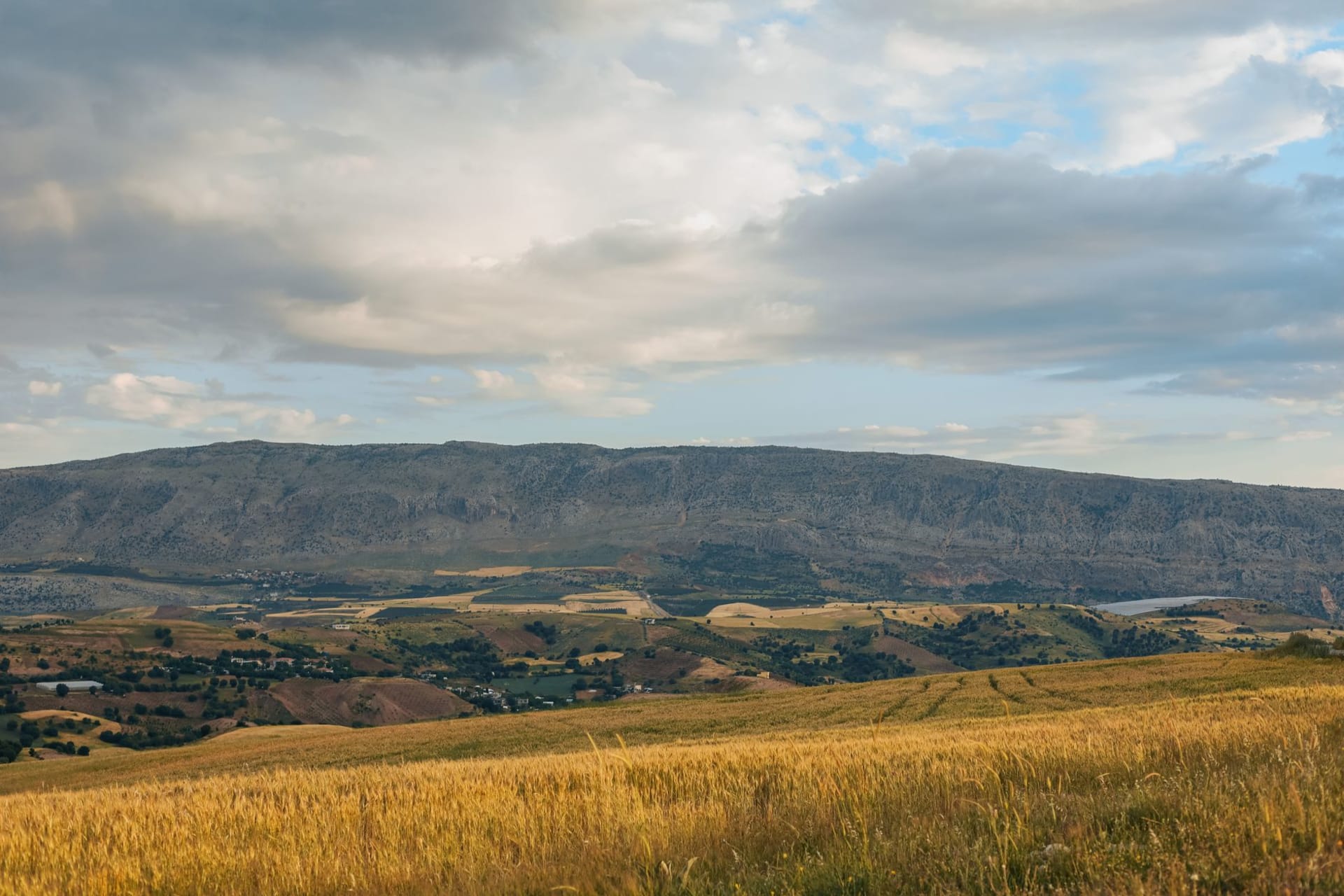
The surrounding landscape earns attention. The Asi River, cold and fast where it emerges from its source springs, runs through a valley below the town that is green in spring in a way the rest of the Bekaa rarely manages. Waterfalls feed into the river from the slopes above. Fishermen work the river for trout. The area is popular for summer camping among Lebanese who know it, but unknown to most foreign travelers.

The drive north from Baalbek to Hermel is sixty kilometers on a road that becomes steadily more dramatic as the valley narrows. The town is close enough to the Syrian border that it exists in a different political weather system than the rest of Lebanon, and the journey itself — the gradual emptying of the landscape, the mountains growing more austere — is half the reason to make it.
When to go: Late April through June is best — the Orontes Valley is green, the wildflowers are in bloom on the surrounding hillsides, and the weather is mild. Autumn also works well. Avoid high summer when the heat is intense and the river lower. The Hermel Monument can be visited year-round; it requires no ticket and no guide, just the willingness to climb a rocky hillside.