Bilbao
"The Guggenheim is genuinely extraordinary. But the city underneath it is more interesting."
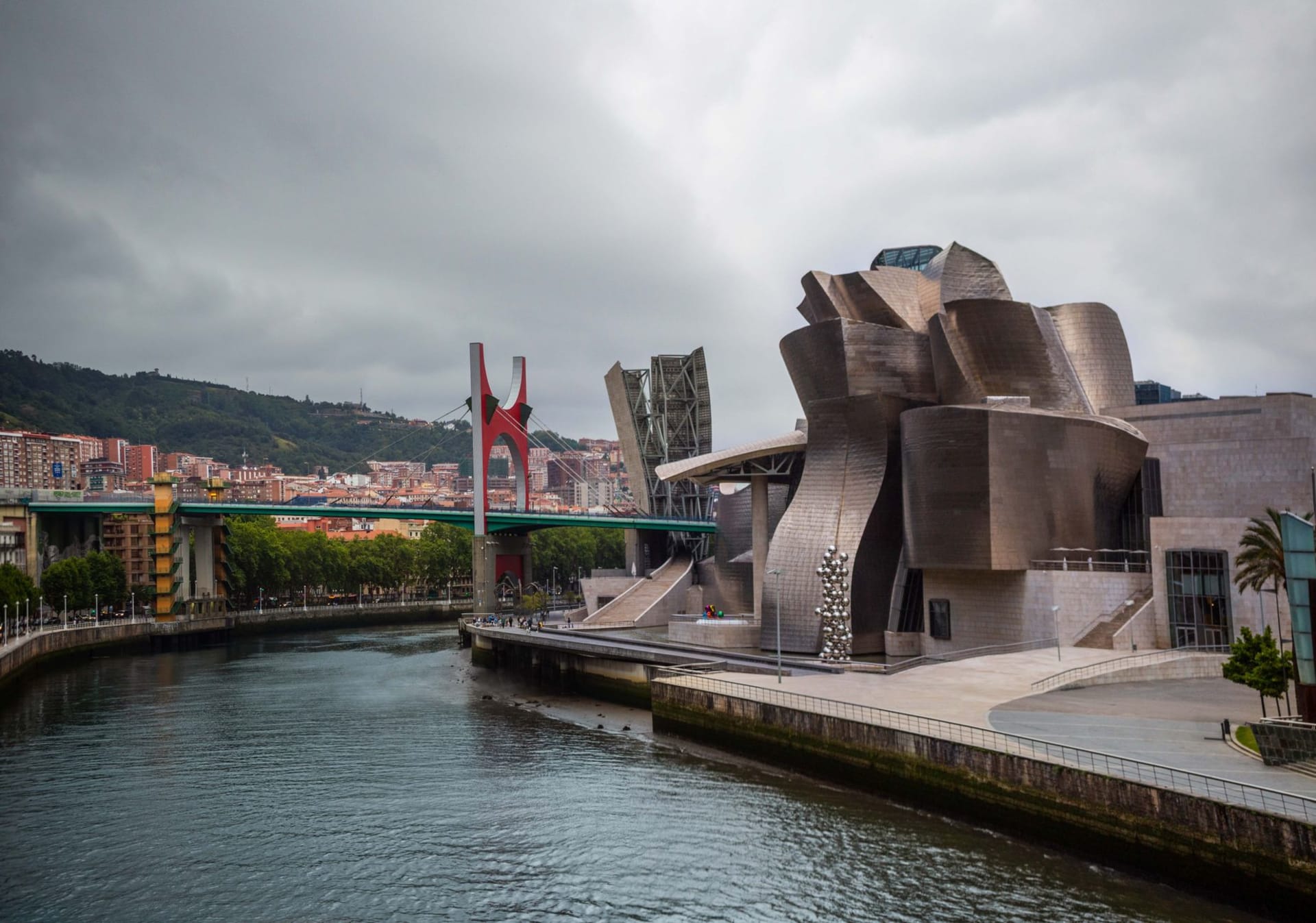
The train from San Sebastián deposits you at Abando station and the first thing Bilbao shows you is not the museum. It’s the Nervión — a wide, grey-brown working river, crossed by bridges carrying trams and pedestrians and, in the older industrial imagination of this city, something heavier still. I walked downstream along the left bank past the old shipyard buildings, now converted into offices and apartments, and the river smelled of nothing in particular. Clean. That itself is the story: twenty years ago the Nervión was an ecological disaster. Now people run along its banks in the morning and couples eat on terrace tables facing the water.
The Guggenheim arrives without warning if you approach from the Casco Viejo. You turn a corner and there it is — Frank Gehry’s walls of titanium cladding, metal folded like paper, catching light in a dozen different shades depending on the angle of the sun. I had seen photographs. The photographs do not convey the scale, or the way the building seems to be in motion even when still, or the genuine delight on the face of Puppy — Jeff Koons’s enormous flower-covered terrier — who looks like he has found exactly the right spot. I sat on the river steps for twenty minutes before I went inside. The exterior is the thing.

The Casco Viejo is where Bilbao breathes on its own terms. Seven streets — the Siete Calles — laid out in the fourteenth century, compressed and loud, the pavements crowded with people who are not there to see anything in particular but to drink a zurito of cold beer and argue. The Mercado de la Ribera sits at the river end of the old quarter, an Art Deco building from 1929 that runs the length of the bank and houses, on the upper floor, pintxos bars where the morning crowd stands with wine at ten a.m. I ate a plate of gildas there — the classic Basque anchovy-pepper-olive skewer — and thought about how a thing so simple could feel so resolved.

Athletic Club de Bilbao — the football team that has always fielded only Basque players and has survived in La Liga for over a century without breaking that rule — is not a sentimental concept here. It’s a live argument. The red-and-white shirts appear in windows, in conversations, tattooed on forearms. San Mamés, the stadium, is a cathedral in the physical sense: enormous, lit white at night, capable of making strangers feel the weight of what collective identity means when it’s real and not performed.
Walking the Abandoibarra waterfront at seven in the evening, I watched families, elderly couples, teenagers on bikes moving through the same riverside space where cranes once worked. There was a Basque folk group playing near one of the bridges — the txistu flute thin and strange against the glass towers — and it sounded like nothing I had heard before and somehow entirely appropriate to where I was standing.
When to go: May and June are soft and green. September brings the Aste Nagusia — Bilbao’s Great Week — with concerts, street theatre, and fireworks reflected in the river. Winter is mild by northern standards and the city is genuinely local and unhurried once the museum crowds thin. Avoid the Guggenheim on weekend afternoons in high summer unless queuing is your idea of a good time.