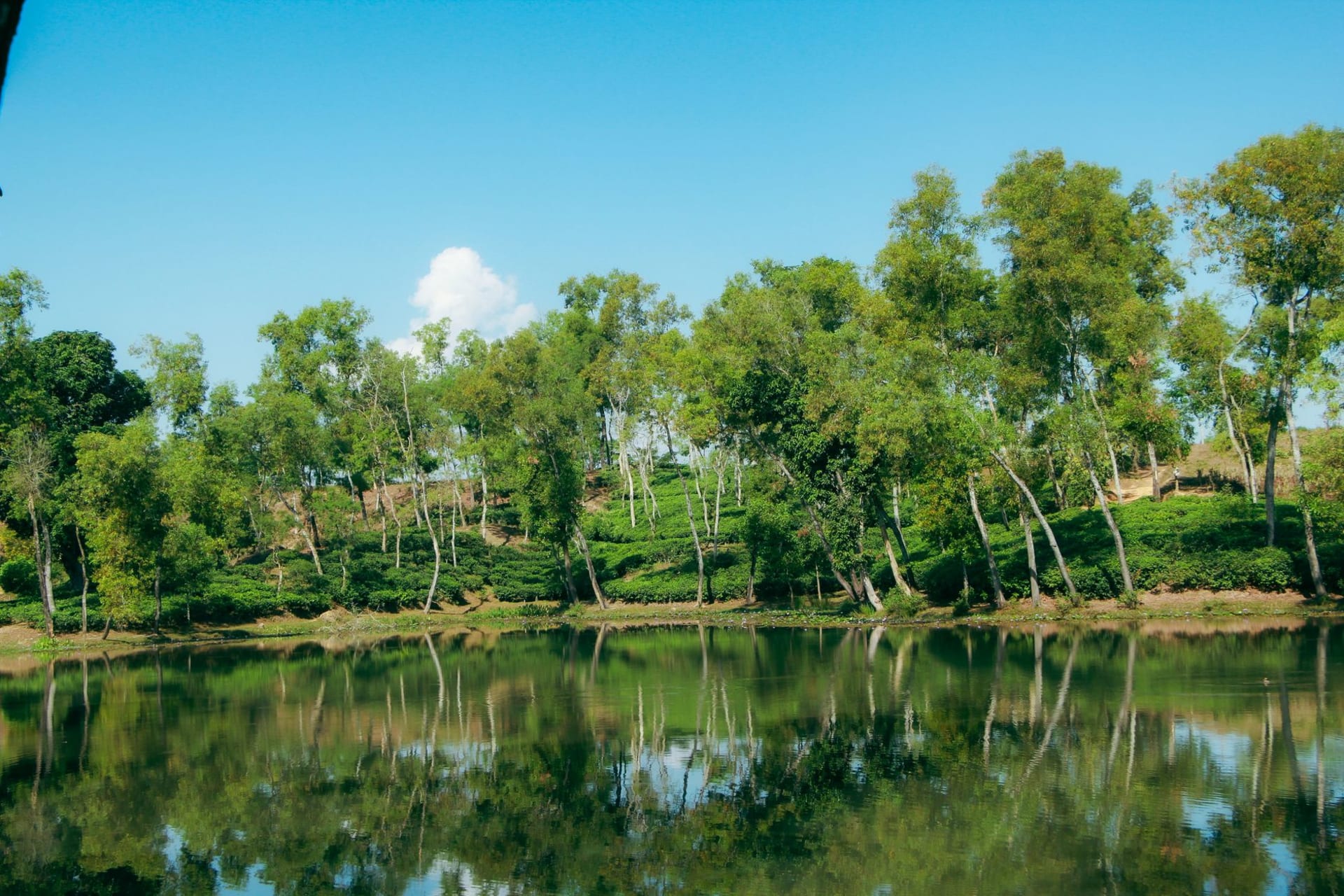
Sylhet
"The river didn't carry water so much as light — filtered through a thousand shades of green."
The bus from Dhaka takes nine hours if you’re lucky, twelve if you’re not. By the time I reached Sylhet, the air had changed entirely — thicker, greener, carrying that damp smell of recent rain on laterite soil that I’d only ever encountered in the northeast of the subcontinent. The hills across the Indian border were barely visible through low cloud. I ate a plate of rice and shutki — fermented dried fish, which is exactly as confrontational as it sounds — and felt immediately, inexplicably glad I’d come.
Jaflong and the Stone River
About an hour north of Sylhet city, the Piyain River runs a pale jade green over a bed of smooth white boulders stretching hundreds of meters across. Jaflong looks like something a landscape painter would invent if they were trying too hard. Khasi tribal communities live in wooden stilt houses on the embankment; workers quarry stones by hand in the river shallows, a practice that’s been slowly destroying the riverbed for decades but still looks extraordinary in the morning light. I sat on a flat boulder for an hour doing nothing useful. On the Indian side, the hills of Meghalaya rose clean and abrupt. The border here is a line someone drew through a landscape that clearly didn’t care.
The Shrine of Shah Jalal
In the center of Sylhet, the dargah of Hazrat Shah Jalal draws pilgrims every day of the year. The fourteenth-century Sufi missionary arrived here from Yemen — the story is complicated, as these stories always are — and his shrine now anchors the spiritual life of the whole northeast region. I went in the late afternoon, when the air smelled of incense and rose water and fried snacks from the stalls outside. Men sat reading Quran under the courtyard trees. A giant catfish pool nearby is considered sacred; attendants threw in food and hundreds of huge fish rose to the surface like a slow biblical event. No one seemed to find this unusual.
Ratargul’s Drowned Forest
Forty minutes out of the city, the Gowain River floods a low forest every monsoon season and refuses to leave. The result is Ratargul, a freshwater swamp forest that you can only navigate by narrow wooden boat. The boatman paddled in near silence, pushing under branches, the canopy reflecting in dark still water. Calls I couldn’t identify moved through the trees. In the dry season — November through April — the water level drops and the effect is less dramatic, though the forest is still deeply strange and beautiful. Come between June and October if you want the full drowned-world experience and don’t mind being wet.
When to go: November through February for comfortable travel around Sylhet city and Jaflong. June through September for Ratargul at full flood — extraordinary, but hot and humid. Avoid the height of monsoon (July–August) for overland travel; roads can wash out.