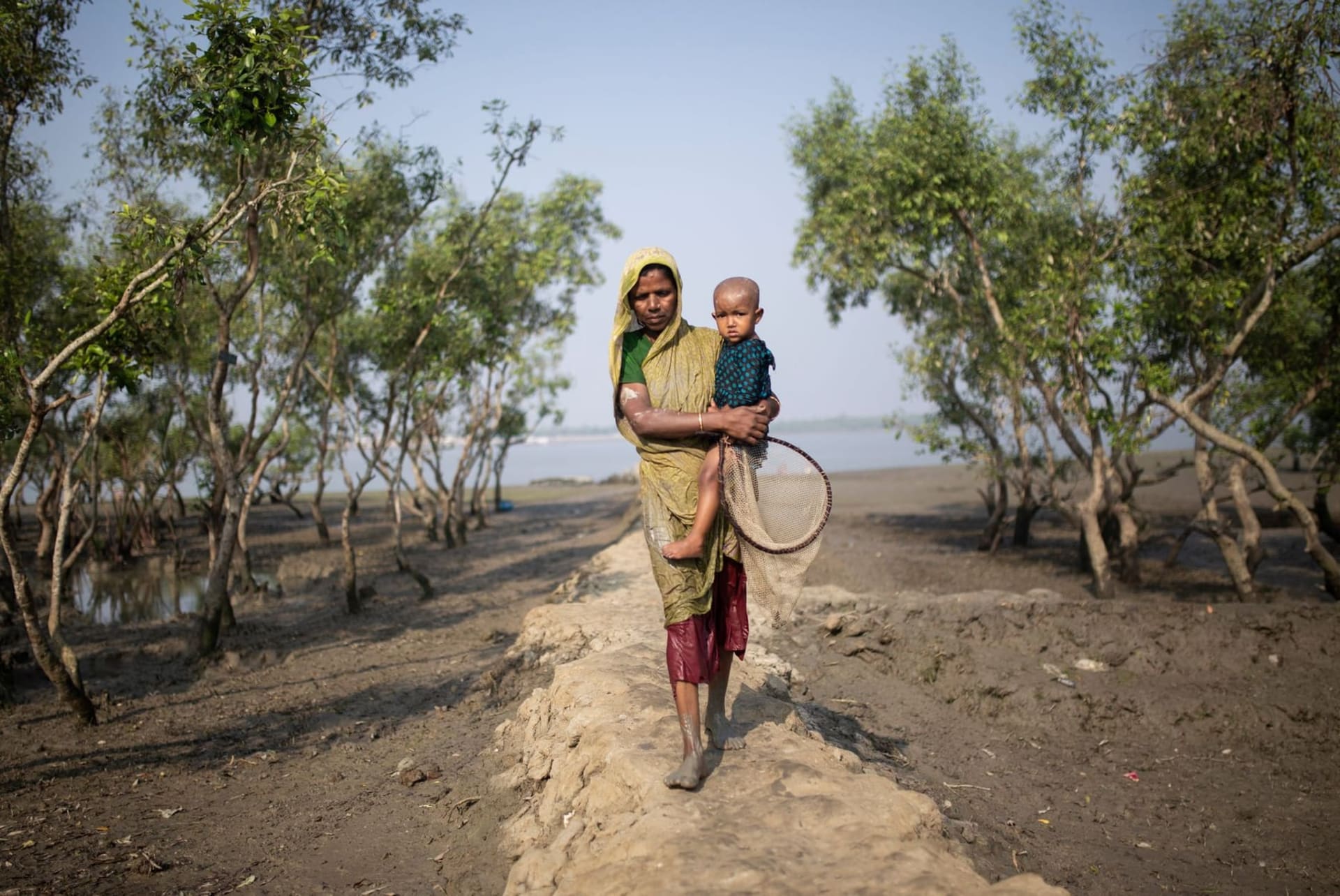
Sundarbans
"The Sundarbans is the only place where a tiger walks through a forest that is also technically a sea."
The world's largest mangrove delta where Bengal tigers swim between islands and kingfishers outnumber tourists.
The boat leaves Mongla before dawn, when the Passur River is still a dark mirror and the air smells of salt, mud, and something vegetal and ancient that I later come to associate with the Sundarbans specifically — a fermented green smell, like the forest is composting itself in real time. Our guide, Rafiq, cuts the engine twice within the first hour. Both times I see nothing. He just listens.
That is the first lesson the Sundarbans teaches: how to be still.
A Forest That Moves With the Tide
The Sundarbans covers roughly 10,000 square kilometers across the Bengal delta, straddling Bangladesh and India, and what makes it genuinely disorienting is that its geography shifts twice daily. The channels that separate Kotka Island from Karamjal are navigable at high tide, impassable mud flats at low. The sundari trees — Heritiera fomes, the species that gave the forest its name — stand in permanent tidal water, their breathing roots arching out of the surface like a thousand crooked fingers.
We moored one afternoon near Hiron Point, the southernmost tip of the Bangladeshi sector, where the Bay of Bengal opens up wide and grey. Lia had spotted a spotted deer earlier on the bank, and we were both still carrying that particular heightened alertness that the forest induces after the first sighting. Kingfishers — there are eight species here — darted across the water with a precision that made the whole spectacle feel staged. An olive ridley turtle surfaced once, regarded the boat with reptilian patience, and dove.
The tigers remain invisible. This is both the point and the frustration.
The Unexpected Thing
What I had not anticipated was the honey. Every spring, teams of licensed honey collectors called mawalis enter the deepest forest channels to gather wild honey from hives hung in the sundari canopy. They wear crude clay masks on the backs of their heads — a deterrent, local belief holds, against tiger attack, since tigers prefer to ambush from behind. The forest department controls access and the season is tightly regulated. Rafiq showed me a photograph on his phone: a man standing waist-deep in tidal water, smoke rising from a makeshift torch, the hive enormous above him, wearing his clay face on the back of his skull like a second identity. The honey, when I tasted it from a jar at the Karamjal eco-center, had a faint bitterness underneath the sweetness, something dark and resinous — the forest concentrated into a tablespoon.
Living With the Tiger’s Absence
The Bengal tiger is most present in the Sundarbans as an absence. You know it is there — roughly 100 to 150 individuals in the Bangladeshi sector — because Rafiq never lets anyone stand at the bow near the treeline, because every watchtower is built in steel, because the villagers in Munshiganj who fish the outer channels wear the same clay masks as the mawalis. The tiger here has evolved as the only tiger population in the world that regularly swims open water between islands. It is, taxonomically, the same animal as the tigers of Rajasthan, but the Sundarbans version feels like a different creature — amphibious, tidal, adapted to a world that technically qualifies as sea.
I never saw one. I am not sure I needed to.
When to go: November through February, when humidity drops and the forest is navigable without the monsoon swelling the channels into flood. Avoid June through September entirely — cyclone risk is real and much of the park closes.