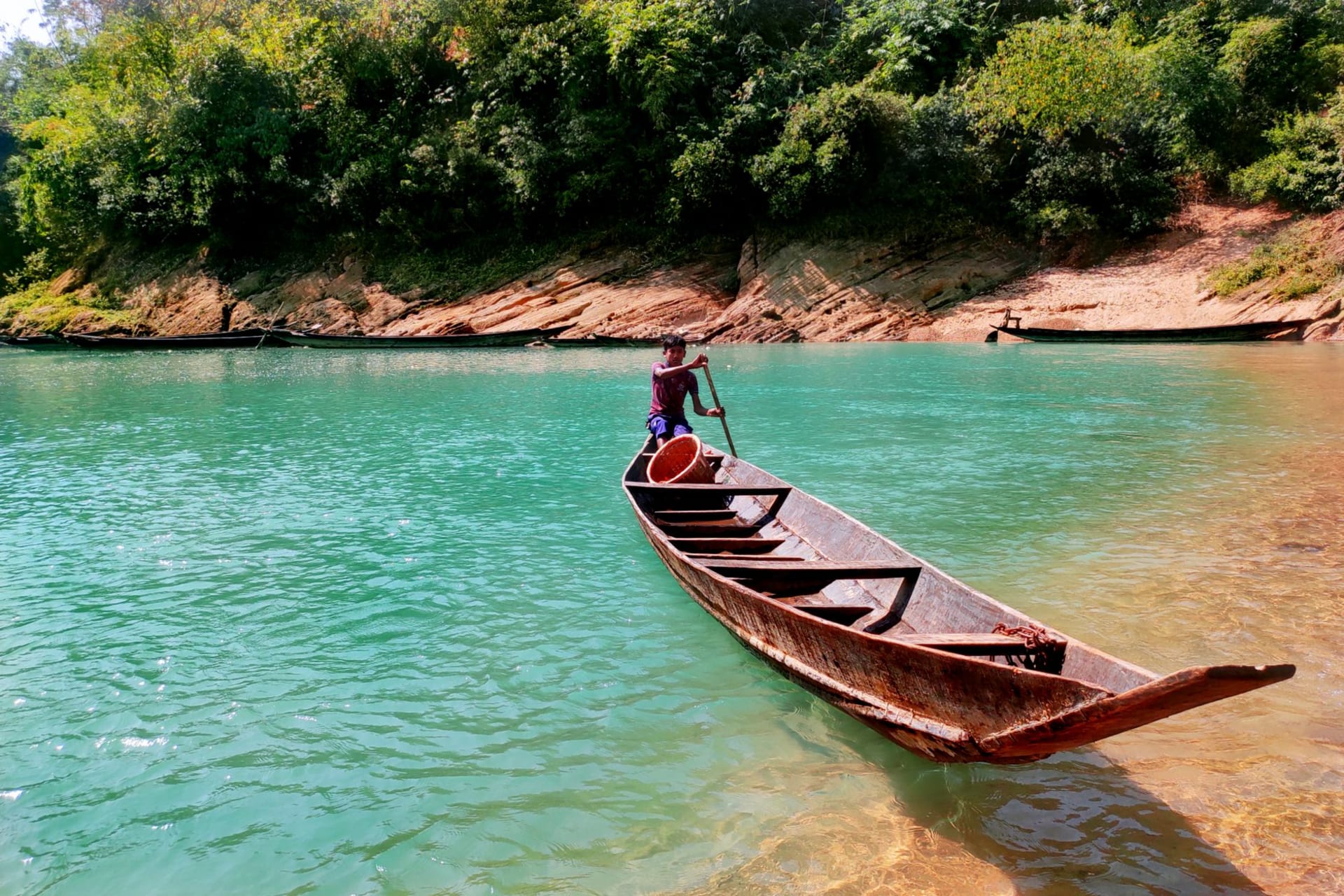
Most people leave Bangladesh thinking it’s flat. They’re not wrong about most of it. But push south from Chittagong toward the Myanmar border and the land buckles and rises into something unexpected — forested ridges folding into each other, bamboo groves on every slope, rivers running rust-red after rain. Bandarban is the capital of Bangladesh’s southernmost hill district, and it takes genuine effort to reach, which is most of the reason it feels like it belongs to a different country.
The Road to Chimbuk
The army controls access to Bandarban’s deeper interior, and permits are required for the furthest points. But Chimbuk Hill — at roughly nine hundred meters, one of the more accessible high points in the district — doesn’t require paperwork, just a willingness to take the switchback road at dawn when the mist is still sitting in the valleys below. I hired a motorbike and driver who knew every bend. At the top, I stood above a white blanket of cloud with only the highest ridges visible, and for twenty minutes nothing else existed. When the light shifted and the clouds started dissolving, I could see all the way to the silver flash of the Sangu River far below.
The Chimbuk plateau is home to a Bawm community, one of the dozen or so indigenous groups of the Chittagong Hill Tracts. The villages here have a quality of completeness — woodsmoke, woven cloth drying on fences, children watching foreigners with frank curiosity rather than performance.
Boga Lake
Two hours deeper into the hills by jeep and then on foot, Boga Lake sits at twelve hundred meters in a crater that may or may not be volcanic, depending on which geologist you ask. The water is an unreal shade of blue-green, and the surrounding forest is dense enough that sound stops traveling normally — you hear yourself thinking. Getting there requires a permit, a guide, and either a very good pair of legs or a horse for the final ascent. Lia refused the horse on principle and regretted it for the last forty minutes. The lake at sunrise, surrounded by still water and total silence, was worth every step of both descents.
Marma Villages
The Marma are Buddhist, descended partly from Burmese settlers, and their villages along the Sangu River valley have a texture completely different from Bengali lowland Bangladesh. Temples with pointed roofs painted saffron and gold appear between the trees. Women weave on backstrap looms under their houses on stilts. At the market in Bandarban town on Thursday — the weekly market day — Marma, Tripura, Bawm, and Tanchangya traders come down from the hills together, and the mixture of languages and dress is disorienting in the best way. I drank tea with a Marma shopkeeper for an hour and communicated mostly through gestures and shared admiration of his extraordinary hat.
When to go: November through February for clear skies and cooler temperatures in the hills — the only time Boga Lake is fully reliably accessible. Monsoon (June–September) floods roads and makes trekking treacherous. Spring (March–April) brings wildflowers but also heat.