Es Vedrà
"Some rocks you photograph. Es Vedrà you just sit down in front of and go quiet."
A 382-meter limestone islet off Ibiza wrapped in myth, falcons, and feral goats, best watched from Cala d'Hort as the sun drops behind it.
Lia and I had heard about Es Vedrà long before we ever set foot on Ibiza — someone at a dinner in Mexico City had gone on about magnetic anomalies and compasses spinning out near some rock, and I filed it away as the kind of story that gets bigger with every retelling. Then we actually stood on Cala d’Hort beach one evening in September, and I understood why people keep telling it. The islet doesn’t look real. It rises 382 meters almost straight out of the sea, closer to a wall than a hill, and even knowing it’s just limestone — the same stone as the Ibiza mainland, cut off from it by millions of years of erosion — doesn’t make it feel any less like something dropped there on purpose.
We got there around seven, ordered two beers at a beach kiosk that was clearly built for exactly this ritual, and watched the rock go from grey to gold to a deep purple-black silhouette as the sun sank almost directly behind it. I’m not a spiritual person by default, but there’s something about watching that light show with fifty strangers who’ve all gone silent at the same moment that gets to you.
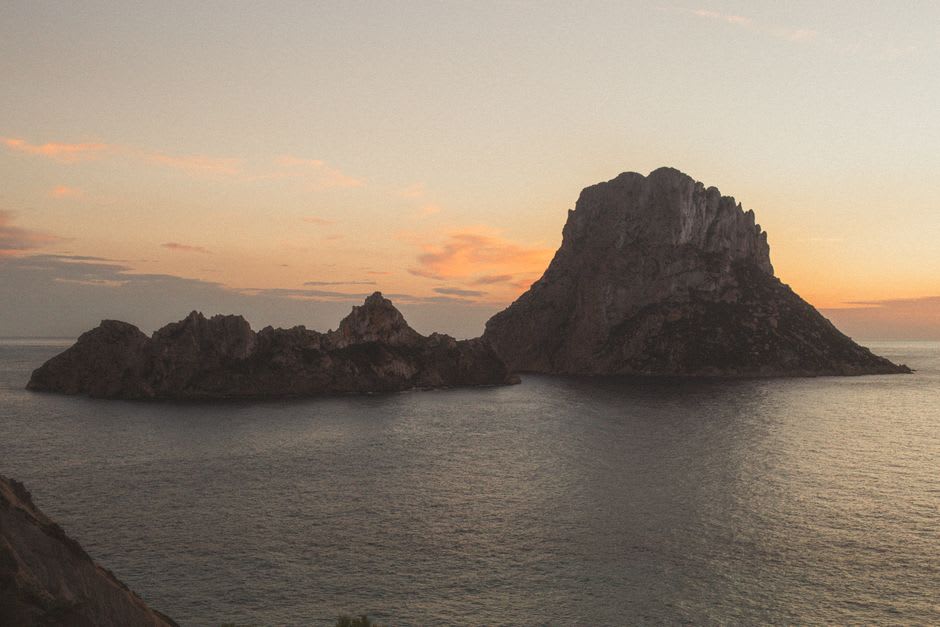
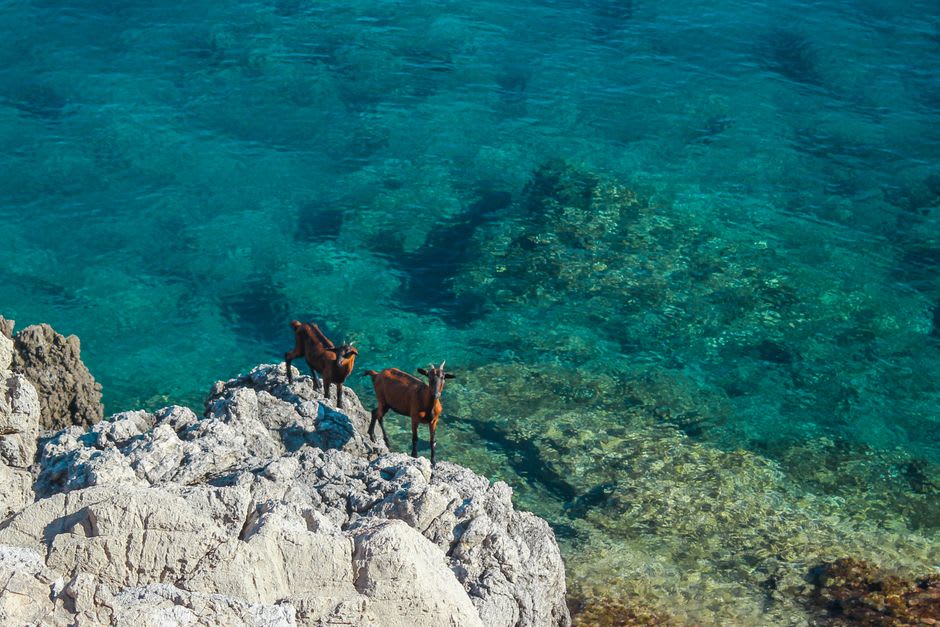
What I liked most, though, came after the sunset crowd thinned out. A local guy running the kiosk told us the fishermen here used to steer wide of Es Vedrà, convinced their compasses went haywire near it, and that some ancient writers even placed the Sirens of the Odyssey on that stretch of coast. Whether or not any of that holds up, the islet has been a protected nature reserve since 1979, home to Eleonora’s falcons that we actually caught wheeling overhead, and to a colony of feral goats that apparently nobody has ever managed to catalog properly. There’s also a tiny hermitage dedicated to Our Lady of the Snows on Vedranell, the smaller islet right beside it, which felt like a strange, sweet footnote to all the Siren talk.
We stayed until it was properly dark and the rock was just a black cutout against a navy sky, then walked back to the car with sand still in our sandals, neither of us saying much. Some places you narrate to each other as you go. This one, we just watched.
When to go: Sunset from Cala d’Hort is the moment to build your evening around, and we’d point you toward May through October, when the skies stay clear and the light has time to really perform on its way down.
Keep exploring
More from Balearic Islands
 balearic-islands
 Formentera
The smallest of the four Balearic islands — flat pine land, a salt lagoon, and light that painters and photographers cannot stop arguing about.
Explore balearic-islands
 Maó
Menorca's capital above the deepest natural harbor in the Mediterranean, where the British left behind a gin tradition the island has not seen fit to abandon.
Explore balearic-islands
 Palma de Mallorca
The Balearics' only real city — a Gothic cathedral, market stalls heaving with sobrassada, and a waterfront finally reclaimed from the traffic.
Explore balearic-islands
 Sant Joan de Labritja
The rural north of Ibiza — whitewashed fortified churches, red-earth tracks, and the island's best hippy market still run by the people who invented it.
Explore balearic-islands
 Sóller
An orange-growing valley town in the Tramuntana, connected to Palma by a 1912 wooden train that is not a tourist attraction but a functioning line.
Explore balearic-islands
 Valldemossa
A honey-stoned mountain village in Mallorca's Tramuntana, where Chopin spent one miserable, immortal winter.
Explore