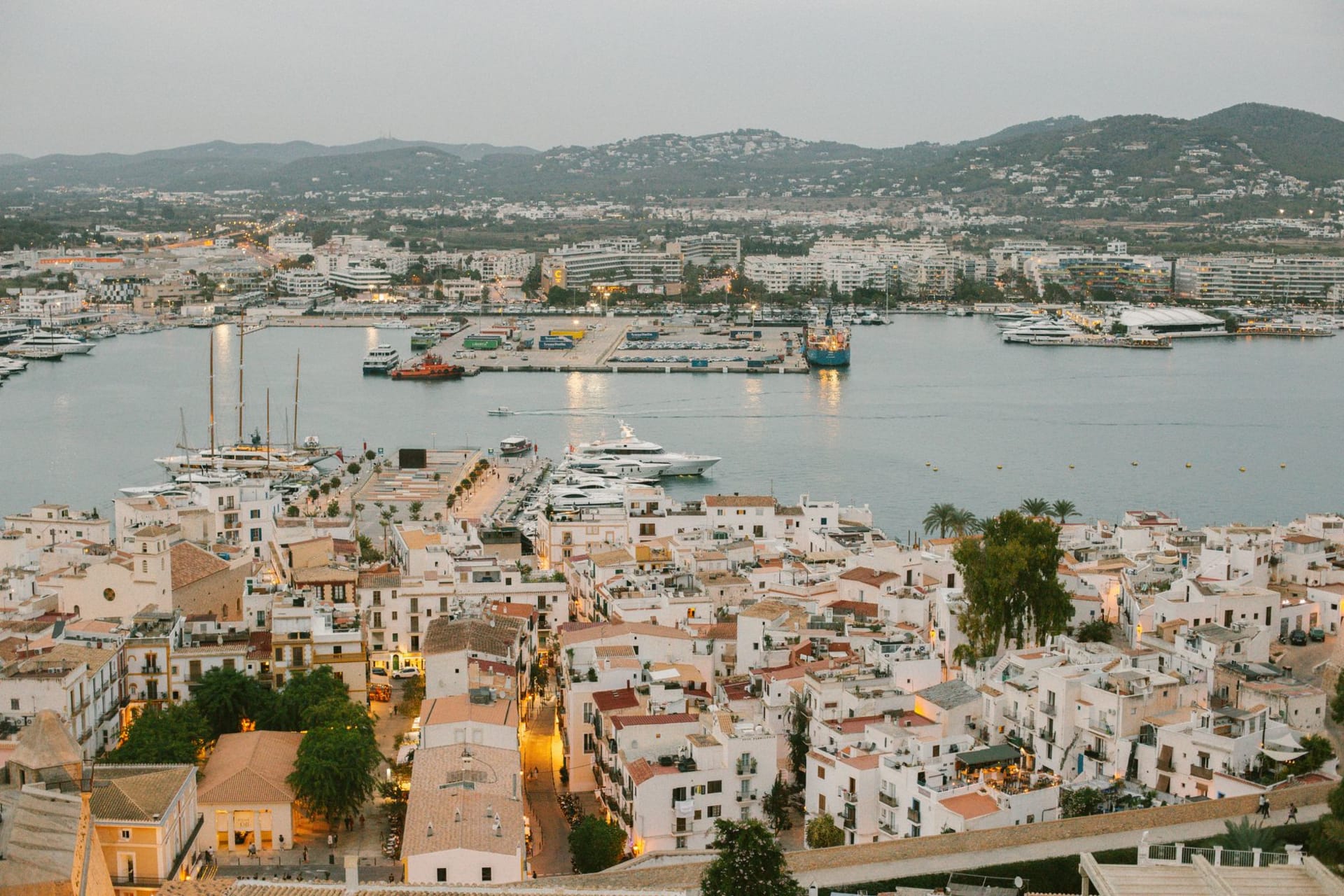
Dalt Vila
"Inside the walls, Ibiza becomes a different kind of Mediterranean entirely."
The first time I walked through the Portal de ses Taules — the main gate into Dalt Vila, flanked by two Roman statues and the coat of arms of Philip II — it was ten o’clock at night, and the clubs at the harbor below had already started vibrating. Inside the gate the street noise dropped immediately. Cobblestones, narrow alleys, a cat on a step, the smell of jasmine from a courtyard I couldn’t see. The contrast was so complete it felt theatrical, like a set change. I had stepped through the gate of one Ibiza and into an entirely different one that had been here since the Phoenicians.
Dalt Vila means “upper city” in Catalan, and it earns its altitude. The walled settlement sits on a hill above the harbor, its ramparts built by Charles V in the sixteenth century over Moorish and Phoenician fortifications that were already ancient by then. The walls are massive — six meters thick in places, designed for artillery — and from the top of the main bastion the harbor spreads below: the ferry terminal, the club district, the boats anchored in the bay, and on the horizon the pinewood silhouette of Formentera. The perspective makes Ibiza’s various eras legible simultaneously, each one visible at a different elevation.

The cathedral at the summit — built over a mosque, as usual, though the current structure is seventeenth century — houses a small museum of Phoenician and Roman artifacts from the island’s excavations. The collection is modest and excellent: terracotta figurines, painted amphorae, bronze amulets from the necropolis at Puig des Molins. The necropolis itself is around the corner from the main gate, a UNESCO site in its own right, three thousand tombs cut into the rock over six centuries of Phoenician and Punic occupation. The Phoenicians really liked Ibiza. They called it Ibosim. They stayed for six hundred years.
The restaurants inside the walls are significantly more expensive than those at the harbor below, for reasons that are entirely explicable and not entirely unjustifiable. A table on a terrace overlooking the harbor at sunset is the kind of dining experience where the view is doing at least half the work. I ate at one of the smaller places in the upper streets instead — a room of six tables, handwritten menu, the owner cooking and her daughter serving — and had a chicken dish with local herbs and a carafe of Ibizan red that cost seventeen euros and was better than most things I’ve eaten at twice the price.

The neighborhood in the morning — before the day-trippers arrive from the harbor and before the restaurants open — belongs to the people who actually live here: an improbably high number of artists and craftspeople for a village of a few hundred permanent residents, their studios visible through open doorways, the smell of coffee from the one bakery that opens at seven-thirty. The cats multiply at that hour, appearing from walls and window ledges with the authority of animals who have occupied this hill considerably longer than any of the current human residents.
When to go: May through June and September through October. Dalt Vila is accessible year-round and quietest from November through April, when many harbor restaurants close but the walled city remains inhabited. Summer evenings are atmospheric but crowded — the sunset from the ramparts attracts hundreds. Go at nine in the morning instead and have it largely to yourself.