
Todos Santos
"The mango ice cream from the cart on the corner was so cold and ripe it made the heat outside feel earned."
A colonial Pacific town where the mangoes ripen in summer heat, the surf pounds an unswimmable beach, and artists have been arriving and staying since the eighties.

Todos Santos sits at the junction of two climates — the Pacific fog that rolls in off the ocean and the Baja desert heat that arrives from the interior — and that tension gives the town a particular quality of light, slightly diffused, never quite harsh. I arrived in October, which is mango season’s end but still warm, and the streets had the feel of a place returning to itself after a busy summer. A dog followed me from the main square to the art district for no reason I could determine and then sat down in the shade of a doorway and watched me walk on.
The town has been an artist colony since the 1980s, when a combination of cheap rents, extraordinary light, and the kind of isolation that forces productivity drew painters and potters and writers who needed distance from somewhere else. Some of them left. Many stayed, or their studios stayed even after they left, and the result is a town where galleries occupy nineteenth-century sugar mill buildings and where you can buy serious Mexican ceramics next to surf wax and Oaxacan mezcal. The art is not decorative in the resort-town sense. At one gallery I spent an hour with paintings that made me genuinely uncomfortable in the way only work with something real behind it can. The painter, I later learned, had lived in the town for twenty-six years.

The Pacific beach is nothing like the Sea of Cortez beaches that characterize most of southern Baja. It is wide and dark-sanded and the surf is violent in a way that makes it beautiful to watch and inadvisable to enter. Playa La Pastora stretches north from the town for kilometers with essentially no infrastructure — no palapas, no vendors, just the sand and the ocean and the occasional surfer in a wetsuit reading the break from the shore before committing. I walked for an hour and turned around and walked back and the beach looked exactly the same in both directions, which is the particular luxury of an unbuilt coast. The fog had come in by then, softening everything, and the surfers in the water were reduced to silhouettes.
The Hotel California exists and is nothing to do with the Eagles song — the owners have made a comfortable peace with the joke, turning it into a sort of light marketing — but the town’s actual culinary life is better than its fame suggests. There are restaurants here cooking with local ingredients at a level that would sustain them in any city. I ate at a place in a courtyard off the main street: roasted beet salad with goat cheese from a ranch thirty kilometers north, snapper baked in a sauce built from local chiles, a dessert of caramelized plantain with cream. Everything tasted like it had been grown in the same sky it was being eaten under.

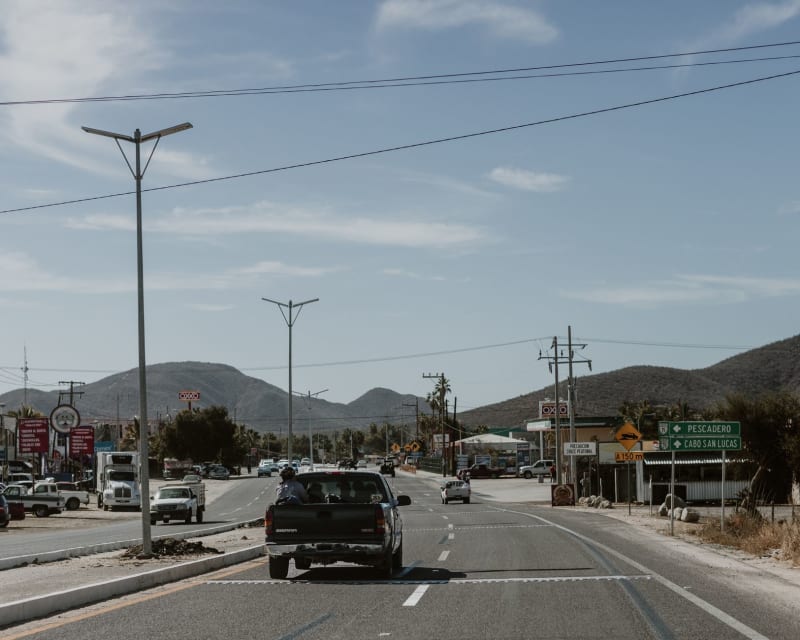
The town occupies an interesting position between something and something else. It is not yet Cabo San Lucas — it has not surrendered to that kind of scale. But it is not as isolated as it was ten years ago. New hotels have appeared, slightly more expensive than they need to be. The art scene has acquired enough reputation to attract buyers who were not looking for Todos Santos specifically, which changes it. I think it is still finding its answer to the question every place with beauty and good art has to eventually answer: how to share itself without selling itself.
When to go: November through April for the ideal climate — cooler, drier, with excellent surf conditions. October brings the end of mango season and lighter crowds. The whale shark season in the nearby waters of the Pacific lagoons overlaps with winter months.
Keep exploring
More from Baja California
 baja-california
 Valle de Guadalupe
Mexico's wine country where the dust tastes like minerality, the chefs cook over open fire in the vineyards, and no one pretends this is Napa.
Explore baja-california
 Bahía Concepción
A long, sheltered bay south of Mulegé strung with beaches of impossibly calm turquoise water, where vanlifers and pelicans share the same stretch of sand.
Explore baja-california
 Bahía de los Ángeles
An isolated Sea of Cortez bay ringed by desert islands where whale sharks feed at the surface and the only sounds at night are wind and the occasional generator.
Explore baja-california
 Cabo Pulmo
A village without ATMs or nightclubs where the coral reef holds one of the ocean's most extraordinary recoveries — and the bull sharks do not care that you are there.
Explore baja-california
 Cataviña
A scatter of house-sized granite boulders in the middle of the Baja desert, where cardón cacti grow directly out of cracked rock and the transpeninsular highway feels genuinely remote.
Explore baja-california
 El Rosario
The last town before the real Baja begins — famous for a lobster burrito, a legendary family kitchen, and the moment the paved road stops pretending.
Explore